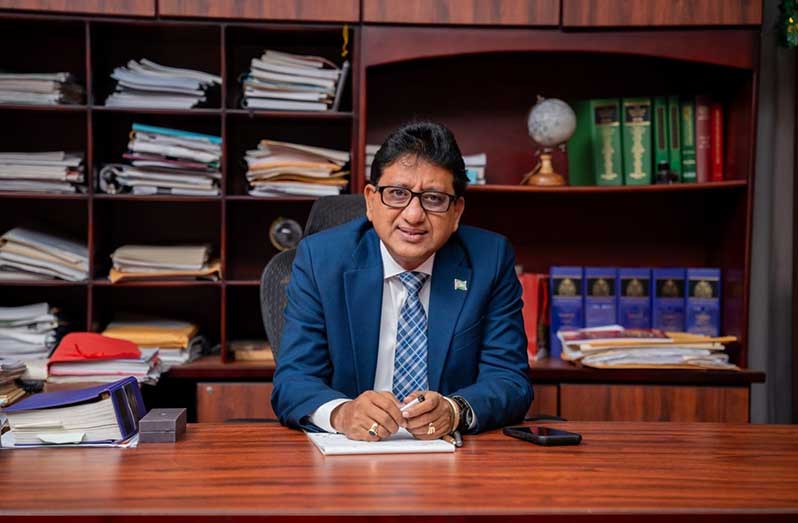
ATTORNEY General and Minister of Legal Affairs, Anil Nandlall, SC, has confirmed that amendments aimed at strengthening Guyana’s anti-litter laws will be ready for the next sitting of Parliament, as the government moves to clamp down on widespread garbage dumping.
During a telephone interview with the Guyana Chronicle on Tuesday, Nandlall indicated that the legislative changes are being fast-tracked in response to growing concerns over the indiscriminate disposal of waste across the country.
“It will be ready for the next sitting of the parliament,” he said when asked about the timeline for the proposed amendments.
The initiative forms part of a broader government push to improve sanitation, public health and environmental standards, amid increasing reports of garbage being dumped on roadways, in drains and in public spaces.
Nandlall said that the amendments are specifically designed to address what he described as reckless and irresponsible behaviour by individuals who continue to dispose of waste improperly.
“This is simply to strengthen the laws in relation to the callous and indiscriminate dumping of garbage and refuse,” he stated.
A key component of the proposed changes will be tougher penalties for offenders, particularly through increased fines.
While details are still being finalised, the Attorney General confirmed that financial penalties will be a central feature of the reforms.
“Fines, yes. Fines,” he said when asked about the nature of the penalties.
However, he declined to provide specifics on whether harsher measures will be introduced for repeat offenders, noting that the drafting process is still ongoing.
The Attorney General also clarified that the amendments are contained within existing laws, including the Criminal Law (Offences) Act and the Summary Jurisdiction (Offences) Act.
The move to tighten anti-litter laws comes against the backdrop of mounting concerns over the impact of improper waste disposal on the country’s infrastructure and public health systems.
Government officials have repeatedly warned that clogged drains and canals—often filled with plastic waste and other refuse—contribute significantly to flooding, particularly in urban areas. The issue has also been linked to broader sanitation challenges and environmental degradation.
In a recent social media address, Minister Nandlall expressed concerns over the persistent dumping of garbage on city streets, into drainage canals, and in public spaces, warning that such behaviour undermines efforts to build a clean, safe, and health-conscious society.
“We cannot continue to tolerate this level of disregard for our environment and public health,” he said.
The attorney general noted that littering has become both a sanitation issue and a cultural challenge requiring firm legal intervention.
The government is also examining mechanisms to ensure that offenders are more consistently identified and prosecuted.
The AG stressed that the initiative is not only about punishment but also about changing public behaviour. He called on citizens to adopt more responsible habits and to take collective ownership of the country’s cleanliness.
Prime Minister, Brigadier (Ret’d) Mark Phillips, used last Saturday’s nationwide clean-up exercise to urge stronger personal responsibility and improved national waste management practices, stressing that maintaining a clean environment requires both government action and citizen cooperation.
He said Guyana must restore the image of a “garden city,” referring to the capital, Georgetown, and recalled earlier perceptions of cleanliness while urging citizens not to become complacent.
“We need to play our part as citizens of Guyana in keeping our country clean,” he said, warning against indiscriminate dumping of waste in public spaces.
Phillips emphasised that proper disposal systems must be respected, noting that garbage should only be placed in designated collection points.
“You have to get the garbage, the container, and put it someplace, some designated place where everybody agreed that the collectors will come and pick up the garbage,” he said.
He described solid waste management as a continuing national challenge, adding that it remains a key reason behind the need for coordinated clean-up campaigns across the country.