







—dismisses country’s partnership stance as ‘interest-driven’
A PARTNERSHIP for National Unity (APNU) on Friday sought to cast doubt on the United States’ confidence in Guyana’s development trajectory, with its leader, Aubrey Norton dismissing Washington’s position as “interest-driven” despite mounting international recognition of the country’s rapid transformation.
Norton’s remarks, made during a press conference, were directed at recent statements by United States Ambassador Nicole Theriot, who had pointed to widespread infrastructure expansion and the strategic use of oil revenues as evidence that Guyana is moving in the right direction.
However, in attempting to counter that assessment, Norton argued that the United States is motivated primarily by its own geopolitical interests, suggesting that its engagement with Guyana should not be interpreted as genuine partnership.
His position, though, stands in stark contrast to both the scale of development currently underway and the broadening international consensus around Guyana’s economic and social progress.
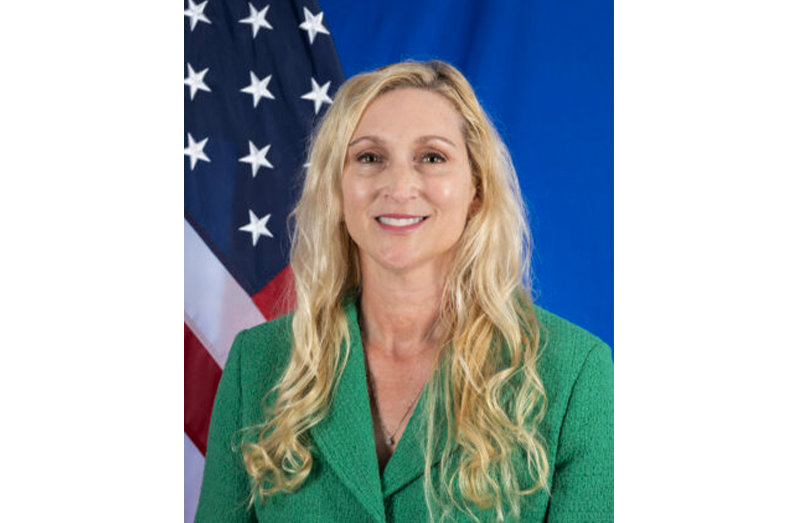
Ambassador Theriot, speaking on the Sources programme, had emphasised that development is taking place across the country, not just in Georgetown, with oil revenues being channelled into infrastructure designed to improve mobility, productivity and living standards for all Guyanese.
“I honestly believe that the current leadership of this country has the Guyanese people’s best interests at heart,” the Ambassador said, pointing to the scale and reach of development across the country.
She emphasised that progress is not confined to Georgetown, noting that her travels across Guyana have revealed extensive infrastructure works underway in multiple regions.
“I just look around at all of the infrastructure projects that are going on, and it’s really important to note they’re not just in Georgetown. I travel all around the country, and I see it everywhere that I go,” she said.
According to the ambassador, the government’s strategic use of oil revenues is laying the foundation for long-term national advancement, with investments targeting improved mobility, economic opportunity, and enhanced quality of life for citizens.
“They are using the oil revenues that they’re receiving now, and the budget is being allocated to create critical infrastructure that will benefit all Guyanese,” Theriot explained.
She added that these developments are expected to bring tangible benefits across key sectors, including agriculture and business, while improving everyday life for citizens.
“That is going to allow the Guyanese farmer, Guyanese business people, the average Guyanese citizen to be able to move more freely and quickly around the country. And that is going to improve the personal circumstances of the Guyanese people,” she said.
Addressing a common criticism that infrastructure alone does not equate to development, the ambassador underscored that such investments are essential building blocks for sustained economic growth.
“I see everything moving in the right direction,” she added.
Theriot also commended the government’s decision to partner with United States companies on major development initiatives, noting that such collaborations bring high standards of quality, sustainability, and business ethics.
“When you work with a US company, you’re going to have quality, you’re going to have sustainability, and you’re going to have very high business ethics standards and international quality,” she said, describing the partnership as “a wonderful decision” by the Government.
Beyond infrastructure, the ambassador highlighted growing economic ties between Guyana and the United States, revealing that increasing numbers of American companies are exploring opportunities across a wide range of sectors.
“US companies have really woken up to Guyana,” she said, noting expanding interest not only in oil and gas, but also in agriculture, information technology, and security.
She explained that the presence of the United States Department of Commerce office within the US Embassy in Georgetown has played a key role in facilitating partnerships between American investors and local businesses, acting as a bridge to deepen economic cooperation.
While acknowledging that investors have raised concerns about regulatory frameworks and transparency, Theriot said these issues are actively being addressed, with ongoing reforms improving the business climate and boosting investor confidence.
“There is concern there, but I think it’s being addressed, and it’s making US companies much more comfortable as they see the attention being paid to those issues,” she noted.
Against this backdrop, Norton’s attempt to downplay these gains has raised questions about the opposition’s willingness to acknowledge measurable progress. While he argued that infrastructure alone cannot define development, his critique stopped short of addressing how improved connectivity, reduced travel time and expanded access to services directly impact citizens’ daily lives.
Moreover, his characterisation of U.S. engagement as purely “interest-driven” appears increasingly out of step with the depth and diversity of cooperation between the two countries since the Ambassador’s assessment had highlighted a growing international confidence in Guyana’s economic direction, with sustained investment, expanding infrastructure, and deepening partnerships positioning the country as a key player in the global energy and development landscape.




