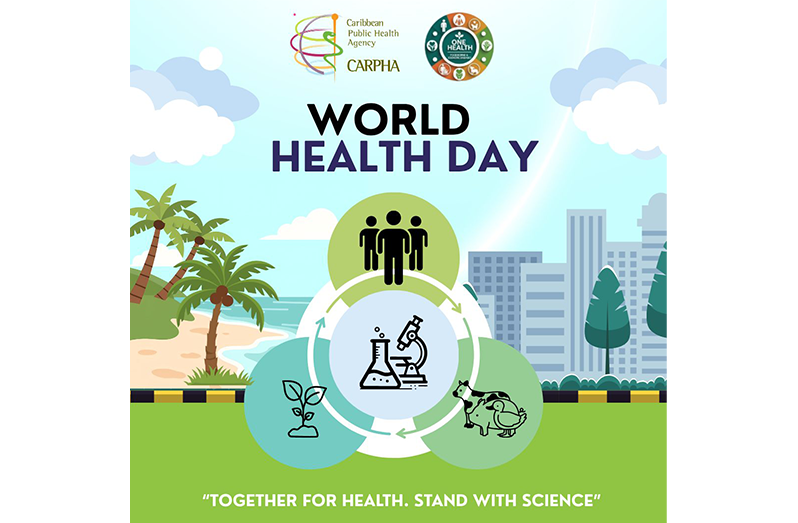
THE Caribbean Public Health Agency (CARPHA) has marked World Health Day on April 7, 2026 by calling for strengthened integrated surveillance and cross-sectoral collaboration to combat food-borne diseases (FBDs) and zoonotic threats across the Caribbean.
Highlighting the urgent need for coordinated action, CARPHA stressed that emerging health risks, including climate change, antimicrobial resistance, and environmental degradation, are driving the spread of diseases that affect humans, animals, and the environment.
Globally, the World Health Organisation (WHO) reports that roughly 600 million people fall ill from FBDs each year, resulting in an estimated 420,000 deaths. In the Caribbean, one in 49 individuals contracts an FBD annually, a figure that rises to one in 11 during large mass gatherings, with nearly 43 per cent of cases occurring in children aged 1–4 years.
Under the theme, “Together for health. Stand with science”, World Health Day underscores the importance of science, data sharing, and coordinated responses to emerging health threats.
CARPHA emphasised that integrated, science-based approaches through the One Health framework are critical to safeguarding public health in the Region.
“One Health recognises the interconnectedness of human, animal, plant, and environmental health, requiring coordinated, multisectoral action to prevent and respond to disease risks,” said CARPHA’s Executive Director Dr. Lisa Indar.
“A unified approach is essential to protecting populations and strengthening regional health security,” she added.
CARPHA’s One Health initiatives, rooted in the former Caribbean Epidemiology Centre (CAREC), and expanded since 2013, include the development of a Regional One Health FBD Action Plan, support to Member States in updating National Action Plans, and the creation of the One Health Multisectoral Steering Committee (OHMSC) to improve inter-agency coordination.
The agency is also developing the Regional Integrated Early Warning and Surveillance System (RIEWSS), designed to integrate human, animal, environmental, and laboratory data for faster detection and response to health threats. Strengthened laboratory capacity, rapid diagnostic tools, and collaboration with international partners such as the Pan American Health Organization, Food and Agriculture Organisation, World Organisation for Animal Health, and regional agencies further enhance preparedness.
To address growing public health challenges, CARPHA is advocating for: Strengthening integrated surveillance across human, animal, and environmental health sectors; Enhancing real-time data sharing and interoperability through digital platforms such as DHIS2; Expanding laboratory and diagnostic capabilities across Member States; Formalising multisectoral coordination and governance structures; Investing in workforce development and One Health training; Promoting evidence-based decision-making and sustained regional collaboration; and Building Resilience for the Future.
“Health threats today are interconnected, and siloed approaches are no longer sufficient,” CARPHA stated. “By strengthening integrated surveillance systems and embracing the One Health model, the Caribbean can improve preparedness, protect communities, and ensure a more coordinated and effective public health response.”
CARPHA reiterated its commitment to working with Member States, regional partners, and international organisations to advance these priorities and build a resilient, responsive, and collaborative health system for the Caribbean.