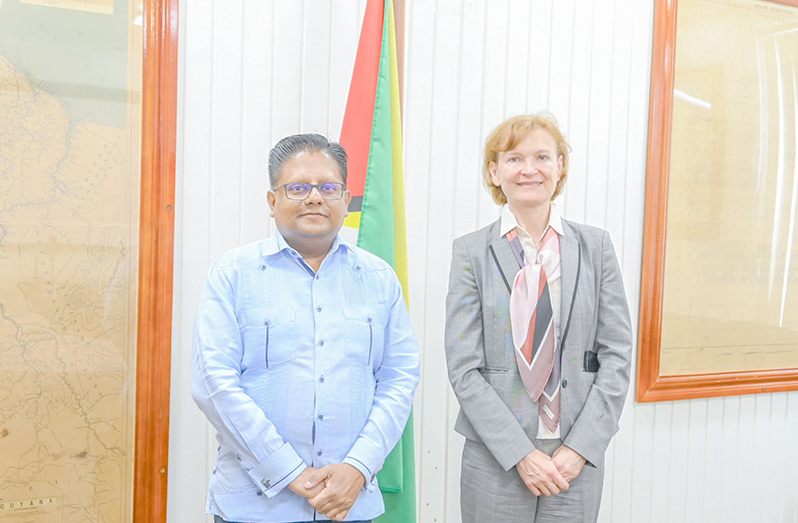
-World Bank official says, commends government for investing ‘in what really matters’
GUYANA has undergone a remarkable economic transformation over the past five years, fuelled by rapidly growing oil revenues and a series of strategic public investments in people, infrastructure, and climate resilience.
World Bank Country Director for the Caribbean Lilia Burunciuc, during a recent discussion emphasised that Guyana has moved from being one of the lowest-income economies in the hemisphere to one of the fastest‑growing in the world, while seeking to ensure that the benefits of growth are broad‑based and sustainable.
Burunciuc recalled first visiting Guyana almost five years ago, just as the country was preparing to receive its first oil revenues. She noted that at the time, Guyana’s income per capita was among the lowest in the region.
“Almost five years ago, Guyana was the first country I came to in the entire region, and it was the moment when Guyana discovered oil and was preparing to start receiving the revenues, but it was still a country which had one of the lowest income per capita in that hemisphere,” she said.
The World Bank official said the transformation since then has been striking, citing rapid growth, improved living standards, and a visible shift in the physical landscape.
Recent years have seen major investments in transport and hospitality infrastructure, including new bridges, upgraded roads and hotel developments, helping to support both domestic connectivity and international business.
“I could feel the change in the air. The change was coming. And five years later, when I see the country, the country has changed,” she said adding:
“The country is very different from what it was five years ago. I can only imagine what this country will be in another five years or 10 years. The development is remarkable. I must commend the government for investing in what really matters when you have an economy that gets significant revenues.”
STRATEGIC USE OF OIL REVENUES
The government has stressed that oil earnings are being channelled into long‑term development, rather than short‑term spending.
Joining the discussion, Senior Minister in the Office of the President with Responsibility for Finance, Dr Ashni Singh, pointed out the importance of directing resources into areas that will sustain growth beyond the oil era.
This approach he stressed aims to avoid the pitfalls often associated with resource‑rich economies, by diversifying the economic base and equipping citizens with the skills needed for new and emerging sectors.
“What we’ve been able to do in more recent years, particularly over the last five years, is we’ve been able to dramatically accelerate our investments in building a more resilient Guyana,” he said.
HUMAN CAPITAL AND DIGITAL EDUCATION
A cornerstone of Guyana’s strategy has been a major push to strengthen human capital, with the government explicitly asking the World Bank to serve as its lead development partner in this area.
“We just had a meeting with President Ali, where we reconfirmed that we will continue supporting building skills, building the human capital, and building the human capital for the future with the focus on digital skills and digital education, which is excellent,” Burunciuc shared.
There has been expansion and modernisation of school infrastructure to support universal access, particularly at the primary and secondary levels and the deployment of educational technology in classrooms, helping to bridge gaps between urban and rural areas.
“We feel so strongly that the most important investment that we can possibly make is the investment in our people, and in particular, in their education and skills of building up the skills base,” Dr. Singh added.
With new and increasingly specialised roles emerging across multiple sectors, Dr. Singh stressed that investment in education, science and technology training, and digital skills are critical, so that Guyanese workers are equipped to take full advantage of the new opportunities being unlocked by these global and local transformations.
“In the current era of Guyana’s economic journey, we have now more jobs being created than at any other time in our country’s history, and new jobs and new types of jobs demanding new types of skills,” he said adding:
“On the one hand, job types and skills, types that are in demand are changing very rapidly. And then you add on top of that the additional layer of the rapidity with which the Guyanese economy is changing with new industries coming on stream, new types of jobs, better jobs. Jobs that require more science and technology, more engineering capability, more specialised skills, etc.”
VISIBLE INFRASTRUCTURE GAINS
Alongside human capital, Guyana has embarked on an ambitious infrastructure drive, much of it supported by development partners.
Notable advances include, new and upgraded roads and bridges, improving connectivity between key economic zones and communities.
The development of new hotel and airport facilities, signalling growing investor confidence and rising visitor demand.
Agricultural infrastructure projects, such as improved roads and connectivity are helping farmers to access markets more efficiently and stimulating rural economic activity.