






–$3.5B invested as Govt pushes hybrid emergency response model
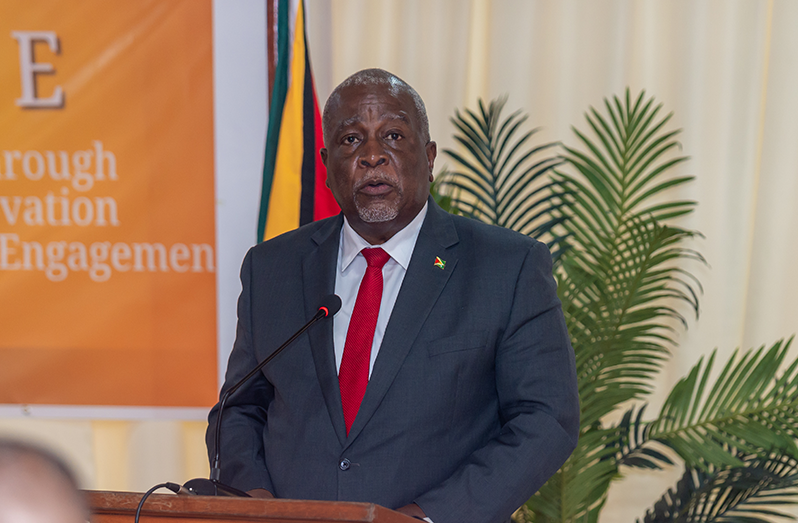
THE Guyana Fire Service must become more modern, more responsive and more deeply rooted in communities if it is to meet the demands of a rapidly changing country, Prime Minister Brigadier (Ret’d) Mark Phillips said on Wednesday.
Addressing the Guyana Fire Service Annual Officers’ Conference on behalf of President Dr. Irfaan Ali, Phillips said the Government’s vision is for a Fire Service that is not only better equipped, but also better positioned to respond to the wider range of emergencies now facing the country.
“If a citizen loses their home and feels that the response was slow, the statistics on response times mean nothing to them. They have lost everything. And it is for the Guyana Fire Service to ensure high levels of public confidence in its work,” the Prime Minister said, adding:
“We must not only be effective; we must be seen to be effective. We must not only be fast; we must be trusted to be fast.”

He told officers that more than $3.5 billion has been invested in capital acquisitions for the Fire Service over the past five years, signalling what he described as the end of an era in which the institution had to operate under persistent constraints and shortages.
The government, he stressed, is now laying the foundation for a stronger and more capable emergency response system.
“We have not merely bought vehicles; we have improved your capability. We have built a new architecture of firefighting. Fire-fighting vehicles, specialized equipment are the tools that will allow you to do what you swore to do: save lives and reduce losses,” he added.
DECENTRALISATION
He noted that in order for the fire service to reach a certain level of responsiveness, the service must fundamentally rethink how it deploys its service.
“The Guyana Fire Service must equally drive a new model of firefighting. Consider our demography. Most of our population livealong our coast. Some areas are densely populated where minutes matter.”
Phillips said the Government would like to see each Neighbourhood Democratic Council (NDC) equipped with a small fire tender that could be used to provide an immediate first response before larger firefighting units arrive.

Such a system, he said, would be especially important in rural communities and other areas where the distance between fire stations can significantly affect response times.
He said the future of firefighting in Guyana must involve a hybrid structure, one built around a professional national Fire Service supported by community-based units capable of early intervention.
“I trust that this conference will pronounce on how best we can go about achieving this vision. I want you to think about the training, the protocols, the command structure,” he said, adding:
“We are moving toward a hybrid model: a strong, modern, professional core which you represent complemented by decentralized, community-based units, manned by the communities themselves.”
Phillips said the Officers’ Conference provides an important opportunity for the leadership of the Fire Service to examine how that vision can be translated into practical policy and operational reform.
He urged officers to recognise that as Guyana grows, the risks facing its people are also changing, and the Fire Service must evolve even faster to keep pace.
“Officers, I have spoken about equipment. I have spoken about modernization. I have spoken about essential services and decentralization. But let me end by bringing us back to the elemental truth of your profession. Fire is a powerful force. It cooks our food. It powers our energy. Fire is a good servant,” he said adding:
“But fire is also indiscriminate. It does not care if the building belongs to a millionaire or a pensioner. It does not care if it is destroying a business or a home. It is hungry. It is fast. It is merciless. Fire is a dreadful master.And it is therefore the task of the Guyana Fire Service to ensure that fire remains the servant and never becomes the master over our people.”
Echoing the Prime Minister’s sentiments, Home Affairs Minister Oneidge Walrond noted that prevention and not just fast responses must define how effective a modern fire service can respond to emergencies, especially fires.
She noted that while response time remains crucial, effectiveness too can be measured by prevention, noting that the most effective fire service is the one that reduces how often that response is needed.
She further commended the officers and staff for their hard work, sacrifice, and service to the people of Guyana.
“As our country develops, safety in our communities must remain the foundation of national security.”




