







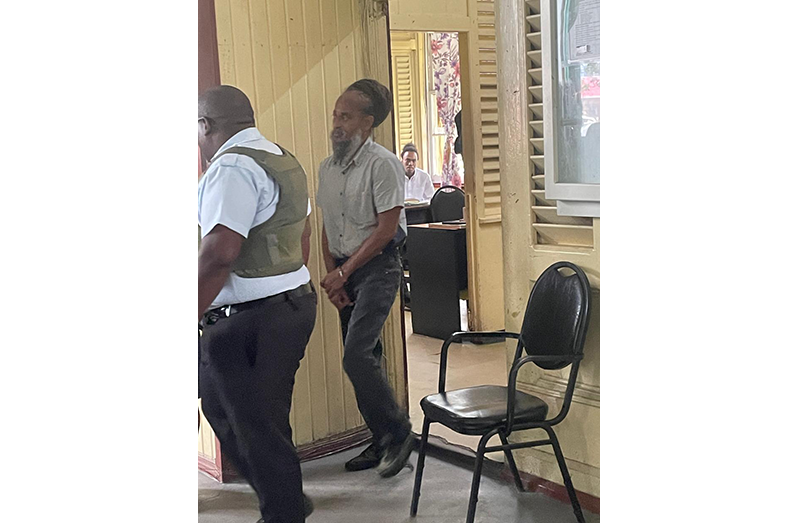
A PRINCESS Street, Wortmanville, Georgetown resident, Brian Mathieson, 50, has been sentenced to five years’ imprisonment, less time already served, after pleading guilty to the lesser offence of manslaughter in the 2022 killing of 40-year-old Aubrey Baird.
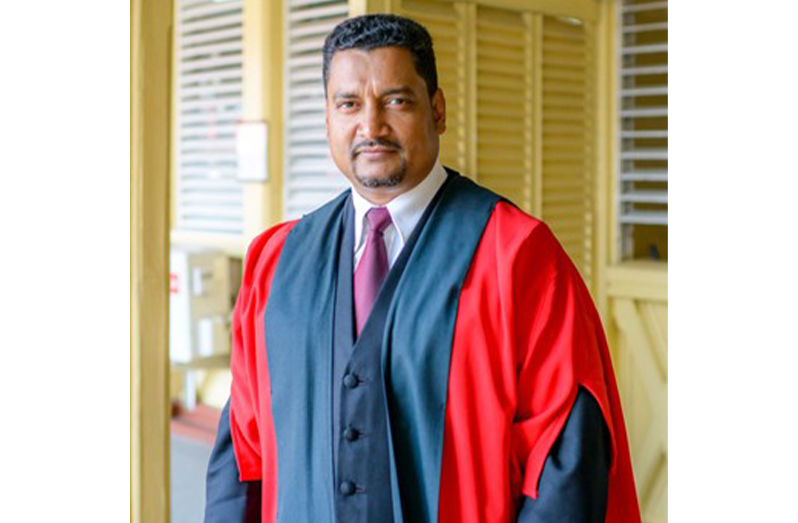
The sentence was handed down by Acting Chief Justice Navindra Singh at the Demerara High Court after considering detailed submissions from both the prosecution and the defence, a probation report, and emotional victim-impact statements from the family of the deceased.
Mathieson had initially been indicted for the capital offence of murder but admitted to manslaughter in relation to the fatal stabbing, bringing the matter to a close without a full trial.
The court heard that the incident occurred on the night of February 8, 2022, along Hardina Street in Wortmanville. According to agreed facts, Mathieson rode past Baird, a clothes vendor and others gathered outside a residence, shouting in their direction. Although he initially left, he later returned to the area and continued hurling expletives.
A confrontation followed when Baird approached and punched Mathieson in the face. In response, Mathieson dismounted his bicycle and stabbed Baird twice in the chest with a knife he had in his possession. A struggle ensued, during which both men ended up in a nearby drain. Baird then armed himself with a piece of wood and struck Mathieson.
A post-mortem examination revealed that Baird sustained two incised wounds to the chest, including one that penetrated the chest cavity and perforated the heart. The injury was described as inherently fatal and caused by a sharp instrument at least eight centimetres in length.
Defence attorney Latoya Roberts told the court that Mathieson has expressed genuine remorse for the incident that had led to Baird’s death. She said that Mathieson was approached and struck first by the now deceased man, suggesting that the circumstances could have supported a defence of self-defence.
However, Roberts noted that her client chose not to pursue that route. Instead, he opted to plead guilty to the lesser offence of manslaughter, effectively throwing himself at the mercy of the court. She submitted that this decision demonstrated accountability and a willingness to accept responsibility for his actions.
The defence also reminded the court that rehabilitation is an important aspect of sentencing. Roberts indicated that since 2022, Mathieson’s life has been on what she described as a “certain trajectory,” suggesting a positive change in his behaviour and outlook.
In view of these factors, she urged the court to temper justice with mercy when determining an appropriate sentence.
In outlining aggravating factors, State Counsel Christopher Belfield stressed that the offence was grave and serious, pointing to Mathieson’s decision to leave the scene and later return armed with a knife. The prosecutor argued that this demonstrated escalation rather than a spontaneous act. The court was told that his actions reflected a disregard for human life and set in motion a chain of events that resulted in Baird’s death.
Particular emphasis was placed on the use of a weapon. Belfield argued that Mathieson’s readiness to resort to a knife significantly heightened the risk of serious harm, noting that such conduct reflected a willingness to inflict grave injury. The court was also asked to consider Mathieson’s actions after the stabbing. The prosecutor noted that he fled the scene without attempting to assist the injured man, despite the severity of the wounds.
He was later seen running along Durban Street before being apprehended by police. This failure to render aid, according to Belfield, demonstrated indifference to the victim’s suffering.
Further aggravating the matter, the court was urged to consider the wider impact of the killing. Victim-impact statements painted a devastating picture of the loss suffered by Baird’s family.
His wife, Devon Grandison, told the court that they had been together for over two decades and shared three children. She described her husband as the backbone of their family and said his death had caused their lives to collapse. She spoke of the emotional and financial hardship that followed, explaining that he had been the primary provider and a source of constant support and guidance.
Grandison said her husband was deeply family oriented and well known in the community for helping others. She expressed that she felt robbed of her husband and best friend, adding that the grief remains constant and overwhelming.
Baird’s sister, Candacie John, also addressed the court, describing him as a loving and supportive brother who played a vital role in her life and in the upbringing of her children. She said he treated her children as his own and was a source of stability and care for the wider family.
She told the court that his death had left her traumatised and living in fear, noting that even four years later, the pain remains fresh. She explained that the loss had fundamentally changed her life and left a void that could not be filled.
A probation report presented to the court provided insight into Mathieson’s background and character. It outlined that he is an artist who had a relatively stable upbringing and demonstrated academic promise, having attended President’s College.
Over the years, he worked in various fields, including banking, construction, teaching, and the culinary sector. However, the report also revealed troubling accounts of his behaviour within his community. Several individuals described him as confrontational and alleged instances of verbal and physical aggression towards relatives and others. There were also claims of prior violent incidents involving family members.
Despite these reports, prison authorities indicated that since his incarceration in 2022, Mathieson has demonstrated good behaviour. He has complied with institutional rules, maintained a co-operative attitude, and utilised his artistic skills to assist with sign art and graphics within the prison.
In addressing the offence, Mathieson expressed remorse and stated that he never intended to cause Baird’s death. He conveyed sympathy for the victim’s family and acknowledged the hardship now faced by his children and partner. He told the court that, if confronted with a similar situation in the future, he would choose to walk away rather than engage in violence.
Prosecutor Belfield, however, urged the court to impose a sentence that would serve as a deterrent, citing the prevalence of violent crime and the need to send a strong message against the use of deadly weapons in disputes. Reference was made to legal authorities, emphasising the court’s duty to reflect society’s condemnation of such acts.
In determining the sentence, Justice Singh considered the nature and seriousness of the offence, the degree of escalation, the use of a weapon, the impact on the victim’s family, and Mathieson’s personal circumstances, including his conduct while in custody and his expressions of remorse.
The judge noted that Baird was the aggressor in the matter. The sentence commenced at 18 years, but several deductions were applied, including credit for an early guilty plea.
This resulted in a final sentence of five years, from which time already spent on remand must be deducted. Justice Singh advised the convict to walk away if he encountered trouble again and wished him well moving forward. State Counsel Geneva Wills also served as one of the prosecutors.




