






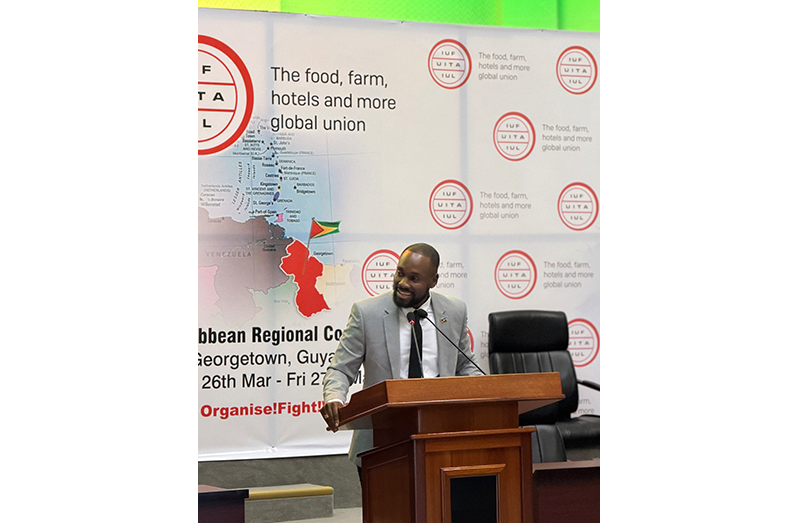
– Minister Griffith tells opening of 7th annual IUF Caribbean Regional Conference
–says Caribbean must create opportunities at home to curb migration
THE Government of Guyana is actively strengthening labour protections and expanding opportunities for workers through targeted policies and programmes, according to Labour and Manpower Planning Minister, Keoma Griffith.
Addressing delegates at the opening of the 7th International Union of Food, Agricultural, Hotel, Restaurant, Catering, Tobacco and Allied Workers’ Associations (IUF) Caribbean Regional Conference at the Arthur Chung Conference Centre, Minister Griffith outlined the government’s labour agenda.
He said the administration is committed to “strengthening protections, expanding access to training, and ensuring that every worker has the opportunity to thrive with dignity and respect.”
He pointed to the signing of Guyana’s third Decent Work Country Programme (DWCP 2025–2030) as a key step in advancing these efforts. The initiative, developed in collaboration with the International Labour Organization (ILO), and national stakeholders, aims to create decent jobs and improve labour conditions across emerging sectors.
“This programme is fully aligned with our world-renowned Low Carbon Development Strategy 2030 and the Sustainable Development Goals,” Griffith stated. “It places emphasis on creating decent jobs in high-growth and emerging sectors, including the green and digital economies.”
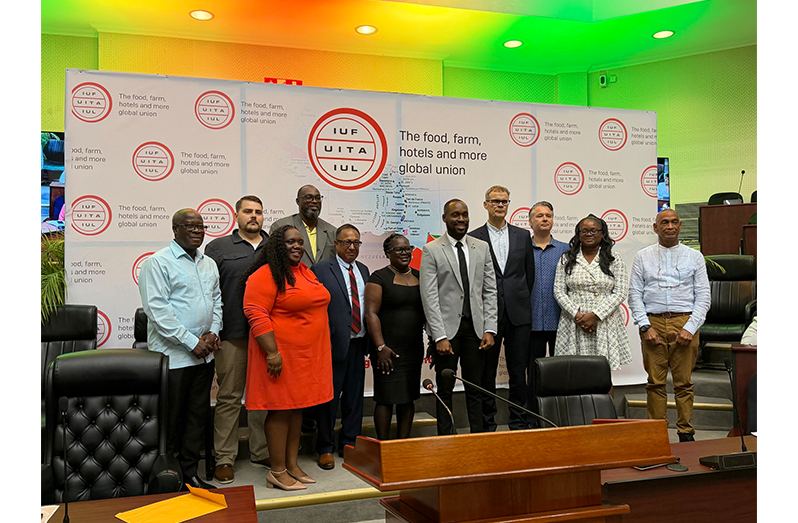
The minister explained that the programme reflects a broader national commitment to “advance workers’ rights, strengthen social protection mechanisms, and institutionalise tripartite social dialogue as a cornerstone of labour governance.”
Delivering the feature address, Minister Griffith told regional representatives that Guyana is also focused on building a “resilient, inclusive, and forward-looking labour market that serves all Guyanese.”
His remarks came amid discussions on the future of work in the Caribbean, as technological advancement continues to reshape traditional industries. Griffith warned that while innovation presents opportunities, it also poses challenges for job security and workforce readiness.
“There is clear and undeniable evidence that the world of work is undergoing significant and unprecedented transformation,” he said, noting that developments in artificial intelligence, automation, and digital platforms are changing how industries operate.
He stressed the importance of preparing workers to adapt, stating, “We must spare no effort in ensuring that our workers are not displaced or left without support. On the contrary, it is our duty to ensure our workforce is prepared, reskilled, and empowered to participate meaningfully in this ever-evolving labour landscape.”
The minister also highlighted the need for greater investment in human capital, particularly in light of ongoing migration challenges affecting the Caribbean. He urged regional leaders to create opportunities at home and inspire younger generations to see sectors such as agriculture and hospitality as viable and rewarding career paths.
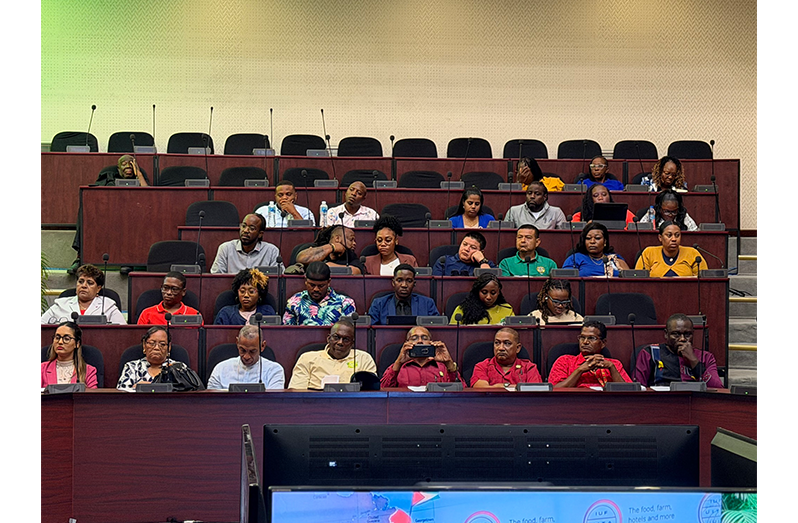
“We must inspire younger generations to see agriculture, food production, and hospitality not as aging or unappealing industries, but as dynamic sectors full of opportunity,” he said.
Minister Griffith further underscored the importance of supporting frontline and informal workers, many of whom are women. “If we are to truly reposition Guyana and the wider Caribbean, we must begin by investing in, and uplifting, these workers,” he stated.
He said this requires coordinated policy action, including strengthening labour protections, ensuring fair wages, expanding training and certification, and promoting meaningful social dialogue. He also reaffirmed Guyana’s commitment to regional collaboration, noting that the country’s progress is closely tied to that of the wider Caribbean.
“This conference reflects a renewed consciousness—one that affirms that we cannot, should not, and will not wait for others to do for us what we must do for ourselves,” Minister Griffith said.
STRONGER UNION, DEEPER COLLABORATION
Meanwhile, General Secretary (ag) of IUF, Kristjan Bragason, called for stronger union organising and deeper regional collaboration as workers face mounting global challenges.
Speaking at the event, Bragason said it was “a real pleasure… and an honour to be with you in Guyana for the seventh Caribbean regional conference,” while expressing appreciation to regional leaders for their continued work.
He acknowledged the difficult global environment, noting that “we meet at a time of profound global uncertainties and wars,” with workers increasingly under pressure.
According to him, “inequality is growing, corporate power is becoming more concentrated, and the democratic space is under strain in many parts of this world.”
He added that across sectors such as agriculture, food production and tourism, workers are grappling with “restructuring, precarious employment… and now recently again, rising cost of living.” Despite these challenges, Bragason urged delegates to focus on building the future of the labour movement. “We are here to organise. We are here to build union power. We are here to build and shape the future of our members,” he said.
He stressed that membership growth must remain central, particularly targeting “young workers, women and migrants,” while ensuring workers are not left without adequate representation.
The General Secretary also underscored the importance of international solidarity, noting that “the companies we face are global, and our response must be global as well.”
“The IUF is not just an organisation, it is a movement based on solidarity, democracy and the belief that workers, when organised, can change the world,” he said, urging participants to “organise, fight and win.”
IUF Caribbean Regional Secretary, Clifton Grant, urged trade union representatives to remain focused and united as they confront growing global and regional challenges affecting workers.
Also speaking at the opening of the conference in Guyana, Grant highlighted the significance of the gathering, noting that delegates were “representing from 10 different countries in the Caribbean, representing 17 different affiliates of the IUF.”
He warned that global developments could have far-reaching consequences for the region, stating that “the situation in the Middle East is not something that we should ignore,” as it is already impacting prices “especially at the pump.”
Grant stressed that the conference must produce meaningful outcomes, calling on participants to “demonstrate our determination, our willingness to fight and win in challenging times.”
He also pointed to ongoing struggles within the labour movement, including efforts to secure “bargaining rights” and benefits for workers, particularly in expanding sectors like fast food, where employees are often “denied their right to be a part of trade union.”
Encouraging solidarity, he reminded delegates, “we are here for business,” urging them to remain focused and committed throughout the conference.




