






–as Guyana braces for week of heavy rainfall, potential flooding
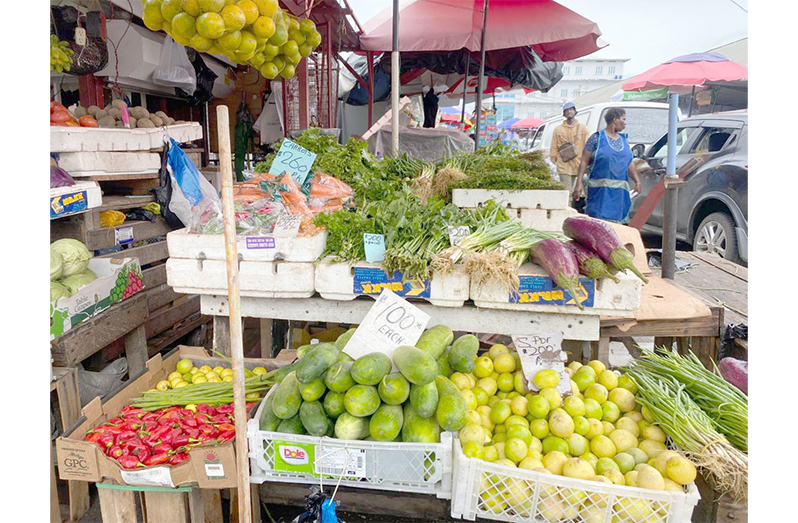
FOOD prices at major markets, such as Bourda in Georgetown, have remained moderate to stable, amid ongoing erratic weather patterns.
Checks made by the Guyana Chronicle revealed that meat and poultry prices ranged from $480-$500 per pound, while the average price for eggs stood at $1500-1600 per tray.
The prices for fresh fruits and vegetables varied with parcels of celery being priced at $200.
Other vegetables such as carrots, cabbage and tomatoes ranged between $260 to $300.
Meanwhile, Agriculture Minister, Zulfikar Mustapha, said that the Hydrometeorological Service (Hydromet) has been monitoring the weather patterns, with excessive rainfall being reported in the past 24 hours.
Minister Mustapha noted that mechanisms have been put in place to minimise potential flood risks; while he noted that key drainage and irrigation infrastructures are working, the ministry is still challenged with the dumping of garbage at pumps and drainage canals.
“All the pumps are working, sluices are working, canals are cleaned, [but] we are encountering some difficulties where residents continue to throw garbage in the drainage canals,” he said adding: “They must desist from doing that; this puts a strain on our system, clogging up the pumps, clogging up the sluice doors.
According to Hydromet, moderate to heavy rain showers were observed over areas of Regions One, Two, the Essequibo Islands and Region 10.
Light rain showers were observed elsewhere and conditions over Timehri were improving, with mostly cloudy conditions currently being observed up to press time on Tuesday evening.
According to a Special Information Bulletin issued on Monday by the National Weather Watch Centre, “unstable weather conditions are expected to produce widespread rainfall with flooding potential for the next six days (March 23 to 28, 2026)”.
Hydromet said the developing weather pattern could not only trigger new flooding, but also worsen existing conditions, particularly in low-lying and poorly drained communities.
Meteorological analysis indicates that the current system is being driven by “strong low-level convergence, supported by moisture transport from the trade winds,” alongside upper-level atmospheric dynamics that are intensifying instability.




