–President Ali says, touts country’s strategic location for storage, trade
GUYANA has begun engaging stakeholders to examine proactive responses to potential disruptions to global trade and the energy markets, amid the ongoing conflict in the Middle East.
This is according to President Dr Irfaan Ali, who, on Monday, warned that escalating tensions in the Middle East and the closure of the Strait of Hormuz could trigger a severe global crisis.
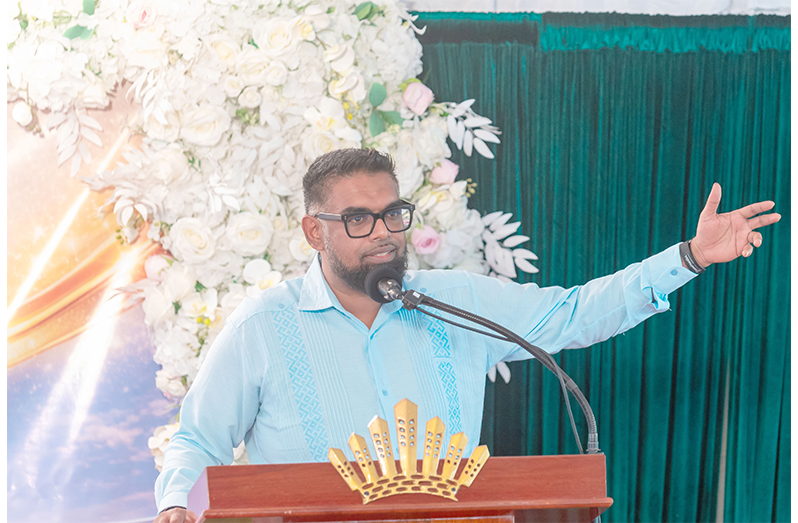
While speaking at the opening of Demerara Bank’s new location at Beterverwagting on the East Coast of Demerara, the Head of State noted that his administration has already begun engaging key stakeholders to identify ways to navigate the unfolding challenges, emphasising that decisive leadership is required in times of uncertainty.
“The war in the Middle East and the closing of the Strait of Hormuz have given us an important piece of history lesson. You have a situation now where marine transportation, global insurance, movement of food, movement of fertiliser, movement of petrochemicals, all of these things can come to an almost instant halt. Right now, most countries are operating from strategic reserves,” he said.
The situation he emphasised has underscored the fragility of global supply chains.
“They’re operating from product that they would have had in their reserve over the last four months. If the Strait of Hormuz continue to be closed for the next three, four weeks. We are in a global crisis. We are in a global crisis,” he stressed.
The President further revealed that Guyana is positioning itself to capitalise on emerging opportunities, particularly by promoting the country as a strategic hub for storage and logistics in the Western Hemisphere.
“And what do you do as a leader? We are already talking to different stakeholders as to how we can navigate through this crisis. I don’t have the luxury of sleeping through crisis. We have to work on finding strategic ways of navigating through this crisis,” he said adding:
“And one of the things I want to present to the Middle East is listen guys, you guys have great infrastructure, but now is the time for you to evaluate whether it is necessary to build out strategic infrastructure in other parts of the world. Imagine if Guyana had a strategic storage facility that had maybe six to nine- or 12-months reserve.”
GEO-POSITIONING
Further, he pointed to the possibility of establishing large-scale storage facilities in Guyana with the capacity to hold several months’ worth of critical supplies, including fertiliser, which could serve regional and international markets during periods of disruption.
According to President Ali, Guyana’s geographic location, which offers a direct access to the Atlantic and proximity to major markets such as Brazil, places the country in a unique position to support global supply chains.
He added that the country’s trade arrangements within the region, coupled with its natural resource base oil, gas and gold could further strengthen its potential as a strategic logistics centre.
“I want to present Guyana as that location, that geographic location that can be a strategic storage location,” he said adding: “And why Guyana, our geographic location, our access to the Atlantic, our access to large markets in Brazil and the trade arrangement we have within our region. But importantly our ability also to add our natural assets, which includes gold, that includes crude oil [and] natural gas as part of that portfolio, in building out a strategic geo-positioning for this entire industry.”
The Head of State framed the current crisis as both a warning and an opportunity, stressing that Guyana must move decisively to pursue this vision, positioning itself as a key player in global energy and commodity security while enhancing its own economic resilience.
“And that’s an opportunity that this conflict has brought to bear, an opportunity that we must pursue, that we have to pursue, and we’re going to pursue that opportunity.”
Last week, Dr Ali condemned recent strikes on energy facilities in Qatar, the United Arab Emirates and Saudi Arabia, stressing that the damage would not be quickly reversed.
“We also condemn the attack on critical infrastructure in the Gulf, in Qatar, Kuwait in Saudi Arabia that will have long term impact and implications for global trade,” the President had said.
Much of the pressure, he noted, centres on the Strait of Hormuz, which he described as “an important trading location,” especially for petroleum products and natural gas.
Here is where about 20 to 25 per cent of the world’s total seaborne oil trade passes through.
Attacks and disruptions in the Gulf have already led to sharp price movements and supply shortfalls.
According to President Ali, 17 per cent of energy capacity had been affected, dismantled and could be considered lost.
He pointed too to a 25 per cent jump in fertiliser prices and rising fuel and freight costs, warning of cascading consequences for food security and global manufacturing.
He further linked these developments to a wider vulnerability in the global energy system, noting that the Gulf oil output had fallen from 21 million barrels per day to 14 million barrels per day while only about 3.5 to 5 million barrels can be rerouted through pipelines.