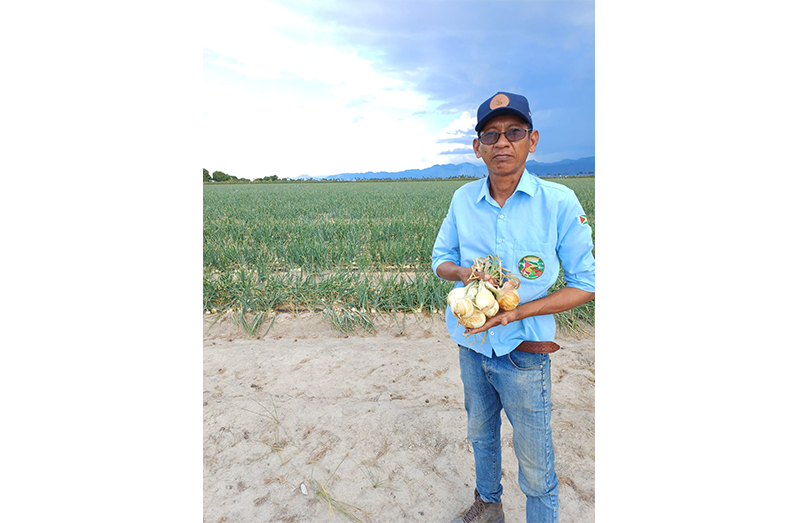
-following successful five-acre pilot project
GUYANA’S agriculture sector continues to grow through collaboration and innovation. Among the most recent examples is the Ministry of Agriculture’s partnership with Region Nine farmer Christopher Moses.
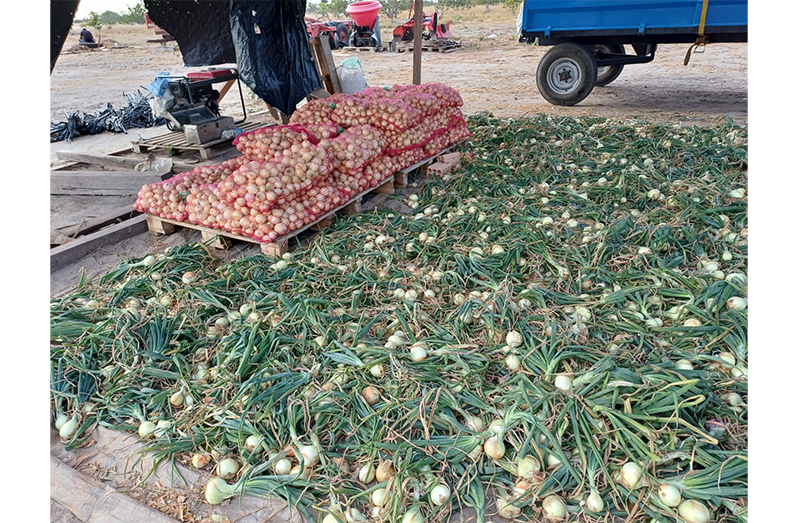
Through a partnership in late 2025, Moses, with support from the ministry, cultivated five acres of onions on his farm in Manari. Recently, he and his team pre-harvested the first batch of onions from the $9.5 million project.
Highlighting the success of the project, Moses shared that the crops are tremendously promising, with him having very high and positive hopes ahead of harvesting in the second week of April. Then crop was planted in December last year.
With the project expected to produce 70 tonnes per hectare, Moses has already continued his partnership with the ministry to cultivate an additional 40 acres as the project moves to a new phase.
Speaking to the Guyana Chronicle from his farm in Region Nine, Moses shared that his large-scale farm in the Rupununi has been operating for a few years and began with watermelon cultivation.
Last year, however, a meeting with fellow farmers, stakeholders, and the Minister of Agriculture, Zulfikar Mustapha, saw the minister highlighting the possibility of onion cultivation in the region.
Seeing an opportunity to diversify his farm, Moses indicated his interest to the ministry and drafted a proposal that was accepted. “Last year, the minister had a meeting with stakeholders and said that the Ministry of Agriculture wanted to do onion production,” he said adding, “I indicated that we could do it, and that is where it all started. We prepared the project, developed the costing, and submitted it. The Ministry agreed to partner with us, contributing to the cost of inputs and seeds, while we provided the land, equipment, and expertise.”
Following this, Moses and his team collaborated with the National Agricultural Research and Extension Institute (NAREI) and worked alongside agronomists from Brazil to make the cultivation a reality.
Sharing insight into the process, Moses said that while he and his team focused on management of the farm, hands-on cultivation, and crop health, support from the ministry, NAREI, and third-party agronomist from Brazil, Agmon Da Costa, created space for technology sharing by adopting techniques used by NAREI and across the border in Brazil.
“We had a lot of support from NAREI and from a third-party agronomist from Brazil. We paid to have a third-party agronomist from Brazil, so it was more like a technology transfer,” he said.
Further, he noted, “They have already been doing this just across the border in the state of Roraima, because we have similar soil, weather, and conditions. There was a learning process, but it was not very challenging because of that support.”
GREAT RESULTS
Now moving closer to its harvesting stage, Moses says the pre-harvest has shown great results, with the quality of the crops being very good. The success of the crop, he added, is largely due to support and use of a proven model from Brazil. “The crop has been very successful so far. On a scale of one to ten, I would rate it a nine. The success is largely because we applied a proven model from Brazil rather than starting from scratch.”
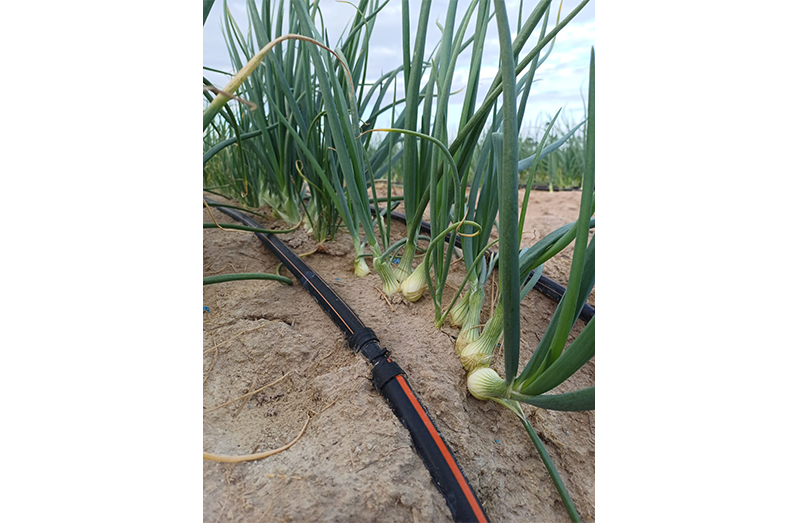
Another reason for the crop’s high quality has been the soil and regional climate, he said adding, “The Rupununi is unique in Guyana because it has a long dry season, about eight months, and a shorter rainy season of about four months. We do not have heavy rainfall during the Christmas period, which makes it ideal for agriculture. The low humidity reduces issues like fungal infestations, but it does mean that irrigation is necessary. Overall, the conditions here are very suitable for crop production once irrigation is in place.”
While initially one of the primary challenges Moses and his team faced was accessibility and transportation, that is now being addressed. Citing the recently completed 100 kilometres of the Linden-Mabura Hill Road project, Moses said this has made getting the crops to Georgetown and other retailers much easier.
“One of the challenges in the Rupununi is transportation and being far from Georgetown. But that will soon be resolved with the road that is being built. The recently asphalted section of the road, about 100 kilometres has been really helpful. It is just one-third or a quarter of the way to Georgetown, but it has really helped,” he said. This comes as Moses and the ministry plan to move to the next stage of onion cultivation.
Moving forward with 40 acres of land would require greater technical support, specifically through mechanised harvesting equipment.
Moses explained that currently harvesting is being done manually on the five-acre plot. The far larger 40-acre plot, however, would require harvesting equipment to adequately and efficiently harvest the crop.
While he has made efforts in this area on his own, he shared that moving forward, he will collaborate with the Ministry of Agriculture. “Harvesting will be done manually for now because it is just five acres. When we move forward with the next project, it will be 40 acres in collaboration with the Ministry of Agriculture,” he said.
He noted, “When we go ahead with that, we will have to mechanise in terms of harvesting. Right now, the planting is mechanised but moving forward, we have to get the equipment to deal with a larger plantation.”
Currently, Moses is looking at the distribution of the crops following harvest in early April.
He explained that he has already partnered with the Guyana Marketing Corporation to aid in getting the estimated 70 tonnes of onions to Georgetown. “We will be working in collaboration with the Guyana Marketing Corporation to distribute the onions in Georgetown, Lethem, and we will also be supplying the local market in the Rupununi.”
The successful project and the plan for an additional 40 acres highlight not only Guyana’s agricultural potential, but also the positive impact of strong leadership, collaboration, and innovation.