






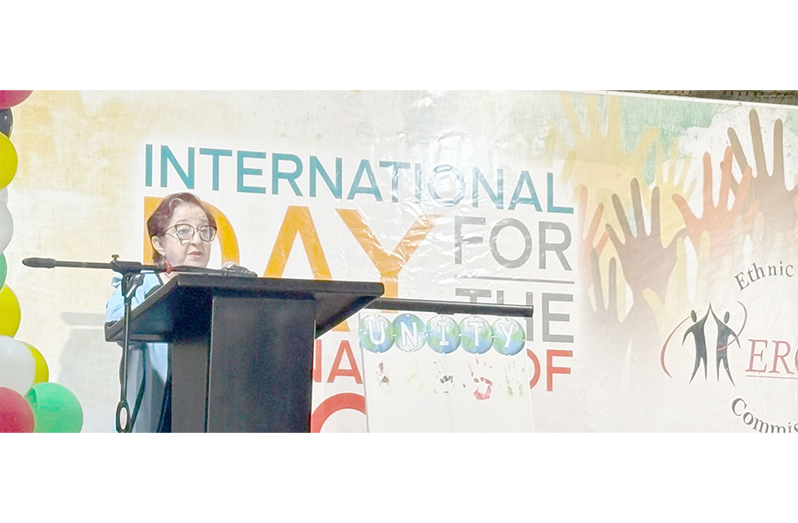
–Minister Teixeira emphasises, highlights gov’t has closed gaps, created opportunities for all
–cautions against social media being used as a destructive tool
GUYANA’S democratic framework and constitutional protections have enabled the nation to steadily evolve into a more inclusive, unified and equitable society, Minister of Parliamentary Affairs and Governance, Gail Teixeira emphasised on Monday.
During her remarks at the Ethnic Relations Commission’s (ERC) observance of the International Day for the Elimination of Racial Discrimination along with the current commission’s third anniversary at the Umana Yana, Minister Teixeira highlighted Guyana’s progress, stating, “We’ve travelled a long way as a country.”
Emphasising that citizens must give credence to how far Guyana has advanced, she noted that even with the deep ethnic, religious and linguistic diversity, and times of intense political tension, Guyana has never descended into war.
As Minister Teixeira explained, Guyana’s greatest achievement is not just economic growth or infrastructure expansion, but also its ability to avoid the conflict that has destabilised many similarly diverse nations.
The minister then reflected on the decades of global upheaval and the profound violation of human rights through atrocities such as fascism, which led to the creation of the United Nations (UN), which she said is now “under threat.”
Guyana’s constitution, as the minister pointed out, is one that is distinct and expansive, and that came about because of civil strife.
She said: “We’d come out to the 97 elections, and if there was violence, and we could have gone a different way, like we could have gone a different way in 2020 post elections, but we, as a people and by the political leadership of the time, we went back to the Constitution, amended it, and brought in very strong articles.”
Teixeira emphasised that human rights are the bedrock of democracy, underscoring that Guyana’s development, in that context, must be understood under a broader historical backdrop.
Additionally, she highlighted the gradual cultural shift in Guyanese society, where younger generations are rejecting the rigid ethnic and religious divisions.
Giving her observation on the 2025 General and Regional Elections, the minister said: “I observed, and I may be wrong, that the language that began at the beginning on the social media was very racial, halfway down the line in the campaign, you started to see that dissipate. And I think that I know my own belief as a politician is that race no longer plays as divisive a role as it played for decades.”
Still, the minister cautioned against social media, although a productive tool, being destructively used to infringe upon human rights.
“Today, the society is much more open, but there still are prejudices,” she said.
Drawing on lessons from renowned human rights activist, Nelson Mandela, the minister reminded the audience that hate is learned and can be unlearned.
Pointing to the global trends, the minister underscored the need for vigilance.
Central to Guyana’s progress as a society, is the fact that the constitution explicitly prohibits discrimination, whether it be on the basis of gender, race, religion, nationality and disability.
Constitutional reforms have also led to the ability for citizens to seek redress directly through the courts and the creation of key human rights bodies such as the ERC.
“These are innovative creations of the Guyanese people and the Guyanese politicians. We didn’t follow the examples of other countries and when you look at the Guyana constitution, and many innovations that are not necessarily in other people’s constitutions, and in some of them that we brought in, a number of governments might not like them, because they hold the Government in Guyana accountable in a way that some other countries are not,” Minister Teixeira said.
DEVELOPMENT REJECTS DIVISION
Minister Teixeira posited that modern discrimination emerges not just from prejudice but also from unequal access to opportunities.
In that regard, the minister highlighted how the People’s Progressive Party/Civic (PPP/C) government is closing the gap with initiatives.
These include tens of thousands of house lots distributed at subsidised rates, free education for all and equitable access to scholarships, the distribution of the ‘Because We Care’ cash grant to thousands of learners, training opportunities, the creation of thousands of jobs, and subsidies that remove pockets of poverty.
Adding to that, she disclosed that universal secondary education is projected to be achieved by 2026/2027.
The minister also pointed to the expansion of internet, electricity and water access in hinterland communities.
“We have come a long way, and that those things reduce feelings of discrimination, reduce ethnic insecurities, because you can see in housing schemes, when you go to them, that they reflect Guyana, they reflect the diversity of Guyana,” she added.
The minister urged citizens not to take for granted the unique social fabric that Guyana has built, where religious and cultural traditions are respected and communities remain.




