






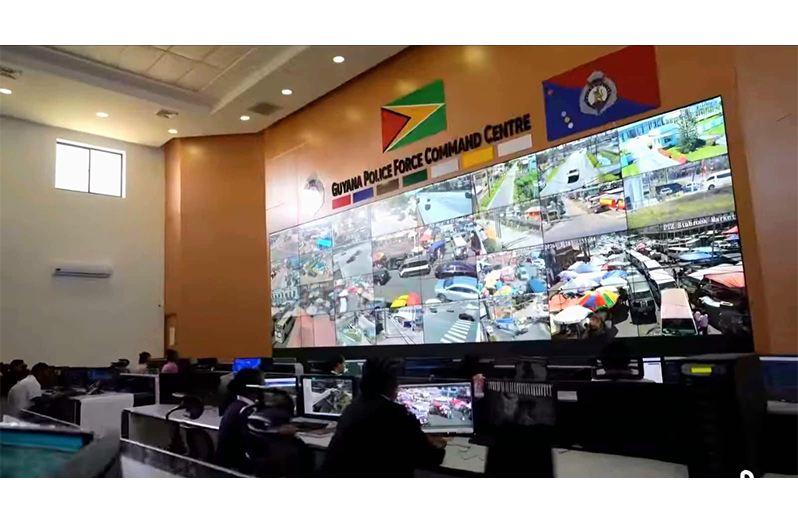
–as cameras act as ‘witness, guide’ by turning apparent ‘minor activities’ into ‘big leads’
THE Guyana Police Force Command Centre has emerged as the “Digital Brain” of the Force, with a shift to a high-tech, intelligence-led era of policing.
The transformation did not happen overnight. The story of the Command Centre dates back to its beginnings as the National Emergency Response Operations Centre, once managed through the NDMA and operated by the Guyana Defence Force. What began as a modest emergency hub has now evolved into a national powerhouse for real-time policing.
Step inside on any given day or night, and you will find no pause, no lull. A team of 911 call takers, dispatchers, IVS operators, supervisors, and duty officers rotate in twelve-hour shifts, ensuring that Guyana is never without eyes, ears, and support.
The phones ring constantly. Some calls are urgent, some frantic, some hopeful. In 2025, almost 890,000 calls passed through these lines. More than 5,600 became active cases of crime, fire, medical emergencies, traffic incidents, and other public-safety concerns. Even when the prank calls came by the hundreds of thousands, the discipline of the ranks never wavered. Behind every ring is a possibility of life, and so every call matters.
But the Command Centre’s strength is not limited to the lines it answers, it is also found in the vast network of cameras stretching across the country. Born out of the Safe City programme and now expanding into Safe Country, this network covers strategic points in Regions Three, Four, Five, and Six, with Regions Two and 10 currently being outfitted under new phases.
Hundreds of camera sites have been installed, each location fitted with PTZ cameras, facial recognition units, license plate readers, and traditional bullet cameras. Every camera, every angle, tells a story.
Inside the Centre, operators watch these stories unfold in real time. A suspicious figure pacing at a street corner. A sudden gathering that seems to grow too quickly. A vehicle that doesn’t belong in the place it’s spotted.
A fight breaking out near a shop. A motorcyclist weaving recklessly through traffic. Moments like these are detected in seconds, and divisional patrols move out with clear intelligence guiding them. The cameras do not just record, they prevent, they protect, they interrupt.
Many breakthroughs in recent policing operations in have unfolded because of what the Command Centre observed. In several instances, intelligence gathered through the camera network has assisted investigators in tracing the movements of vehicles and persons of interest, enabling ranks to respond swiftly and effectively.
CRITICAL LEADS
What may appear to be minor activity captured on camera can often provide critical leads, prompting further investigation and operational response. The cameras acted as both witness and guide.
And the Centre’s capabilities only continue to grow. Today, more than 11 million facial snapshots and over 30 million license-plate images sit securely in the system’s databases.
When investigators need to track a suspect, confirm a vehicle’s presence, validate a timeline, or extract footage for court, the Command Centre becomes the anchor of the case. The number of investigations strengthened by video evidence over the past year is in the hundreds, and rising.
Yet, perhaps the most impressive part of this operation is not the technology itself, but the people who use it. Every camera feed is interpreted by trained eyes, every alert is assessed by a professional who must decide, often in a split second, what action is required.
The Command Centre collaborates daily with the Traffic Department, General Duty ranks, and specialised units, ensuring a flow of intelligence that strengthens every corner of the Force. Whether it is identifying speeding offenders, monitoring crowds at major events, or supporting anti-crime patrols, the Command Centre stands as the silent partner to every operation.
As the Safe Country initiative continues its phased expansion, the Command Centre grows with it, extending its reach deeper into the regions and offering more communities the protection of intelligent, modern policing. It represents the future the Strategic Plan envisioned, a Guyana where public safety is not reactive but proactive.
And so, the Command Centre is not just a room filled with screens. This multi-layered infrastructure, and public assistance improve the Force’s ability to detect incidents, track movement, and monitor crime patterns nationwide. (Guyana Police Force)




