






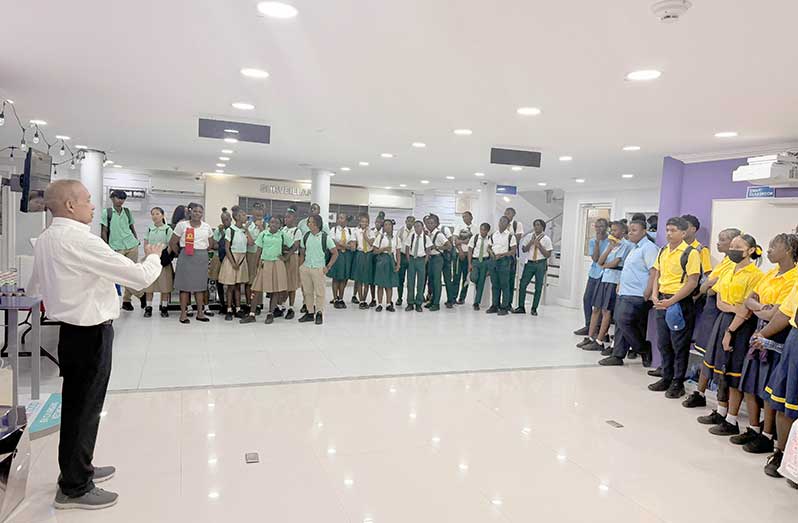
– STARR Computer President tells students during tour
PRESIDENT of STARR Computer Inc., Mike Mohan, on Wednesday, positioned Guyana as a future global hub of human capital and innovation, as he addressed scores of secondary school students during an educational field visit focused on technology, artificial intelligence and emerging global challenges.
Approximately 80 students and six teachers from institutions including Lodge Secondary School, South Ruimveldt Secondary School, Freeburg Secondary School, New Campbellville Secondary School and Vrymans Erven Secondary School toured the company’s facilities, gaining firsthand exposure to the country’s rapidly evolving digital landscape.
Mohan used the opportunity to outline what he described as a defining moment for Guyana, arguing that global instability, from war to climate change, will reshape migration patterns and place the country at the centre of a new economic and demographic reality.
“Conflicts across the world and the accelerating effects of climate change will force populations to move,” Mohan indicated, noting that Guyana’s economic growth and political stability make it an increasingly attractive destination. “In time, we may face a surplus of human resources, and that means preparation is critical.”
He stressed that the rise of artificial intelligence and robotics will fundamentally transform how societies function, making digital literacy and technological adaptability essential skills for the next generation.
TECHNOLOGY AS A NATIONAL STRATEGY
During the visit, students were introduced to STARR Computer’s operations, which Mohan said reflect a model of integrated digital transformation already taking shape locally.
The company’s infrastructure, spanning three interconnected buildings, demonstrates advancements in computer production, networking, surveillance systems and solar-powered energy solutions.
“Digital transformation is not a concept for the future; it is happening now,” Mohan told the students, pointing to the role of technology in driving economic expansion, financial inclusion and productivity.
He highlighted partnerships with global technology brands and the company’s efforts to make innovation accessible, particularly through initiatives aimed at young people.
Among these is the Student Advantage Card, a digital platform offering identification services, retail discounts, educational resources and pathways to internships.
Mohan said the programme is designed to bridge the gap between education and employment, preparing students for a workforce increasingly shaped by automation and data-driven systems.
PREPARING FOR A CHANGING WORLD
Mohan warned that while Guyana’s rapid development presents opportunities, it also demands foresight and strategic investment in human capital.
He explained that climate-related pressures, such as rising sea levels and extreme weather, combined with geopolitical tensions could accelerate both migration and “remigration,” with members of the diaspora and foreign nationals seeking opportunities in stable, resource-rich countries like Guyana.
In that context, he argued that the country must leverage technology not only to sustain growth but to manage the social and economic implications of population expansion.
“AI and robotics will not replace humanity,” he said. “But they will redefine the kind of skills that are valuable. Countries that invest in digital education and innovation will lead.”
The field trip formed part of ongoing efforts to expose students to real-world applications of technology and entrepreneurship. Many participants expressed interest in careers in information technology, business and engineering after engaging with STARR’s operations.
Mohan encouraged the students to embrace innovation and position themselves as future leaders in a rapidly changing global economy.
“As Guyana rises on the world stage, you will be the generation that sustains and advances that success,” he said.
According to one student, the visit provided valuable insight into the level of technological advancement taking place in Guyana, particularly in areas such as artificial intelligence and digital systems.
Another student stated: “The remarks delivered emphasised the importance of innovation and entrepreneurship, which are essential for future national development.”




