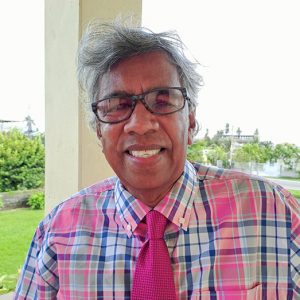
ONE of the consistent spokespersons for the Mulatto/Creole class is WPA archivist, Nigel Westmass. In yesterday’s (Saturday) edition of the Stabroek News (SN), a letter on my politics was published that is more than half a page, in which so many nuances of my political writings, political beliefs and social activism are commented on.
Westmaas added: “You can expect Kissoon to produce about eight apoplectic columns on this (his) letter.” So much was written about me in Westmaas’ SN ranting that Westmaas is right; it may run into 8 submissions, maybe more. Westmaas’ letter provides me with an opportunity that I consider priceless to do a number of things. 1- Educate the younger Guyanese on the dialectics of psychic transformation in the individual activist; 2 – Discuss the politics of betrayal of the working masses by leaders this nation once admired and looked towards for bread, justice, liberation and a future;
3- Assign class analysis to events, occurrences, phenomena, political behaviour and the sociological evolution of the Guyanese society; 4 – Finally, an examination of the nuances in the media landscape in Guyana. That is a tall order that may exceed the 8 explanations that Westmaas anticipates.
Now let’s look at number 1 because Westmaas claimed that I have changed and offers quotes from my pen in my previous political life. I use the word “previous” because I do not want to return to my previous political life because it is psychically traumatising. My political life has been a rich one. I went into politics in 1968 and still remain in it. I taught for 26 consecutive years at UG and I have entered 38 consecutive years as a newspaper columnist for all of Guyana’ major newspapers.
So, I have seen it all and Westmaas’ missive allows me to address the Guyanese people, especially more than half the population that were not around when I was intensely active as a Guyanese nationalist. Here now is my response to my political metamorphosis that Westmaas highlighted.
Westmaas would know about the transformation of my politics because his profound change took place simultaneously with me, only that we went in opposite directions. I remained the same scrawny individual today that went into politics in the 1968 general elections. Three stances of my politics persist. One is that I have not operated outside of the class which I belong to. My politics have always been based on the economic and social empowerment of the class I was born into in Wortmanville.
Secondly, I have carefully, emotionally and philosophically eschewed identification with ethnically based culture and ethnically based politics. I cannot change my genetic belonging, but it begins and ends there. My politics is to be among people in general and to help humans in their daily disadvantages. And those humans are Guyanese citizens. I do not want to belong to any ethnic group that sees its task to speak exclusively for an ethnic community.
However, I do not disagree with Ravi Dev that the ethnic factor in Guyanese society is a reality that cannot be excluded when national solutions are being studied. I cannot disagree with someone who says that he speaks for Africans and another says he speaks for Indians. I speak for the Indians and Africans, who I believe ought to have a substantial presence in the relations of production. My political life in the past carried that configuration. It always will.
So how has my politics changed from that of the thousands (yes thousands if you start from 1968 and include 2025) of Guyanese activists including Westmaas, that I embraced and shared an enduring camaraderie with it? At 17, I worked at the Michael Forde Bookstore, where I soaked in philosophy books, some of which were impossible to grasp at my age back then.
From 17 onwards, my activism was based on idealism – power must be used to liberate the souls of humans. Power is dangerous and we must devote our lives to diluting its unsavoury characteristics so power can become liberating. A huge part of my political evolution involved traversing two horizons. One was the struggle against Forbes Burnham’s totalitarianism. Burnham directed some of his vendettas against me personally, which led to the indelible imprint on my mind that we have to struggle for freedom in Guyana.
The second horizon was I had endured and stomach enough in a country where one man ruled forever. The mistreatment and brutalisation of my friends and the discrimination against Walter Rodney by permanent power made me want to fight against a system where you cannot change the country’s leader. When I joined the struggle for free and fair elections in 1968, I thought the people I struggled with, like Westmaas and the WPA, believed in it too. I was painfully wrong.
DISCLAIMER: The views and opinions expressed in this column are solely those of the author and do not necessarily reflect the official policy or position of the Guyana National Newspapers Limited.