






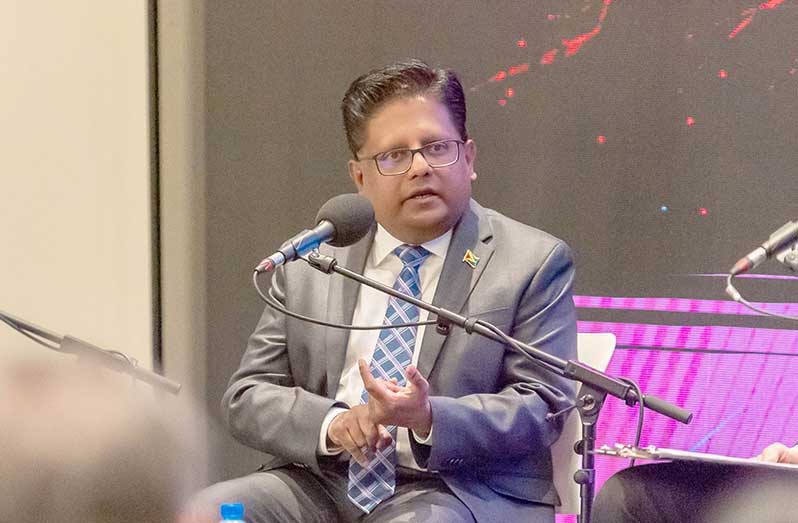
—Dr Singh pushes back on opposition narrative during BBC World Questions
—counters claims that Guyanese are not benefitting from oil wealth; points to record economic growth, job creation, expanding opportunities.
SENIOR Minister in the Office of the President with Responsibility for Finance, Dr Ashni Singh, pushed back against claims that Guyanese are not benefitting from the country’s rapid economic growth, describing such assertions as a “difference between rhetoric and reality,” during the BBC World Service programme World Questions, which was recorded in Georgetown earlier this week.
The programme, chaired by BBC journalist Jonny Dymond, brought together a panel that included Singh; Opposition Member of Parliament Tabitha Sarabo-Halley; activist and businesswoman Ayodele Dalgety-Dean and Private Sector Commission Secretary Clinton Urling.
During the discussion, an audience member suggested that despite Guyana’s booming oil-driven economy, ordinary citizens were not experiencing meaningful improvements in their daily lives.
Responding to the claim, Dr Singh rejected the premise, arguing that the data and tangible developments across the country tell a very different story.
“I am, in fact, happy that Mike, the question that he did and framed it the way he did, because I think the statement he made or the question he asked provides a very good illustration of the difference between rhetoric and reality,” Singh said.
The Finance Minister pointed out that Guyana has experienced unprecedented economic expansion since the discovery and production of offshore oil.
“The reality is, as you said, the Guyanese economy has been growing at a pace that has never been seen before… We have grown over the last five years at 36 percent per annum in real terms, from 2021 to 2025,” he explained.
Singh emphasised that this growth has translated into visible transformation across the country, including new infrastructure, expanded services and economic opportunities.
According to him, the government’s approach is guided by two central priorities: improving the lives of Guyanese in the short term, while simultaneously investing in long-term economic resilience.
“The first is to improve the lives of all Guyanese people in a tangible way in the shortest possible time… At the same time… we have to ensure that we protect the resilience and sustainability of our economic growth for the long term,” Singh said.
He also cited job creation as a key indicator of progress, noting that thousands of new employment opportunities have been generated in recent years.
“Over the last five years alone we have created 104,000 new jobs. In a population of about 950,000, that is a significant number of jobs,” he told the audience.
Singh added that the growth has not been limited to low-skilled employment, highlighting expanding opportunities in technical and professional fields, particularly within the oil and gas sector.
“We have 6,000 persons now working in the oil and gas sector… many of them are engineers working on the FPSOs and in highly skilled technical areas in jobs that simply did not exist before,” he said.
Beyond employment, the minister pointed to improvements in housing access and disposable income as evidence that economic gains are reaching citizens.
“We have allocated land to more than 50,000 Guyanese. We have increased disposable income so that almost 15,000 persons become owners of their own cars every year,” Singh noted.
When the conversation shifted to transparency, Singh again defended government actions, citing legislation and international standards.
“We firmly agree with the importance—the paramount importance—of transparency and accountability.”
He highlighted reforms such as the Natural Resource Fund Act and international transparency commitments.
“We legislated a new Natural Resource Fund Act… which has very robust requirements in relation to transparency… including publication of every single receipt of oil revenue.”
Later in the programme, during discussion on political divisions, Singh also pushed back against narratives of ethnic polarisation in politics.
“Guyana’s diversity is by far more a strength… For the greater part of decades, Guyanese people of all backgrounds have lived next to each other… in harmony.”
He also argued that no political party can win purely on ethnic support. “No single party can win an election with support from only one ethnicity,” Dr Singh said.
The BBC forum explored a range of issues related to Guyana’s rapid economic transformation, including the distribution of oil revenues, governance, foreign policy and opportunities for young people.
Throughout the discussion, Singh maintained that while challenges such as the cost of living remain real, the broader narrative that Guyanese have not benefitted from economic growth is misleading.
He stressed that the scale of development currently underway represents a historic shift for the country and is generating opportunities across multiple sectors.
“The growth in the Guyanese economy has resulted in the creation of an unprecedented wave of opportunity for Guyanese of all ages,” Singh said.
The World Questions programme, broadcast globally on the BBC World Service, featured questions from a live audience in Georgetown and focused on the future of Guyana as it navigates rapid economic expansion driven by oil revenues.




