HERE are the words that Tacuma Ogunseye used in an email to me on March 6, 2018 at 9:21 PM: “The observations you made of his politics is [sic] correct. I remember persons who knew the “Brother” told us that we will later have problems with the comrade – their point was that his political orientation was not Guyanese or Caribbean but European.
“He came from the European lift (sic) culturally. I had and still have problems with the brother’s politics and his political culture, but the WPA, before Walter (sic) return, and during his activism and after had always seen the anti-dictatorial struggle as a multi-class struggle – this explains our coexistence and objectively was Indian and one of the better elements of the elite. There is something I would not say at this time.”
Tacuma Ogunseye remarked about many persons telling him about the nature of Roopnaraine. It was the same with me. All his critics were identical in saying that he was a middle-class elite not suited for West Indian mass politics.
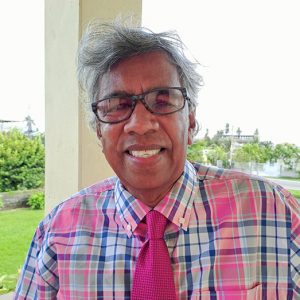
Rupert Roopnaraine (RR) with his absolutely brilliant mind should never have been involved in Marxist, working class, West Indian politics. He should have remained a top-class scholar in global academia or found a party like the Green Party. He couldn’t fit in, never fitted in. In philosophy, there is the concept of nature versus nurture. It is a theory used in philosophy to defeat genetic determinism.
Genetic biologists, of which the late E.O. Wilson is the most famous, stipulate that Homo sapiens cannot avoid being shaped by genetic determinism. Wilson went so far to say xenophobia is in built into our system. The nature versus nurture perspective argues that nurture can defeat nature based on the socialisation process.
If you have identical twins, and one has a girlfriend that is deep into the anti-war movement and the other hangs around conservative friends, they will develop different character traits. They will mature to have nothing in common. This is what is meant by nurture defeated nature.
RR was a victim of genetic determinism. Vic Insannaly in his funeral eulogy said that RR’s mother wanted him to be a Guyana scholar so she sent him to private school; from there to Queen’s College, then to Cambridge University.
At Cambridge, RR became an Indo-Saxon. His Anglo-Saxon personality was also shaped by what he studied – classical literature. By the time he left Cambridge, he was the typical West Indian Anglo-Saxon man.
He left Cambridge and jumped deeply into the counter –culture of hippie life sweeping the 60s in the Western world when he went to Cornel University in New York. He got deeper into Anglo-Saxon culture when he did his doctorate on Dickens – the best exponent of the English language. RR by the time he arrived back in Guyana in 1976, he was a pure Indo-Saxon personality saturated with Western culture.
Vic Insannaly told the funeral gathering that three days before RR died, he visited him at his sprawling former sugar plantation residence (my words) where he found him in bed listening to classical music. Those who know Roopnaraine would not be surprised at the choice of music. RR could not escape genetic determinism. The nature versus nurture dialectic bypassed him.
His socialisation was purely among the Mulatto/Creole class (MCC). His personal friends were from the MCC. He told my friend Leyland DeCambra, one of the founders of the UK WPA group, that his best friend was Martin Carter. Imagine that, RR, a revolutionary West Indian Marxist, having an imperialist spokesperson as his best friend.
One day, Mark Benschop and I were leaving New Thriving Restaurant and we passed him with a group all of which were light-complexioned MCC personalities. He told me and Benschop he was celebrating his birthday. Would he have celebrated his birthday with Tacuma Ogunseye?
He was one of the most unique humans in the world. I am using the term “unique” in a value-free context. Normally, the term denotes positiveness. I am not using it in that sense. What makes him unique is that he lost himself simultaneously in two worlds characterised by diametrical class differences – the MCC world and the world of Jaganite/Rodneyite working-class activism.
He was an Anglo-Saxon in character and was the darling of the entire Portuguese and Mulatto/Creole class in Guyana. No one in the history of British Guiana and post-independence Guyana was more embraced by the light-complexioned MCC than RR. It was incredible to see. It was a wonder to witness.
He would talk about Marxism, Cuba and revolution but despite that ideology, the MCC loved him. In the end, he became part of a neo-liberal government that brutalised sugar workers. He damaged his legacy by supporting rigged elections. In the end, he became what he always was.
DISCLAIMER: The views and opinions expressed in this column are solely those of the author and do not necessarily reflect the official policy or position of the Guyana National Newspapers Limited.