-says large volume of court cases highlight ongoing challenges
DOMESTIC and gender-based violence continues to be a persistent challenge across Guyana, with courts processing numerous cases every day.
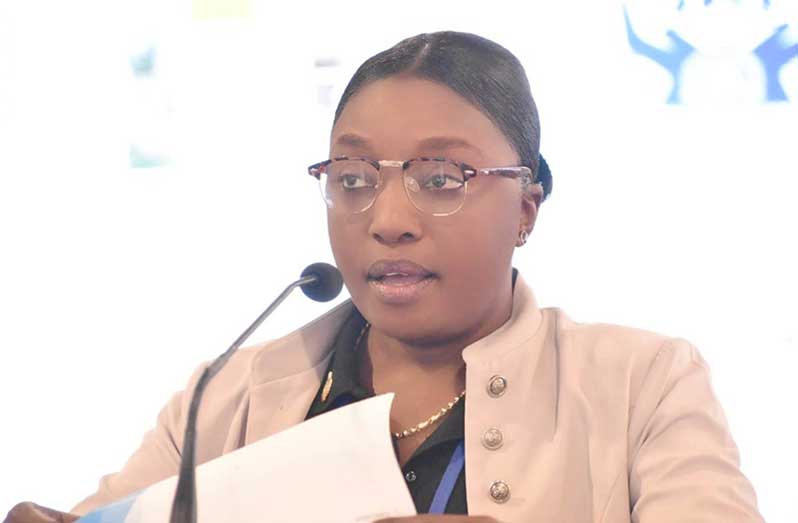
In an interview with the Guyana Chronicle, Senior Superintendent for Region Four Division 4C (East Coast Demerara) Shavon Jupiter said that despite ongoing programmes and zero-tolerance policies, lack of co-operation and broader systemic limitations often hinder the police’s efforts to effectively address such matters.
Jupiter believes more proactive measures are needed, including stronger partnerships with schools and social workers, to address domestic and gender-based violence before it escalates.
The prevalence of domestic violence cases in Guyana, she noted, is particularly evident within the court system.
As the officer responsible for overseeing a total of six courts across Region Four, Jupiter explained that domestic and gender-based violence matters are among the most consistent cases brought before the courts.
In her estimation, the six courts collectively handle around 10 such matters daily. “We see ten of those matters every day,” she said, adding: “Within all of the matters we see per day, ten of those matters are domestic violence-related or gender-based violence-related matters per day.”
However, while there are dedicated police units and a zero-tolerance approach to domestic violence, Jupiter pointed out that several challenges often affect the outcome of cases. Among the most common obstacles are victims becoming unwilling to continue with proceedings due to fear, financial constraints, or other personal and social pressures.
Although about 10 domestic or gender-based violence cases may come before the courts daily, only a small percentage ultimately result in convictions.
Jupiter estimates that roughly three out of every 10 cases, about 30 per cent, are successfully prosecuted. “What happens is that sometimes we have a zero-tolerance approach towards domestic violence, but every so often when the victims and the defendant go to court or the complainant and the defendant goes to court, it is solved in the court as in they say, well, they ask to forgive the person,” she explained.
While acknowledging that continued work by the police is necessary, Jupiter emphasised that broader collaboration is essential to meaningfully tackle domestic and gender-based violence.
Highlighting the far-reaching impact of violence within families, she said she would like to see a stronger police presence within schools.
According to Jupiter, children who witness or experience violence at home often carry the emotional effects of those experiences into the classroom. “I think each school should have a police officer assigned… Because the domestic violence lives in the school. So, despite it is domestic in terms of a domestic setting where you live, children spend most of the hours at school. And when I say it lives in school, it travels from the home to the school because that worry goes into the classroom,” she said.
Additionally, Jupiter stressed that addressing domestic violence requires co-operation across multiple sectors of society. Greater collaboration with social workers, she explained, could help provide a more complete understanding of cases and allow law enforcement to respond more effectively and quickly when incidents occur.
“The collaborative effort in terms of domestic violence, it has to be wide stretch. The schools, the homes, the workplace, everything. And it would really help if the social workers worked along with the police. Not just when there is a call. All the time. Even before the call comes to us. We should be there having that collaborative effort with them. So, when that call comes, we act instantaneously,” Jupiter said.
Jupiter maintained that while the police remain committed to enforcing the laws and supporting victims, effectively addressing domestic and gender-based violence will require sustained cooperation across multiple sectors.
Through stronger partnerships with schools, social services and communities, she believes more preventative action can be taken to better protect women and children across Guyana.