





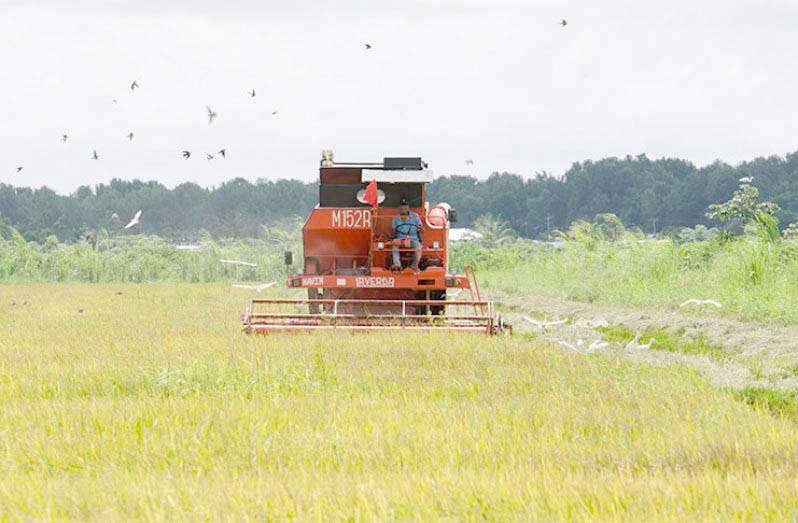
WITH farmers confronting more frequent dry spells and other erratic weather patterns, the Government of Guyana has been promoting more climate-smart techniques across several agriculture sectors, with a particular focus on rice farming.
Addressing the recently concluded he 39th Session of the United Nations Food and Agriculture Organisation (FAO)’s Regional Conference for Latin America and the Caribbean (LARC 39) held in Brazil, Agriculture Minister, Zulfikar Mustapha said rice production remains a key element of the country’s food ecosystem.
To this end, he noted that the government is cognisant that the industry will need to be made more resilient to climate change.
“We are promoting improved rice varieties that are more tolerant to drought, flood and pests. We are also establishing climate-smart rice production models at our rice resort station to demonstrate techniques that reduce risk and improve efficiency under changing weather conditions,” he said.
The minister noted that rice is currently cultivated by around 6,000 farmers across more than 232,000 acres annually.
He stressed that climate pressures, especially more frequent dry spells, are creating new challenges for the industry, but also driving innovation and reform.
Beyond production in the field, the minister drew attention to the often-overlooked problem of post‑harvest loss in the rice value chain.
He said the government is investing in projects such as drying floors and improved milling capacity to reduce losses after harvest.
By upgrading these facilities, the ministry aims to ensure that a higher proportion of the rice harvested by farmers actually reaches the market in good condition.
Mustapha said, “Another important area is reducing post-harvest loss, which is often overlooked when discussing climate resilience. We are also investing in driving a number of projects to improve this, things like drying floor, improving milling capacity, and these are all applicable to the rice sector.”
A key pillar of the minister’s strategy is the promotion of improved rice varieties with greater tolerance to drought, floods, and pests.
Through the Guyana Rice Development Board (GRDB), the government is rolling out these varieties to farmers across major rice-growing regions.
According to Mustapha, these new lines of rice are designed to maintain yields even when rainfall is erratic or when crops are exposed to extremes of water stress and pest pressure. This, he said, is central to protecting farmer incomes and national food security in an era of climate uncertainty.
To complement the improved seed varieties, the ministry is also investing in climate‑smart rice production models. These are being established at the rice research station as demonstration sites, showcasing practical techniques that help farmers manage risk and use resources more efficiently.
The models are intended to highlight best practices in water management, soil health, and input use, giving farmers concrete examples of how to adjust their operations.
Meanwhile, rice farmers along the Corentyne, Region Six, who were recently impacted by heavy rainfall, are set to benefit from compensation through the government’s crop insurance programme.
The insurance project, launched in July last, through collaboration among the Ministry of Agriculture, UPL Costa Rica, Philip Morris International and the Guyana Rice Development Board (GRDB), aims to protect farmers from losses caused by extreme weather events such as floods and droughts.





