






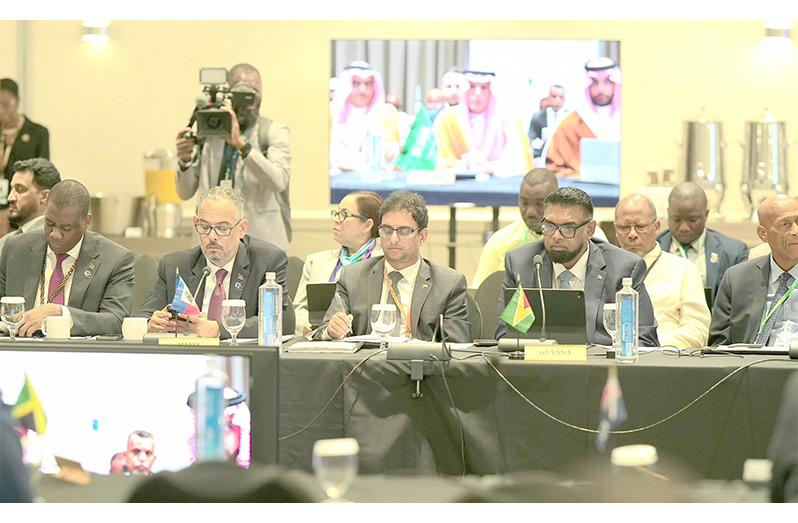
–emphasises importance of efficient flow, movement of goods in Caribbean region
GUYANA is pressing for the free movement of goods and removal of “artificial” trade barriers as President Dr. Irfaan Ali, earlier this week, emphasised the importance of efficient flow of exports across borders.
The 50th Regular Meeting of the Conference of Heads of Government of the Caribbean Community (CARICOM) opened on Tuesday in St. Kitts and Nevis and although President Ali did not address the opening ceremony, he joined regional leaders for Wednesday’s plenary session and held several bilateral engagements, including talks with Trinidad and Tobago’s Prime Minister Kamala Persad- Bissessar.
The President on the sidelines of the 50th Regular Meeting of the Conference of Heads of Government of CARICOM told reporters that while energy security remains a cornerstone in bilateral engagements between Guyana and Trinidad and Tobago, it must go beyond this.
“As I said previously, Trinidad’s private sector has benefited enormously from our energy sector, our construction sector, our consumers and I think that the bilateral for me must be far broader than energy,” Dr. Ali said, adding: “For us, food security is a major issue, and us getting our goods into Trinidad, without the bureaucracy, and without the type of delays that we that we face and I believe that the time has come for those barriers, the artificial barriers, to be removed and the bureaucracy to be removed so that we can facilitate trade in a more efficient way, and we can facilitate the movement of goods in a more efficient way.”
He stated that he looks forward to bilateral engagements to be “very progressive and future driven,” with emphasis on trade expansion.
“The fact is that Guyana has had an open relationship with CARICOM. The entire private sector in CARICOM is welcome on the same playing field like Guyanese; they invest and to work in Guyana,” Dr. Ali added.
Last year, President Ali underscored the urgent need to boost intra-regional trade as a driver of economic stability and growth within CARICOM.
In a commemoratory message to celebrate CARICOM Day, the President called on member states to harness the region’s collective potential, noting that stronger economic linkages will fortify the region’s resilience amid rising external pressures.
“We must vigorously strengthen and strategically expand intra-regional trade, aggressively advance our efforts toward long-term food security, and ensure resilient energy systems and sustainable environmental protections.,” the President urged, emphasising the need for collective action to overcome shared vulnerabilities and unlock the full potential of the Single Market and Economy.
He stressed that enhanced trade within the region is essential not only for economic resilience but also for advancing food security, energy sustainability, and regional self-sufficiency.
President Ali pointed to Guyana’s role in helping drive this agenda, citing the country’s growing food production capacity and emerging energy resources. He noted that Guyana stands ready to contribute meaningfully to regional food security initiatives, and to support energy diversification across the Community.
“Regional integration is no longer a lofty aspiration; it is an urgent necessity, and one that is now more critical and compelling than ever,” he stated, adding that his government remains “unequivocally committed” to this cause.
Beyond trade, President Ali called for deeper collaboration in several key areas, including climate change adaptation, regional security, and diplomacy. He highlighted the need for CARICOM to act as a united front in global affairs, particularly as the region faces mounting threats from climate change, transnational crime, and external economic shocks.




