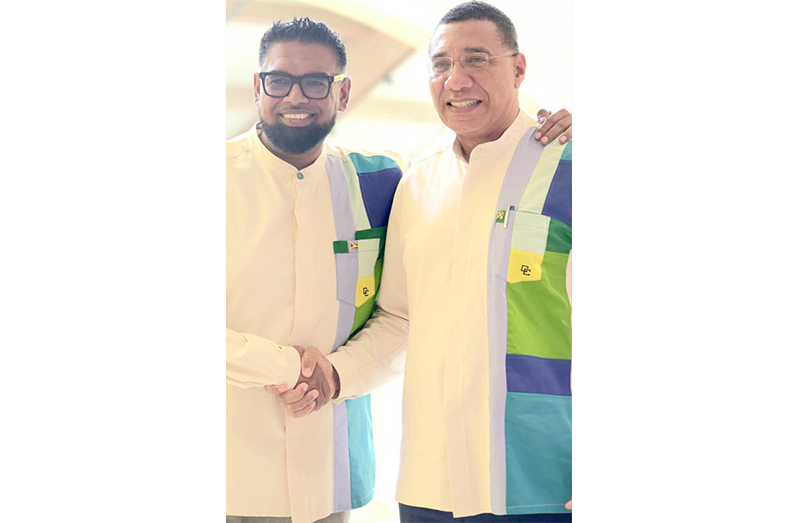
–PM Holness thanks President Ali for hurricane support
TAKING a decisive step in further bolstering economic and security co-operation, President, Dr Irfaan Ali and Prime Minister of Jamaica Dr Andrew Holness on Thursday held bilateral discussions.
President Ali, in a post on his Facebook page disclosed that the talks centred on continued co-operation in energy, agriculture, investment, technology transfer, regional security and infrastructural development.
“President Ali reiterated Guyana’s continued support for the people of Jamaica following Hurricane Melissa and committed to strengthening the historical partnership between the two countries,” the post further read.
Additionally, Prime Minister Holness also lauded the discussions on further co-operation in the several areas, writing in a post on his Facebook page: “I am confident that these discussions will yield tangible outcomes for both our peoples.”
He said that these discussions were aimed at deepening co-operation and expanding opportunities for mutual growth and development.
Jamaica and Guyana share a longstanding historical relationship, grounded in Caribbean “solidarity, shared democratic values, and a common commitment to regional progress,” Dr Holness highlighted.
“Today’s [Thursday’s] engagement reaffirmed our shared vision to build on that legacy by exploring new avenues for collaboration in trade, investment, energy, technology and infrastructure development,” he wrote.
He also stated that as the Caribbean region navigates a rapidly changing global environment, “partnerships such as with Guyana [are] essential to strengthening resilience and unlocking greater prosperity for our respective peoples.”
The 50th Regular Meeting of the Conference of Heads of Government of the Caribbean Community (CARICOM) opened on Tuesday in St. Kitts and Nevis.
Guyana’s rapidly expanding energy and agricultural sectors present new opportunities for further collaboration, particularly in strengthening CARICOM’s agenda in reducing the regional food-import bill and building capacity in food production.
The Government of Jamaica has repeatedly identified food security as a national priority.
The discussions surrounding the expansion of investment, improving technology transfer, and enhancing co-operation in regional security are critical amidst the growing regional confrontation of transnational crime and emerging geopolitical pressures.
On the sidelines of the ongoing CARICOM meeting in St. Kitts and Nevis, President Ali had noted that over the past few years, Guyana has engaged in “expressive amounts of bilateral revolution in social security” and emphasised ongoing efforts to coordinate on security challenges in the region.
He said the goal is to ensure better coordination among countries in addressing regional security issues.
The Jamaican Prime Minister also used the opportunity to express, on behalf of the Government and people of Jamaica, their sincere gratitude for the support Guyana extended to [Jamaica] following Hurricane Melissa.
“The deployment of Guyanese military personnel to assist with rebuilding efforts in St. Elizabeth and Westmoreland stands as a powerful demonstration of Caribbean unity in action,” the Jamaican Prime Minister wrote.
Guyana was among several countries in the regional bloc that responded immediately, sending supplies in several tranches and even deploying ranks from the Guyana Defence Force’s 4 Engineer Battalion.
Later in November last year, CARICOM Heads of Government from Antigua and Barbuda, Barbados, Grenada, and Guyana; CARICOM Secretary-General Dr Carla Barnett and leaders from other regional institutions visited Jamaica.
President Ali was on the ground in the hardest-hit areas of Jamaica, where he committed to the rebuilding of 200 roofs in communities affected by Hurricane Melissa. Guyana agreed to provide both manpower and materials to accelerate reconstruction.
Guyana’s deployment of the GDF forms part of its longstanding commitment to regional co-operation under the framework of the CARICOM. Over the years, Guyana has consistently provided humanitarian and technical assistance to sister CARICOM states during periods of natural disasters and national emergencies, a policy strongly championed by President Ali.