






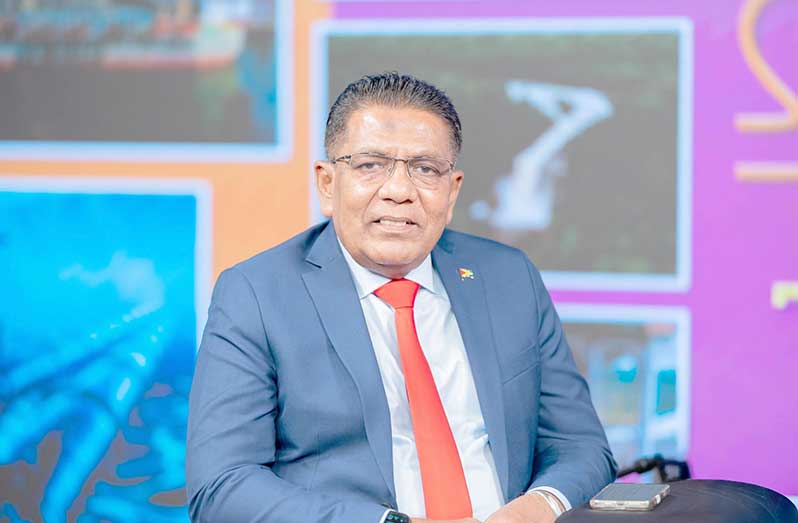
TARGETED investments and ownership-based programmes are reshaping agriculture into a viable and profitable career path for Guyana’s youth and women.
This is according to Agriculture Minister Zulfikar Mustapha, who has outlined what he describes as a deliberate shift in Guyana’s agricultural landscape, as government policies move to position young people and women at the forefront of a rapidly modernising sector.
Speaking on a recently aired “Starting Point” podcast , the minister reflected on what he described as a stark contrast between the years prior to 2020 and the present.
He noted that, in the past, few young people pursued degrees in agronomy at the University of Guyana, and even those who graduated from the Guyana School of Agriculture often found themselves in clerical roles rather than working directly in the field.
According to Mustapha, this trend prompted a deliberate policy shift. He said President Irfaan Ali had urged that greater attention be paid to engaging young people in agriculture, leading to the creation of the Agricultural Innovation and Entrepreneurship Programme (AIEP).
“We formed the company, the Agricultural Innovation and Entrepreneurship Programme (AIEP) . We have over 300 young people now who are shareholders in that company. They have had these shade houses across the country, and they are now owners, shareholders in that company. At the end of the year, we received dividends from the profit,” he said adding:
“But besides that, those persons who would have studied in the Guyana School of Agriculture, the University of Guyana, are making a living now in agriculture. They are now doing their own business in the agriculture sector. So that shows a transformation.”
He further explained that all new agricultural projects are required to allocate at least 35 per cent participation to young people and women.
This policy, he said, is aimed at reshaping attitudes towards agriculture, which has traditionally been viewed as physically demanding and menial work. Through greater education and investment in technology, the ministry is seeking to demonstrate that modern agriculture offers sustainable and profitable career paths.
“We build almost thousands of shade houses across this country, but young people don’t want to work, do the hard, physical labour. That is why we are modernising the sector,” he said, adding:
“We have these hydroponics facilities across the country. We have the largest hydroponics farm in the Caribbean here in Guyana, at Mon Repo. We have another three in regions two, five, and 10, where young people are managing these farms.”
In the livestock sector, the government has facilitated the construction of 13 tunnel-ventilated poultry pens, each with the capacity to produce 40,000 birds every six weeks. Nine of these are expected to be completed by the first quarter of 2026. The minister said groups of between 30 and 40 young people are involved in each facility, with the government providing financial backing, including support with bank guarantees and capital investment. He emphasised that the young participants will become owners and beneficiaries of the ventures’ profits.
“Each one of them have a capacity of 40,000 boards every six weeks, And hopefully, by the first quarter of 2026, nine will be completed. Imagine you have 30-40, young people for one tunnel, ventilated house, nine of those 30.”
“The point I’m trying to make is that these people now will be owners, and they will earn a lot of money coming out of these ventures. So that is the kind of opportunities we are building for young people,” he added.
Programmes targeting women have also been expanded. Mustapha pointed to the cut-rose project at Mon Repos, which supports women—particularly single mothers—in earning independent incomes. He also referenced the Black Belly sheep initiative, through which ewes and rams have been distributed to young women to help establish a national brand, as well as the Black Giant poultry programme, under which more than 120,000 birds have been distributed to women-led groups across the country.




