






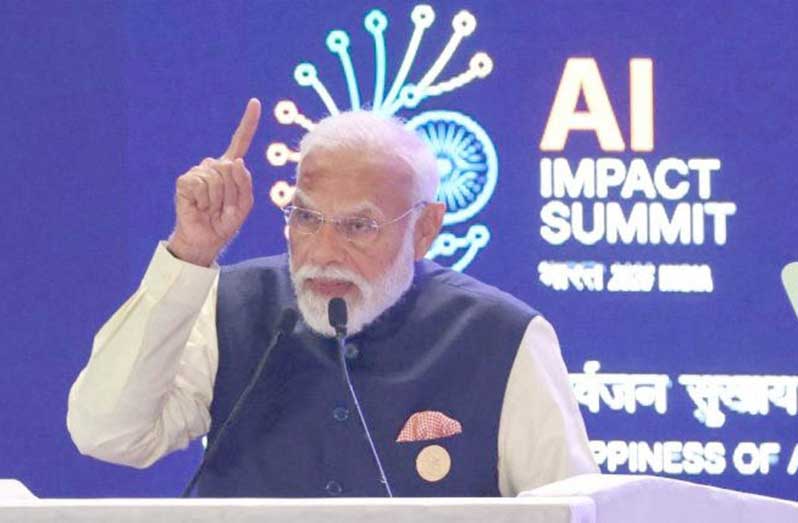
INDIA’S Prime Minister Narendra Modi has urged the international community to shape artificial intelligence around human values, warning that the rapid rise of AI must be guided by ethics, trust and inclusivity to ensure it benefits all of humanity.
Speaking at the AI Impact Summit 2026 in New Delhi, the Indian leader described the gathering as a defining moment in technological history, with representatives from more than 100 countries convening to discuss the future of artificial intelligence and its global impact.
According to Modi, artificial intelligence represents a technological shift comparable to fire, electricity and the internet, but with the power to transform societies at unprecedented speed.
He stressed that AI should function as a “force multiplier for human intent,” arguing that innovation must remain human-centric rather than machine-centric.
“For technology to truly succeed, it must serve people, not the other way around,” he said, emphasising a philosophy rooted in the principle of welfare and happiness for all.
The Prime Minister highlighted India’s expanding role in global digital innovation, noting that the summit showcased cutting-edge AI products while drawing strong participation from youth and innovators.
He described the event as evidence that a mass movement for AI adoption and innovation is underway, driven largely by young people exploring new possibilities.
Modi pointed to several domestic examples demonstrating AI’s practical benefits. One initiative, an AI-powered digital assistant developed by dairy co-operative AMUL, is providing real-time guidance to millions of farmers, many of them women, on cattle health and productivity in their own languages. Another platform, Bharat VISTAAR, delivers multilingual information on weather patterns, crop management and market prices, helping farmers make informed decisions.
Central to India’s proposal was the introduction of the MANAV framework – a governance model intended to anchor AI development in ethical standards. The framework calls for moral and ethical systems; accountable governance; respect for national data sovereignty; inclusive access and legal legitimacy in AI deployment.
Modi also raised concerns about emerging risks linked to generative AI, including deepfakes and disinformation.
He proposed global co-operation on authentication standards, suggesting digital content should carry verification labels similar to nutrition labels on food products. India, he noted, has already moved towards mandatory labelling of synthetically generated content.
The Prime Minister emphasised that AI must evolve as a global public good rather than a guarded strategic asset. Open platforms, he said, would allow young innovators worldwide to contribute to safer and more inclusive technological development.
He further outlined efforts to strengthen India’s AI ecosystem through infrastructural investment under the India AI Mission, including deployment of thousands of graphics-processing units (GPUs), expanded data infrastructure and a national AI repository aimed at democratising access to datasets and computing power for startups and researchers.
Highlighting India’s large youth population and growing technology talent pool, Modi predicted that AI would create entirely new professions, much as the internet reshaped global employment decades ago. He stressed the importance of skilling, reskilling and life-long learning programmes to prepare workers for the evolving digital economy.
Concluding his address, Modi invited global partners to collaborate with India in advancing inclusive innovation, declaring that solutions developed in India’s diverse and democratic environment could serve humanity worldwide.
“Design and develop in India,” he said, “and deliver to the world — deliver to humanity.”




