





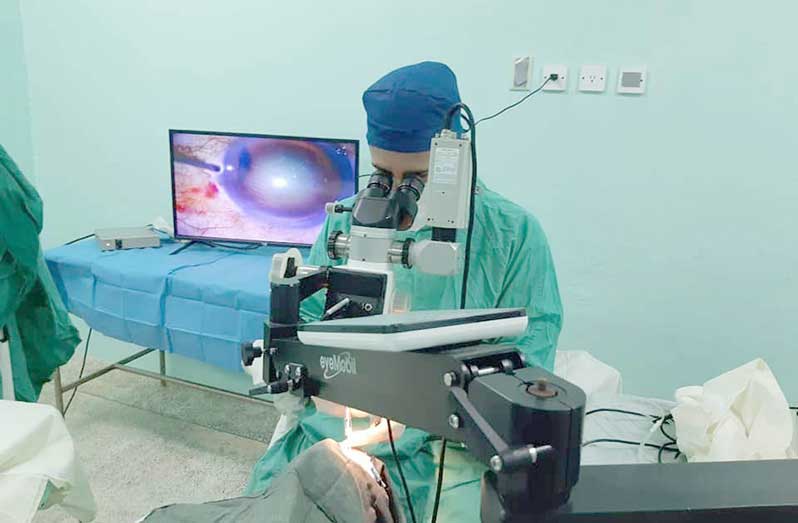
THE National Ophthalmology Centre in Port Mourant is now fully operational, eliminating the national backlog of cataract cases and delivering thousands of eye care procedures to patients across the country.
Speaking in Parliament during the 2026 Budget debate, Deputy Speaker of the National Assembly and Director General of the Ministry of Health, Dr Vishwa Mahadeo, highlighted the achievements of the Centre following major government investments and rehabilitation efforts.
“We all know what the history of the National Ophthalmology Hospital is, it is located in Port Mourant and was built under the watch of President Bharrat Jagdeo, it functioned excellently until 2015. And between 2015 and 2020, there have been zero cataract surgeries done,” Dr Mahadeo said.
He explained the scope of government investment to restore and modernise the facility, “When we took over back in 2020, in the early part of 2021, the Government of Guyana spent over $100 million, in fact, over $25 million to fix the infrastructure alone, and another $100 million to buy equipment, new equipment, so that we can get going again.”
Dr Mahadeo further reported on the centre’s recent performance, including screening, transportation, and surgery for patients from across the country, “And currently, Mr Speaker, we have a Guyanese heading the National Ophthalmology Centre, Dr Saif Alli. Cataract surgeries done for the last year, 228, pterygium surgeries, 312 ; intravitreal injections, 205; cataract-laser surgeries; 275, diabetic retinopathy and retinal laser surgery, 219, a total of 1,736 procedures.”
The cost of these procedures privately would total approximately $246,580,000, funds which patients and families are able to retain for other personal and household needs, the Director General said.
The National Ophthalmology Centre was commissioned in July 2009 as part of a Guyana–Cuba collaboration programme, and was one of five diagnostic and specialised care centres built across the country. It provides specialised services in cataract, glaucoma, and retinal procedures, serving as a key referral point for patients nationwide and contributing to the development of local ophthalmology expertise. The facility continues to operate at full capacity following its rehabilitation and remains central to the government’s mission of equitable access to high-quality eye care.





