-eyes Middle East financing to power food transformation, enhance productive capacity
PRESIDENT, Dr Irfaan Ali says Guyana is deliberately partnering with top global firms and is courting Middle Eastern investors to accelerate development of a modern, export-ready food ecosystem.
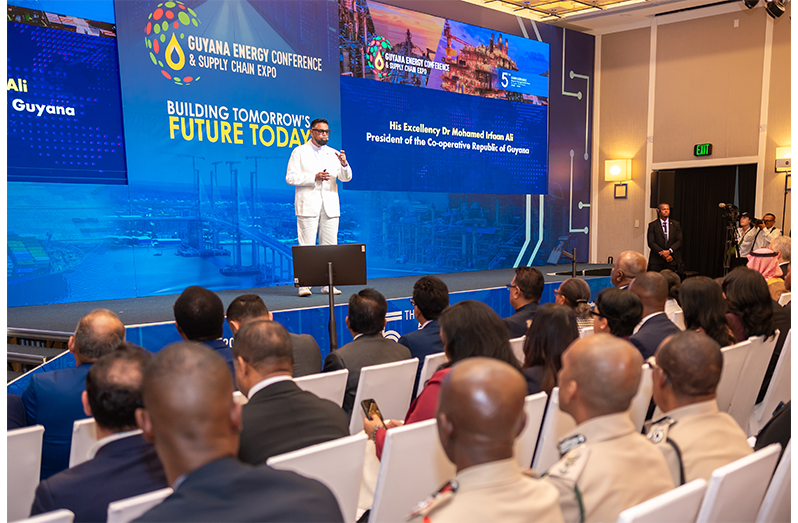
Speaking last week at the opening of the 2026 Energy Conference and Supply Chain Expo, the Head of State noted that the country is leveraging its rapidly expanding oil and gas sector to build resilient food-production systems.
He highlighted the country’s partnership with Blumberg Grain and Logistics, the United States U.S.-based agricultural company to strengthen Guyana’s position as a regional food hub and to boost export capacity.
“How do we build this? The question is no longer how we will build it; it is that we are building it. We have partnered with the best: Blumberg Grains,” he said, adding:
“And why did we partner with Blumberg Grains? Yes, these things are not cheap, they are costly. But if we want to create an ecosystem that is ready for the world in relation to the standards that are needed for our products to get out there, then we have to embrace the best in class.”
The aim is to ensure that Guyana positions itself to access the best markets, technology and resources to maintain relevance and sustainability on the global stage.
“That is why we are partnering with the best who have done this, done it well, and they will help us to get ours completed on time, and done in accordance with the standards that are required,” President Ali asserted.
Through strategic investments in agriculture, Guyana has been positioning itself as the Caribbean’s and by extension Latin America’s food basket, boasting self-sufficiency in food production.
The government has been pursuing more climate-resilient practices, adopting new technologies and expanding production, introducing new crops into its food ecosystem such as corn, soya bean and more high-value crops.
“We see food as a responsibility for us. Because of our richness in fresh water and arable lands, we now see food as a responsibility for Guyana. That is, we have a responsibility to produce quality food at good prices for this region and we are starting that process by integrating our food ecosystem with that of Northern Brazil, transfer the technology; build our local productive capacity; build the processing industry and be the major player in food production for this region and beyond,” he explained.
MIDDLE EAST
Dr Ali pointed to the Middle East as a key partner that could help the country achieve its food goals.
“And that is why the Middle East is also important, because if we lock in financing from the Middle East for this project, then they have a stake in our development, then they have a stake in ensuring that what we are doing is successful and they have a huge market also,” he said.
He stressed that strengthening partnerships with established global players will enhance the country’s success rate and fortify diplomatic relationships among partners that share mutual, sustainable goals.
To this end, the President noted that the government has been deliberate in pursuing collaborations that boost the country’s economic standing, whether it’s in oil and gas or agriculture.
“We are strategic in this outlook because we want as many partners as possible to have a stake in our development, because if we have many partners having a stake in our development, then they all have a responsibility to ensure that their stake is successful and it enhances our success rate and create the environment for us to be successful,” he said.
ECONOMIC DIVERSIFICATION
Even as Guyana’s oil boom continues to gain momentum, President Ali reminded that the government has remained steadfast in its efforts to ensure that traditional sectors continue to expand equally.
And in pursuing a diverse portfolio of projects in health, education, environmental services and ecotourism, the country will build an economy that is resilient and capable of maintaining sustainability in the future.
“The third aspect of leveraging our rapidly expanding oil and gas sector is to propel economic diversification and this is important. I did not say financial diversification; I said economic diversification, because economic diversification is different. It brings with it investment for social services. It brings with it investment in infrastructure, investment in enhancing our competitiveness, investment in marketing, and actually investment in diversification of our economy and you are seeing this.”
He added: “We are building an economy, as you have seen, to position Guyana as a leader in educational services; health services; environmental services; climate services; ecotourism; food manufacturing and industrial development, all at the same time while ensuring that our energy works to our advantage.”