






— Over 37MW of clean energy installed as government diversifies supply mix, modernises grid infrastructure
GUYANA is steadily decentralising and expanding power delivery through a range of energy projects, with more than 37 megawatts of renewable energy now installed across several communities.
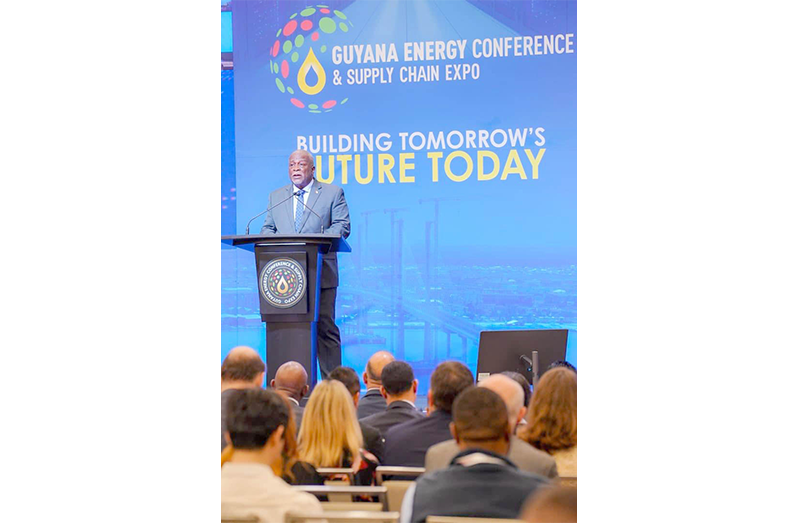
This is according to Prime Minister Brigadier Ret’d Mark Phillips, who, while addressing the 2026 Guyana Energy conference and Supply Chain Expo earlier this week, said diversifying the country’s energy supply remains central to the government’s transition agenda, as the country continues to expand renewable generation and modernise its power infrastructure.
He explained that the energy transition rests on three pillars: expanding renewable and clean energy, upgrading transmission and distribution systems, and building resilience against climate change.
While oil and gas remain important, he noted that Guyana possesses significant, untapped potential in hydropower, solar, wind and biomass and is actively pursuing investment in green innovation to reduce reliance on imported fuels and lower electricity costs for households and businesses.
“Government has been pursuing a clean and just energy transition and developing a diverse energy-supply mix of natural gas and renewable energy, resulting in over 500 MW of newly installed capacity,” he said.
While oil and gas continue to play a central role in the economy, he noted that Guyana possesses significant, untapped potential in hydropower, solar, wind and biomass, which the administration is actively seeking to harness through investment in “green” innovation.
He explained that the move towards a cleaner and more diverse energy mix is aimed at reducing dependence on imported fuels and lowering electricity costs for households and businesses.
“The development of clean and reliable energy also presents socio-economic advantages. Lower energy costs can stimulate industrial growth, support small businesses and improve competitiveness. Access to reliable electricity can transform education, healthcare and daily life, particularly in rural and hinterland communities,” he added.
Since August 2020, more than 186 megawatts of new generating capacity have been added to the Guyana Power and Light (GPL) integrated system, contributing to over 500 megawatts of newly installed capacity from a mix of natural gas and renewable sources.
Upgrades to the national grid are under way, alongside the rollout of solar farms at Onderneeming, Charity, Leguan, Wakenaam, Trafalgar, Prospect, Hampshire, Bartica, Mahdia and Lethem. Mini-hydropower plants at Moco-Moco, Kumu and Kato have also been completed, 46 solar mini-grids installed and more than 37,000 solar home systems distributed, resulting in over 37 megawatts of renewable energy now powering communities.
CARBON TRANSPORTATION/ PUBLIC AWARENESS
He announced efforts to promote low-carbon transportation, with 23 electric vehicle charging stations set to be installed nationwide to support the emerging domestic electric vehicle industry. Energy efficiency and conservation measures are also being advanced through public-education campaigns, appliance energy-labelling standards and equipment-replacement initiatives.
Under the Caribbean Efficient and Green Energy Buildings Project, more than 250 public buildings are targeted for retrofitting and distributed solar photovoltaic systems.
“Energy access must be equitable. It must reach our coastal regions and our hinterland villages. It must support both urban development and rural livelihoods. Through solar initiatives and decentralised energy systems, we are working to bring electricity to communities that have long relied on traditional and less efficient sources,” the Prime Minister added.
He further highlighted Guyana’s environmental stewardship, noting the country’s record of maintaining one of the lowest global deforestation rates. Through the Low Carbon Development Strategy (LCDS) 2030, Guyana has pioneered jurisdictional carbon credits under the ART-TREES standard, secured a US$750 million forest-carbon credit agreement, and ensured that at least 15 per cent of revenues flow directly to Indigenous and hinterland communities.
“Environmental stewardship has always been central to Guyana’s national identity. We are proud of our track record in maintaining one of the lowest deforestation rates in the world,” he said, adding:
“Clean and renewable energy development is more than just technology and infrastructure. It is about the people of our nation and ensuring equity and opportunity, so that every citizen benefits from the energy transition and adverse impacts are minimised.
He reiterated that the government would continue creating opportunities through “green” education and training in renewable energy and energy-efficiency technologies, equipping a new workforce to lead the charge in innovation.
This year’s energy conference was held under the theme: ‘Building tomorrow’s future, today.’




