





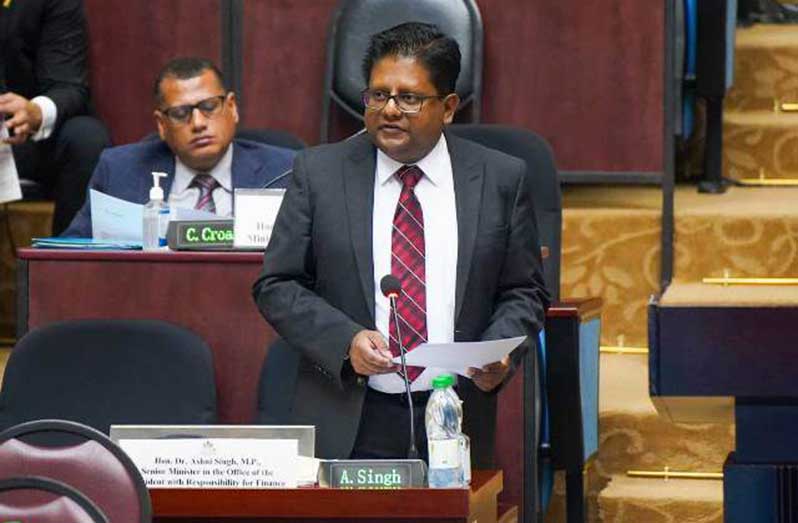
THE government has secured parliamentary approval for $18.8 billion in advances from the Contingency Fund, with the resources having already been deployed in the latter part of 2025 to fast-track developmental works and key social initiatives across Guyana.
Senior Minister in the Office of the President with Responsibility for Finance, Dr Ashni Singh, received the National Assembly’s approval for Financial Paper Number 2 of 2025, which covers expenditures directed towards infrastructural expansion, social-support programmes and regional interventions countrywide.
The approval signals the administration’s continued push to translate its development agenda into immediate on-the-ground delivery, particularly following the renewed mandate secured at the September 1, 2025 General and Regional Elections.
In outlining the broader policy direction, President, Dr Irfaan Ali had emphasised that the government’s vision for the next five years is rooted in execution and tangible results.
According to a release from the Ministry of Finance, the President underscored that “vision without action is only words,” noting that the administration was moving “with urgency and resolve, turning plans into projects, promises into performance and hope into reality-delivering tangible results to the Guyanese people now, for the next five years, and beyond.”
It is within this framework that the $18.8 billion in contingency financing was utilised to sustain momentum on priority works across multiple sectors, ensuring that critical projects were not delayed pending the new fiscal cycle.
A substantial $10.5 billion was allocated under the Ministry of Public Works to support an expanded infrastructural programme. These works included highway improvements along the East Coast of Demerara; miscellaneous road and drainage upgrades; hinterland road development; sea and river defence interventions, as well as works on stellings and government buildings.
The scale of the allocation underscores government’s continued focus on strengthening transport connectivity, climate resilience and public infrastructure as pillars of economic expansion and regional integration.
On the social front, the Financial Paper provided $5.4 billion under the Ministry of Human Services and Social Security for Old Age Pensions, alongside $1.4 billion to bolster Public Assistance payments, reinforcing the administration’s emphasis on safeguarding vulnerable groups while growth accelerates.
In the education sector, $1.4 billion was allocated to facilitate an expanded work programme, specifically to support dietary provisions within primary education, a measure aimed at enhancing student welfare and learning outcomes.
The housing and water sector also benefitted, with $640 million channelled under the Ministry of Housing to advance hinterland water-supply initiatives, expand water services and improve water-management systems in underserved communities.
Additionally, $548.8 million was directed to support expanded work programmes across Regions One, Two, Five, Seven, Eight and Nine, primarily in the areas of health and education, while also covering operational activities such as national and regional events, local travel and subsistence, and sanitation and extermination services.
The distribution of the funds reflects a deliberate effort to ensure balanced development across both coastal and hinterland regions, aligning with government’s stated objective of inclusive growth and equitable service delivery.
The approval of the Financial Paper comes as the administration presses ahead with its wider transformational agenda, anchored by the recently passed $1.558 trillion Budget 2026 – a 12.7 per cent increase over the previous year and fully financed without new taxes.
Dr Singh, in his budget presentation, framed the fiscal programme within the context of Guyana’s approaching 60th independence anniversary, noting that the country now stands “globally respected, politically mature and economically strong.”
The contingency-financing approval, therefore, represents not merely retrospective authorisation of spending, but a continuation of the government’s strategy to maintain project continuity, accelerate implementation timelines and ensure that developmental gains are sustained across all regions as Guyana advances into a new phase of rapid transformation





