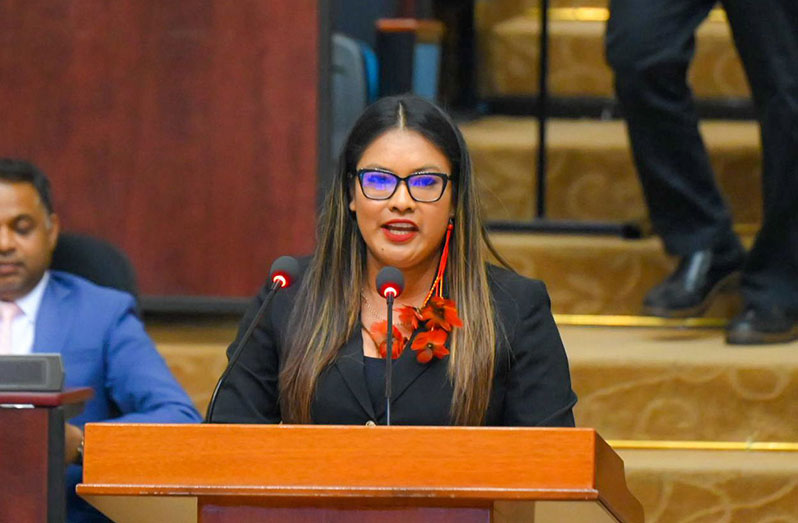
—reaffirms land titling, village economies central to PPP/C’s Indigenous agenda
BY Bebi Shafeah Oosman
MINISTER of Amerindian Affairs, Sarah Browne, has highlighted the tangible benefits Indigenous and hinterland communities are receiving under Guyana’s Low Carbon Development Strategy (LCDS), pointing to the direct transfer of carbon credit revenues to villages as clear evidence of a people-first approach by the PPP/C Government during her debate of the 2026 budget.
According to the Minister, in 2023, 15 per cent of revenues earned from the sale of carbon credits were transferred directly to Indigenous and hinterland villages.
This increased to 26.5 per cent in 2024 and stood at 21 per cent in 2025, ensuring that villages consistently received no less than their guaranteed share.
“That is putting people first,” Minister Browne told the National Assembly.
She outlined several community-led projects already delivering results across the country. In the Mabaruma Sub-District, Region One, the Banabo Guest House, funded through the LCDS, now provides employment and essential services.
In the remote village of Kamana, the Kamana Mini Mart supports local commerce, while the Kaikan Women’s Group in Region Seven currently employs 29 women.
Further, she said, in Region Two, the Mainstay Tourism Project features two self-contained cabins that are fully booked every weekend, and in Karasabai, Region Nine, two self-contained cabins, funded under the LCDS and implemented by the village, are generating employment and income.
Minister Browne stressed that these projects represent only “the tip of the iceberg.” Funds have also been disbursed to villages for initiatives in agriculture, infrastructure, transportation, women and youth development, livelihoods, social welfare, and the preservation of culture and heritage.
She reaffirmed the government’s commitment to ensuring that LCDS resources continue to support sustainable livelihoods, strengthen climate resilience, promote village-led development, and protect the environment for future generations.
This commitment, she noted, was reinforced in Budget 2026, where Senior Minister Dr. Ashni Singh confirmed that villages will continue to receive, at a minimum, 15 per cent of revenues earned from carbon credits to implement their Village Sustainable Development Plans.
Land tenure, Minister Browne emphasised, remains a top priority for Indigenous peoples and the government. She underscored the importance of land to sustenance, environmental protection, identity, and culture, noting that Guyana is among the few countries with legislation that guarantees legal ownership of land by Indigenous peoples.
She reminded the House that the Amerindian Land Titling Project was initiated under a PPP/C administration and supported through the LCDS, but remained dormant for five years.
Since the government’s return to office, the programme has been revitalised, with 15 villages demarcated and 17 villages receiving certificates of title. Over the past five years, an estimated 16,174 Amerindians have secured legal ownership of their lands. In 2025 alone, seven villages received certificates granting absolute ownership of their traditionally occupied lands.
To further advance land security, Minister Browne noted that $400 million has been allocated to expand Amerindian land titling, safeguarding and strengthening tenure within the framework of national legislation.
She also stressed that land tenure must be accompanied by strong village economies. Over the past five years, the government has invested more than $16.7 billion in village-led projects through presidential grants, capital grants, and the Amerindian Development Fund.
These investments have reached 253 villages, satellite communities, and Community Development Councils, improving the lives of approximately 107,000 residents.
Budget 2026, the Minister said, continues this focus through expanded support under the Amerindian Development Fund.
Presidential grants have increased by 125 per cent, amounting to more than $2 billion in investments over the last five years. Additionally, $5 billion has been allocated for economic projects targeting women and youth, including sawmilling, tourism initiatives, agro-processing facilities, shade houses, printeries, bakeries, cosmetology centres, and heritage sites.
Minister Browne, in her fiery presentation, concluded by emphasising that youth development remains central to the government’s vision, noting that sustainable village economies can only be realised through skilled and empowered young people whose capacities continue to be built.