






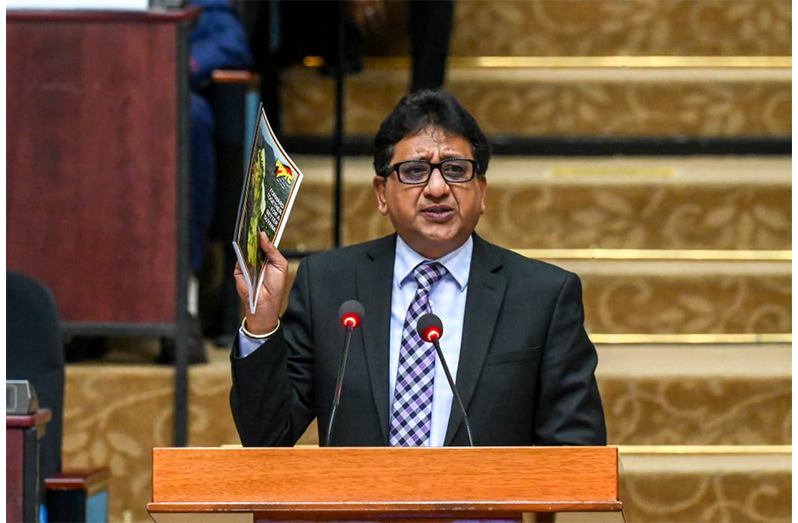
–AG Nandlall highlights 2026 comprehensive legislative agenda
–emphasises legal sector being strengthened with courts, modern systems, regional law school
DECADES-LONG gaps within Guyana’s legal sector are closing, as Attorney General and Minister of Legal Affairs, Anil Nandlall, SC, pointed to the series of landmark legal and institutional initiatives on the cards, including the establishment of new courts, the revision and updating of the law reports and the construction of the long-awaited regional law school.
During the last day of the budget debate, the Attorney General rebutted the common criticisms that emanated from the opposition.
Nandlall first highlighted the ruling People’s Progressive Party/Civic’s (PPP/C’s) track record and reminded the House that the party has been presenting budgets since 1993, underscoring the “winning formula” of engaging the citizens and implementing policies and programmes that will benefit them.
Focusing on his sector, Nandlall stated that a comprehensive revision of its laws is ongoing.
During the current review process, the laws spanning the period 2012 to 2022 are being updated to reflect the country’s many legislative changes.
Additionally, he stated that significant progress is being made on the establishment of Guyana’s first law school.
Back in September, President, Dr Irfaan Ali disclosed that the CLE had granted Guyana approval to establish its own law school.
At the time, he had noted that with the approval granted, work would commence immediately on the establishment of the school, thus enabling hundreds of persons to qualify as attorneys-at-law right here in Guyana with full rights to practise in the Caribbean.
For decades, Guyanese law graduates were required to pursue their Legal Education Certificates (LEC) at CLE law schools in Trinidad and Tobago, Jamaica, and other Caribbean territories.
The law school is expected to strengthen Guyana’s legal infrastructure, broaden professional opportunities, and provide affordable access to high-quality training for future lawyers.
Nandlall said: “So far, we have already cleared, identified and cleared eight acres of land at Campus Turkeyen of UG and in this budget, we have the first capital injection and during the year 2026 we will begin the construction of a law school in Guyana. It is going to be a regional law school. It will attract students from across the Caribbean, and of course, it will provide cheap and accessible legal education to our own guided.
“This is not only an academic institution, but it is also an economic venture, because people of the Caribbean will come here. They will have to live, they will have to find accommodation, they will have to board, lodge and eat and Guyanese will benefit from those investments.”
Further, he provided updates on key international legal matters.
According to the Attorney General, the hearings on the merit of the International Court of Justice in the arbitral award matter between Guyana and Venezuela will open on May 4, 2026, with a detailed schedule forthcoming.
He also pointed to the construction of courts nationwide and stated that more will be built this year.
Nandlall further noted that investments in the judiciary have ensured it has the personnel as well as the institutional capability, technological capability, to manage their caseload.
He emphasised: “I am pleased to announce that at almost every level of the judiciary except the magistrate’s court, for the time being, the High Court, the Full Court, the Court of Appeal and the CCJ, the entire litigation process is now electronic and paperless, and we are working to bring that to the magistrate’s court as well.”
Speaking on this year’s legislative agenda, the Attorney General said a slew of bills will be brought to the National Assembly this year.
The robust legislative agenda for this year includes over 45 bills.
These include: Fiscal Enactments Bill; Development Bank Fund Bill; Guyana Natural Gas Bill; Companies Bill; Evidence Bill; Depreciating Assets Sale Bill; Trust Bill; Rehabilitation of Offenders Bill; Judge Alone Trial Bill; Alternative Sentencing Bill; Business Names Registration Bill; Food Safety (Amendment) Bill; National Heritage Preservation Bill; High Court (Amendment) Bill; Immigration (Amendment) Bill; Virtual Assets Bill; Motor Vehicles and Road Traffic (Emergency Lights and Sirens) Regulations; National Heritage Preservation Bill; Security Interests in Movable Property (Amendment and Validation) Bill and Medical Practitioners (Amendment) Bill.
The Guyana Defence Force Training Institute Bill; Marriage (Amendment) Bill; Hire Purchase (Amendment) Bill; Integrity Commission (Amendment) Bill; Motor Vehicle (Speed Limiting Device) Regulations; Human Organ and Tissue Transplant Regulations; International Recovery of Child Support and Other Forms of Family Maintenance (Hague Convention) Bill; International Child Abduction Bill; Border Patrol Bill; Summary Jurisdiction (Offences) (Amendment) Bill and Food Security Bill are also on the cards.
Others include the Electricity Sector Reform (Amendment) Bill; Sexual Offences (Amendment) Bill; Protection from Harassment Bill; Social Workers Bill; Firearms Control Bill; Prisons Bill; Food Safety (Amendment) Bill; Pesticides and Toxic Chemicals (Amendment) Bill; Plant Protection Regulations; Rice Farmers (Security of Tenure) (Amendment) Regulations; Telehealth Bill; Medicines Regulation Bill; Ambulance Services Bill; Solid Waste Management Bill and Port Authorities Bill.




