






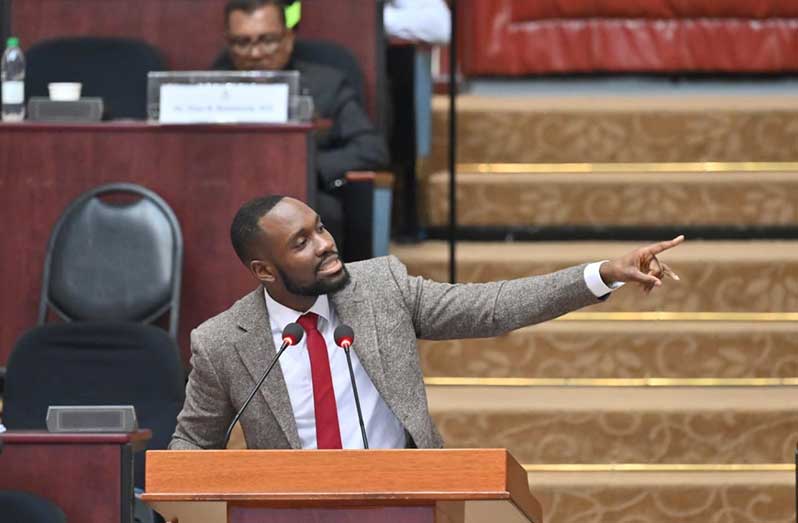
– Labour Minister outlines people-first approach to development
MINISTER of Labour and Manpower Planning, Keoma Griffith, on Wednesday, highlighted Budget 2026 as a people-centred blueprint designed to ensure that the country’s growth turns into tangible benefits for workers and communities across the country.
The minister made this known while making his contribution to the national budget debates, during which he said that the theme of “Putting People First” reflects more than political messaging but captures the core principles guiding the government’s labour and social policies.
“The theme of this year’s budget, putting people first, is not merely a rhetorical slogan… It embodies the guiding principles of our administration and the very foundation upon which the People’s Progressive Party government has structured its economic and social policies,” he said.
It was then that he said that the government’s approach recognises that growth must be inclusive, noting that development should be measured by improvements in employment, access to public services, and support for vulnerable groups.
As such, Griffith added that budget 2026 serves as a roadmap for development rooted in people-focused outcomes rather than abstract economic indicators.
Against this backdrop, the minister sought to reflect on the government’s record on job creation, to which he told the house that more than 104,000 sustainable jobs were created between 2020 and 2025, significantly surpassing the administration’s manifesto promise of 50,000 jobs.
“These are not just numbers… These are real people, real jobs in construction, mining, quarrying, transportation, agriculture, health, education, and the emerging service industries.”
Griffith added that these employment gains were supported by sustained public investment, private sector confidence, and a labour policy framework aimed at ensuring decent work, skills relevance, and workforce adaptability.
Meanwhile, the minister turned to skills training and workforce development, to which he said the government has adopted a robust and inclusive approach to skills development through the Board of Industrial Training (BIT), which has trained more than 16,300 persons across all regions between 2020 and 2025.
These efforts, he notes, also ensure inclusion, particularly for women and persons living with disabilities.
To this end, Griffith added that 615 women have been trained in traditionally male-dominated fields such as welding, heavy-duty equipment operation, and electrical installation. He also noted that over 400 persons with disabilities have benefited from training opportunities over the last five years.
“Over the last five years, more than 400 persons living with disabilities in this country have benefited from the programmes and skills through the work of the Board of Industrial Training,” Griffith said, adding that further support is planned for 2026.
Meanwhile, the minister then pointed to manpower planning as a key pillar of the government’s employment strategy, noting that labour planning has played a role in major national development projects.
Further to this, Griffith said the ministry has also strengthened labour market matching through the National Job Bank, and by 2025, more than 11,000 job seekers were registered on the platform, with hundreds successfully placed in employment, many of them young people.
However, the labour minister said the government has worked to rebuild labour institutions and restore dignity to working people.
“This is what putting people first is all about,” Griffith said.
“This is what it looks like beyond the opposition’s rhetoric and beyond their empty promises,” he added.




