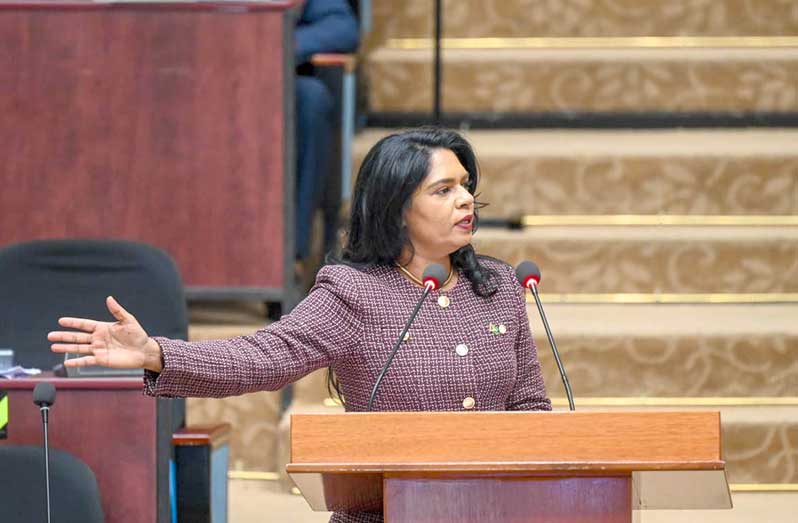
–Parag defends massive gains in education sector, lambastes WIN MP for criticising GOAL programme which he benefited from
MOUNTING a fiery rebuttal to opposition parliamentarians in defence of the investments and policies outlined in Budget 2026 for the education sector, Subject Minister Sonia Parag, on Monday, said the People’s Progressive Party/Civic (PPP/C) has delivered massive gains and will deepen them under the guidance of its people centred agenda.
Parag declared that the budget was “drafted for the people, written by the people, and grounded firmly in the realities, hopes and aspirations of the Guyanese people,” as she took direct aim at the We Invest in Nationhood (WIN) parliamentarian, Dr. Gordon Barker, who criticised the Guyana Online Academy of Learning (GOAL) and several other programmes, despite being a beneficiary.
She pointed out that since GOAL’s launch in 2021, more than 4,000 Guyanese had enrolled and about 6,000 had graduated by 2025, including Dr. Barker.
“You never, ever bite the hands that you feed from,” she told the House, accusing the member of using a GOAL-linked degree, then moving on to a PhD, while now attempting to discredit the same programme.
“I’m going to be very straight up. I’m not going to AI it,” she said.
Turning to the National School Feeding Programme, which carries a $7 billion allocation, Parag blasted the opposition’s portrayal of it as wasteful.
She called the initiative “one of the best programmes Guyana has ever seen for the children of this country”, especially for those in hinterland and rural communities who often walk long distances to school.
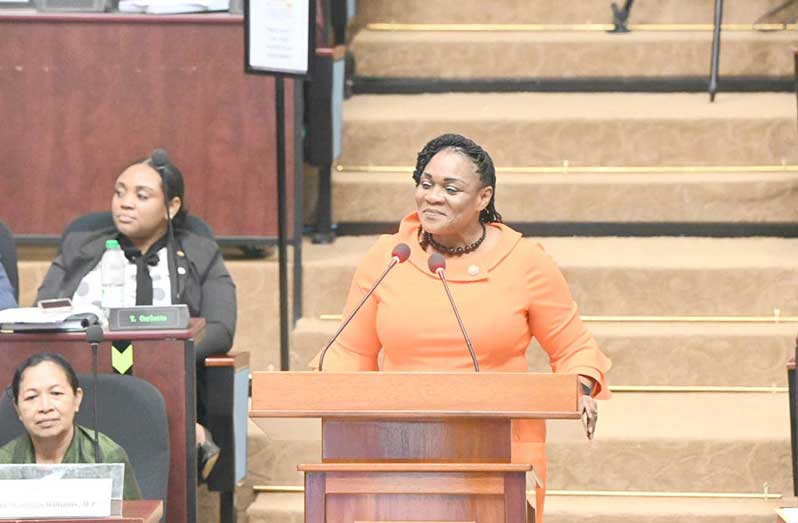
Parag denounced the circulation of unlabelled images of meals on social media as a “deliberate attempt to manufacture outrage” and “mislead the nation”.
“If they are so convinced this is a ‘horrible’ initiative, let them go into the communities and tell the children to their faces they want the $7 billion school feeding allocation removed,” she said.
On promotions and vacancies, Parag firmly reminded the House that the Teaching Service Commission (TSC) is an independent constitutional body, not a political arm of the ministry.
She disclosed that the TSC has already created 1,500 new senior vacancies for 2026, and said the A Partnership for National of Unity, Member of Parliament, Coretta McDonald was “either misinformed or intentionally misleading” when she claimed otherwise.
She underscored that remote, stationed and hardship allowances for hinterland teachers will continue from 2026 onward, and cited a multi-year collective agreement with the Guyana Teachers’ Union setting out salary increases for 2024–2026 as clear proof that the government “listens, negotiates and delivers”.
Contrasting this with the APNU opposition’s tenure from 2015 to 2020, Parag noted the “awful” performance on teacher training and advancement, adding that they had “snatched” the Because We Care cash grant from children without offering any comparable support in return.
Minister Parag acknowledged that some school infrastructure issues exist, including maintenance challenges and isolated defects, but rejected claims of systemic failure or poor construction.
More broadly, Parag said the PPP/C has transformed access to education since 2020, contrasting this with what she described as the Opposition’s “lost years,” during which no secondary schools were built.
She outlined extensive investments across all levels of education, including dozens of new and rehabilitated schools, major expansion in hinterland and Amerindian communities, free university education, expanded scholarships, and increased cash grants and transport support for students.
“Education is poised to continue its progress. We will see the outcomes for our children. We will see the development for our children. We will see the improvements for our teacher, the improvement for our infrastructure, and we will also see, we will also see safer environment in which it will be conducive for them to learn,” Parag said.
Defending the scale and pace of spending, she insisted the government is managing oil revenues responsibly to ensure long-term sustainability, while rolling out initiatives such as the Guyana Digital School, targeted maths interventions, and a national anti-bullying campaign to improve quality, equity and outcomes across the education system.