GUYANA’S hinterland holds a largely untapped wealth of agro-forestry products that could bolster livelihoods, add value for export and help integrate indigenous communities into sustainable supply chains.
Representatives from Wageningen University and Research (WUR) who visited Guyana last week during a business mission, highlighted non‑timber forest products and agro-forestry commodities as prime opportunities for development.
“We tend to forget about the hinterland and the population there. But there also is a photosynthesis of forest and non-timber forest products, and even agro-forestry products, which can produce coffee, cocoa which can produce so many products,” Ria Hulsman, an agronomist and Manager of International Co-operation with Latin America and the Caribbean at WUR, said.
She highlighted to palm fruits, nuts, cocoa and coffee as examples with ready markets in Europe and the wider region.
While noting that the week‑long visit focused largely agro‑processing in and around urban centres, Hulsman emphasised the significant and often overlooked potential of the hinterland.
She recognised the efforts in Guyana to draw Indigenous people into training programmes and suggested a two‑pronged strategy of strengthening market access for forest‑derived products while building capacity at the community level.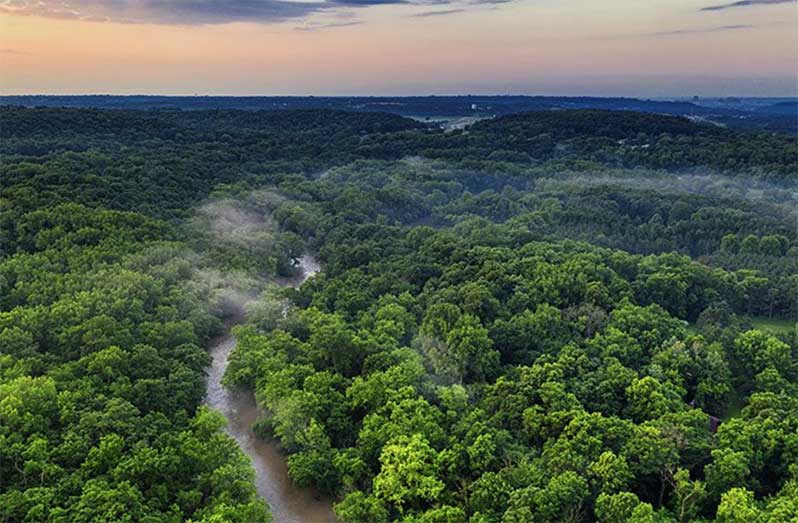
“Opportunities in the hinterland for indigenous groups include non‑timber forest products and agro-forestry products, which you could take out of the forest without damaging anything of the forest,” she said.
“This mission this week has been too short to visit these areas, but I think the potential there is very big,” she said.
EU Ambassador, Luca Pierantoni, outlined the wider vision to “foster more partnership between the European Union and Guyana,” with an emphasis on economic co-operation and business-to-business links between European and Guyanese companies.
According to the ambassador, the initial mission has generated “a lot of interest from both sides.” Three new business missions are planned for 2026, with itineraries now being discussed with EU member states.
“We are talking about partnerships that are mutually beneficial… for Europeans to increase their presence here, and for Guyanese to increase more presence in Europe.”
He described Guyana as a “key partner” in a new phase of co-operation aimed at boosting agro-processing, building youth-friendly farming careers and advancing climate action through joint diplomacy.
Ambassador Pierantoni said Brussels is working to deepen “mutually beneficial” ties that go beyond traditional sectors to focus on investment, trade, and technology transfer.
He explained that the EU is seeking to link European and Guyanese businesses, particularly in priority sectors for Guyana such as agriculture and agro-processing.
The ambassador recalled that a first business mission of Guyanese economic actors including private companies and civil society organisations recently visited the Netherlands, Belgium, France, and Spain, generating strong interest on both sides.
On the back of that mission, the EU is now working with its 27 member states and Guyanese partners, including the Private Sector Commission and GO-Invest, to organise three further business missions in 2026.
These visits are intended to match European firms and institutions with Guyanese counterparts, build joint ventures, and explore how European technology and finance can support Guyana’s ambition to become a regional food production and processing hub.
Meanwhile, responding to questions on why agro-processing was chosen as a focal area, the ambassador explained that the sector is central to Guyana’s own development agenda.
He pointed to President Dr. Irfaan Ali’s vision of Guyana as the “breadbasket” of the region, noting that this will require significant technological upgrades, infrastructure investment and higher standards.