–as Budget 2026 fuels growth, opportunities from corporate-tax exemptions to safer communities
DECLARING that Guyana is positioned as a safe, investable and opportunity-rich nation, President Irfaan Ali has urged Guyanese living abroad to return home, saying Budget 2026 removes long-standing barriers to ownership and offers equal access to investment, tax relief and government co-financing.
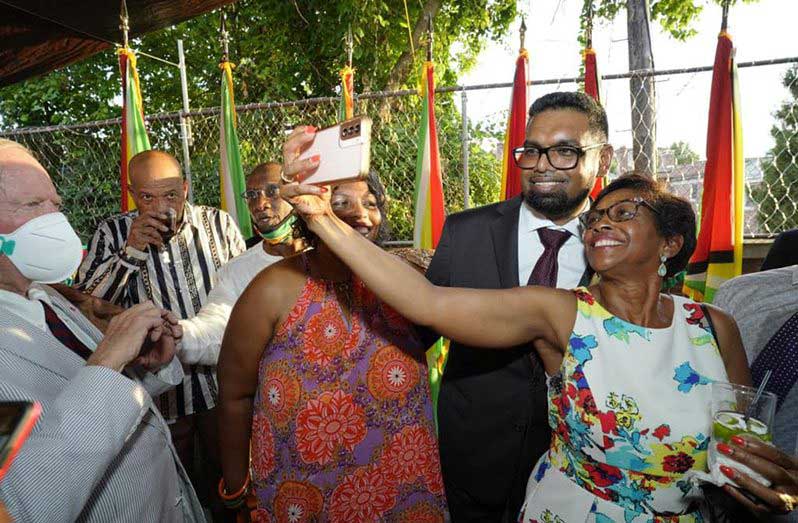
Speaking during a wide-ranging Budget 2026 discussion with an all-women panel, the Head of State said the People’s Progressive Party/Civic (PPP/C) administration’s inclusive development framework is deliberately structured to bring the diaspora into the centre of national economic growth.
“You have many Guyanese over there who have worked all their life, and they have the certification in elderly care. Here’s the opportunity to come here now, the government will even co-invest with you. You have the opportunity now to have tax-free earnings because we’re removing the corporate tax to build out those facilities, care for the elderly, children’s care facility, owning local hospitals, no corporate tax,” the President said.
The President said these incentives extend across priority sectors and form part of a broader strategy to expand local ownership and equity participation, including for Guyanese abroad.
He pointed to emerging investment opportunities in the fertiliser plant, gas-bottling facilities and consortium-based ventures linked to the expansion of local content.
The President went on to say: “And when we increase that list of opportunities that will be added to local content, that’s another opportunity that is ahead of us. So, Guyanese have equity. The diaspora, we’ve always made clear, has equal access and equal opportunity to everything that we’re building out for the local economy; local Guyanese and also persons living in the diaspora,” he said.
Drawing on international examples, President Ali said countries with large diaspora populations have successfully mobilised overseas citizens to finance major national projects and encouraged Guyanese abroad to adopt a similar approach.
“It will have risk, but we have to invest in that risk, and that is where I think a lot of emphasis must be placed,” he said.
RETURN HOME
The President welcomed the diaspora home, pointing to the advancements being made to make Guyana safer and inviting.
Highlighting some of the foundation issues within the diaspora, such as healthcare, education and security, President Ali noted how Guyana has been on an upward trajectory in these areas.
For security, Dr Ali pointed to the major investments made in public security and noted that the country is experiencing a historically low crime rate
“Today, the investment that we’re making in safety and security has really given us tremendous payback. You know, we have our lowest recorded crime. We want to keep it that way. We’re able to detect crime in a predictable way. We’re able to plan in a more strategic way, based on data, hot spots and we were able to apprehend people faster,” he said.
The President also pointed to the deployment of cameras on the roadways, which are already helping tremendously in road safety.
Budget 2026 has earmarked a record $100.3 billion in the security sector in 2026, as the government continues an aggressive, technology-driven push to modernise national-security institutions and strengthen public safety.
In 2025, a total of $94.6 billion was expended across the security sector, reflecting unprecedented investments in infrastructure, equipment, training and digital-surveillance systems.
The 2026 allocation is aimed at building a modern, robust, well-equipped and technology-driven security sector, with major investments directed towards the Guyana Police Force (GPF), Guyana Prison Service (GPS) and Guyana Fire Service (GFS).
The modernisation of the security sector is critical not only for crime prevention and public safety, but also for safeguarding investments, strengthening social stability and supporting Guyana’s long-term national-development agenda.
BETTER HEALTHCARE
Talking about healthcare, President Ali pointed to the building of the six regional hospitals and he further noted that the government is not only building out the infrastructure, but is also investing in healthcare workers.
Talking to the diaspora, he said, while healthcare systems are deteriorating in their current locations, this is not happening in Guyana.
He said: “So they’re coming into the healthcare system and they say this, that is far different from when they left it, and that is more aligning, in some cases, surpassing what they expect or what they’re getting now in their own communities, societies and countries.”
The Government of Guyana has set aside $161.1 billion in 2026 to further modernise the country’s healthcare system.
The plan is to expand medical infrastructure, improve access to modern equipment and medications, strengthen the healthcare workforce, and provide patient-centred care across all regions.
This year’s focus is on completing crucial hospital projects, expanding digital health systems, enhancing drug distribution and launching health-and-wellness programmes nationwide.
In 2026, $24 billion will be allocated for the Paediatric and Maternity Hospital construction, as well as six regional hospitals at Moruca, West Demerara, New Amsterdam, Bartica, Kato, and Lethem.
Additionally, $1.5 billion will improve the Georgetown Public Hospital Corporation (GPHC) and finish new polyclinics in Campbellville and Industry. Furthermore, $12.6 billion has been set aside for building, renovating, and maintaining health facilities across the country.
The government also plans to create a National Neurological Rehabilitation Centre for patients with brain and spinal injuries, along with a modern oncology centre for comprehensive cancer care, which is budgeted at $1.1 billion.
To boost diagnostic and treatment capabilities, $3.1 billion is designated for new medical equipment.
A significant part of the health budget, $34.9 billion, will finance the purchase and delivery of drugs and medical supplies while upgrading the national supply chain.
Five new regional drug-distribution centres will be opened at Mabaruma, Onderneeming, Williamsburg, Lethem, and Bamia. These centres will benefit from a modern, technology-driven inventory management system to ensure accountability and reduce shortages.
A key project for 2026 is the continued rollout of the Electronic Health Records (EHR) System. This system aims to fully digitise patient information and boost service efficiency. With $764 million allocated, this system, already launched at the Festival City Polyclinic, will enable online booking, digital medical histories and data sharing across facilities.
Full implementation at the GPHC is expected in the first half of the year, allowing for expansion to hospitals and clinics nationwide.
The government is making a substantial investment in training and growing the healthcare workforce. Training goals target an additional 162 doctors specialising in neurosurgery, urology, anaesthesiology, and intensive care; 5,440 nurses and allied professionals across the country; and launching a Pre-Med Programme in Regions Two, Three, Six, and Nine. These initiatives build on the 2,862 medical professionals trained in 2025.
In 2026, maternal and child-health services will expand with the six new hospitals commissioned last year. Adding 74 new maternal beds has already increased national capacity. This year, 98,500 students will receive health screenings, with a focus on preschool child health and early autism testing.
At the same time, a significant reform is in progress for emergency response. The government is setting up the Guyana Medical Emergency Authority (GEMA), an entity that will unify and enhance national emergency medical services.
‘GAME-CHANGING’ EDUCATION
Turning his attention to the education sector, the President said the system is being taken to “international benchmarks,” pointing to institutions such as the AI Digital School, nursing schools, the oil and gas institute and the technical and hospitality training institutes.
“So, education, they’re getting that opportunity, free GOAL [Guyana Online Academy of Learning] scholarship, free university education,” he said.
Finally, the President touched on economic opportunities, including the re-migrant benefits on the tax side and noted that the overall quality of life, savings potential, and long-term prospects make returning home an attractive option.
The Government of Guyana has allocated $183.6 billion in Budget 2026 to continue modernising the education system, with a strong emphasis on expanding access, improving quality, and aligning learning to the demands of a rapidly changing economy.
Over the next year, investments will target physical infrastructure, teacher education, digital access, and curriculum enrichment, all aimed at empowering citizens to take advantage of emerging economic opportunities.
A total of $24.3 billion is earmarked for the completion of over 40 new schools and works will also advance on student dormitories in various locations, to improve educational access for hinterland students. The budget also includes funds for continuous rehabilitation and maintenance of existing schools countrywide.
The government’s focus on teacher education continues, with the Cyril Potter College of Education (CPCE) having trained more than 5,000 teachers over the past five years, raising the percentage of trained teachers from 69 per cent in 2021 to 86 per cent in 2025.
In 2026, further emphasis will be placed on training teachers in mathematics, science and music, areas critical to developing a well-rounded and competitive education system.
To enhance learning quality, $2.3 billion is budgeted for the procurement of new textbooks and reading materials, ensuring that every learner at the nursery, primary and secondary levels has access to required texts. Additionally, $3.1 billion has been allocated for school grants so that teachers have resources to purchase classroom supplies directly.
Digital access and inclusion remain top priorities. Through the Guyana Learning Channel, more than 200 schools countrywide have received televisions, solar panels, and satellite equipment under the Hinterland and Riverain Television Project.
Building on this success, the Guyana Digital School, launched in December 2025, is expanding rapidly—over 22,000 students have already registered, and by March 2026, all secondary grades will have access to the platform. This initiative, with $176 million allocated for continued operations, is revolutionising free access to digital learning content across Guyana and the wider CARICOM Region.
The government will also continue major welfare and equity programmes.
With targeted spending across all levels—from nursery to tertiary, from traditional classrooms to digital learning—the 2026 education programme seeks to equip every Guyanese, regardless of geography or background, with the skills and knowledge to thrive in the country’s fast-growing economy.