






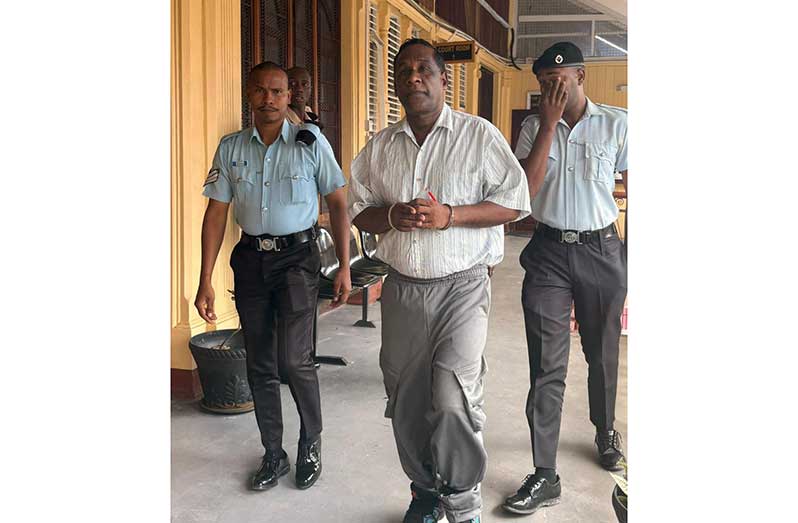
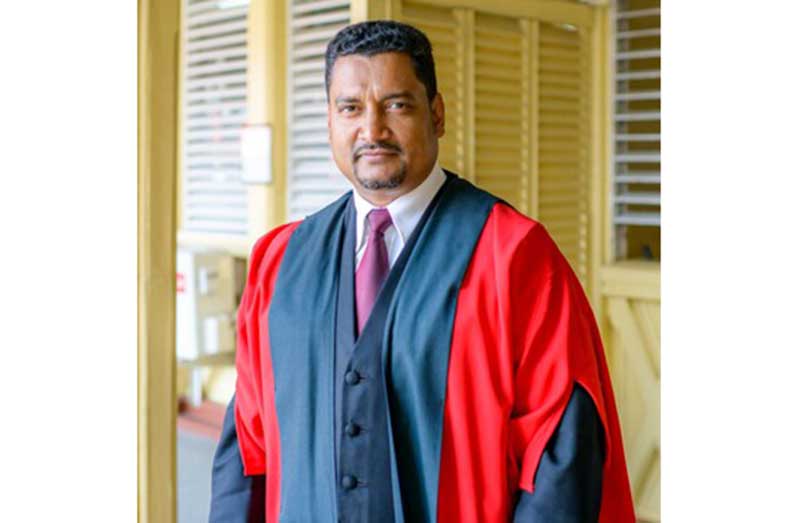
GANESH Lewis, 46, a security guard of Region Three (Essequibo Islands–West Demerara), has been sentenced to 18 years in prison after being convicted of the attempted rape of a four-year-old boy. The conviction followed a trial before Acting Chief Justice Navindra Singh in the Demerara High Court.
Lewis had faced two charges under the Sexual Offences Act, Chapter 8:03 — rape of a child under 16 years and attempted rape of a child under 16 years — arising from an incident that occurred on August 2, 2022, in a shed annexed to a barbershop.
After hearing the evidence, the jury found him not guilty of the rape charge but unanimously convicted him of the alternative count of attempted rape.
In outlining the sentence, Justice Singh adopted a structured approach. A starting point of 20 years’ imprisonment was set, taking into account the gravity of the offence. Five years were deducted based on a favourable probation report, while three years were added due to the extreme youthfulness of the victim and the absence of remorse on the part of the offender.
This resulted in a final sentence of 18 years’ imprisonment. The court noted that no time would be deducted for remand, as Lewis had been on bail throughout the proceedings.
The court also ordered that the Department of Social Services, or any appropriate counselling agency, continue or resume counselling services for the child victim until such time as professionals determine that the support is no longer necessary.
The incident that led to the charges unfolded when a resident reportedly observed Lewis and the child in a compromising position inside the shed near the barbershop. According to court evidence, both Lewis and the child had their pants down. The resident intervened immediately and questioned Lewis about what was taking place. Lewis then left the scene with the child.
The child’s family reported the matter to the police without delay. Lewis was arrested two days later, on August 4, 2022, and denied any involvement in the offence.
During the trial, Lewis testified in his own defence. He told the court that he had been asleep at home when the child came to him and called out. He claimed that he later went to the barbershop area to lift the child off a stool and that the resident who intervened had misinterpreted the situation. Lewis maintained that he did nothing inappropriate and that the allegations against him were untrue.
The prosecution, however, challenged his account, arguing that it would have been impossible for Lewis to hear any noise from the barbershop, as it was closed at the time and not within earshot of his home. Prosecutors contended that the resident’s testimony was credible and consistent with the physical circumstances observed at the scene.
Lewis was first charged on January 27, 2023. Following a preliminary inquiry, he was committed to stand trial on September 21, 2024, after a magistrate ruled that a prima facie case had been established. He was represented by attorney-at-law Ronald Bostwick, while the prosecution was led by State Counsel Simran Gajraj, along with State Counsel Christopher Belfield and State Counsel Geneva Wills.
A probation report presented to the court indicated that Lewis is single and has no children. It noted that he began his first romantic relationship three years ago, but it ended after two weeks due to alleged infidelity by his partner. Out of fear of a similar experience, he reportedly chose not to enter another relationship. The report further stated that Lewis has no prior convictions and continues to deny any involvement in the offence.
The victim, who was four years old at the time of the incident, is now six. In a victim impact statement read to the court, the child’s mother described the emotional toll the incident had taken on her family.
“When I first found out what happened with my son, I felt extremely bad. I also felt hurt because the convicted person was close to us, so his actions were a betrayal,” she said.
She added that the experience brought shame and emotional distress to her child, not because of any wrongdoing on his part, but because of the attention the case attracted within the community.
“I also feel ashamed for my son, because persons in the community are aware of what happened, and he has to live with the shame of the situation every day, even though he did nothing wrong and he was just a child,” she told the court.
The mother expressed relief at the jury’s verdict, saying the conviction brought a sense of closure and justice. “Now that Ganesh has been convicted, I feel satisfied with the decision. It has brought me significant relief, especially since the decision was not mine, but it was based on what the jurors believed happened to my son. I think we have gotten justice,” she said.
During sentencing submissions, State Counsel Christopher Belfield urged the court to impose a custodial sentence, stressing the seriousness of the offence and the circumstances under which it was committed. He emphasised the extreme vulnerability of the victim, noting that a child of such tender years was legally incapable of giving consent.
The prosecution argued that the offence amounted to a gross abuse of trust and authority. Belfield highlighted the psychological and emotional trauma suffered by the victim, pointing out that sexual offences against children often leave long-lasting scars that extend far beyond physical harm.
He further submitted that the crime was not a momentary lapse in judgement but a deliberate and conscious act that required intention and opportunity. This, he said, increased the gravity of the offence and justified a firm punitive response.
Belfield also underscored the importance of general deterrence, telling the court that a strong sentence was necessary to send a clear message that sexual offences against minors would not be tolerated. Leniency, he warned, risked encouraging similar conduct and failing to adequately protect children in society.
In support of his submissions, the prosecutor relied on regional and international sentencing authorities, which consistently hold that courts must prioritise the protection of vulnerable victims over the personal circumstances of offenders.
He concluded that the aggravating factors — the age of the victim, the breach of trust, the lasting trauma caused, and the need for deterrence — outweighed any mitigating considerations and warranted a significant custodial sentence.
After considering the submissions from both sides, the probation report, and the victim impact statement, Acting Chief Justice Singh imposed the custodial sentence.




