— Global democracies show risks of normalising leadership under criminal indictment
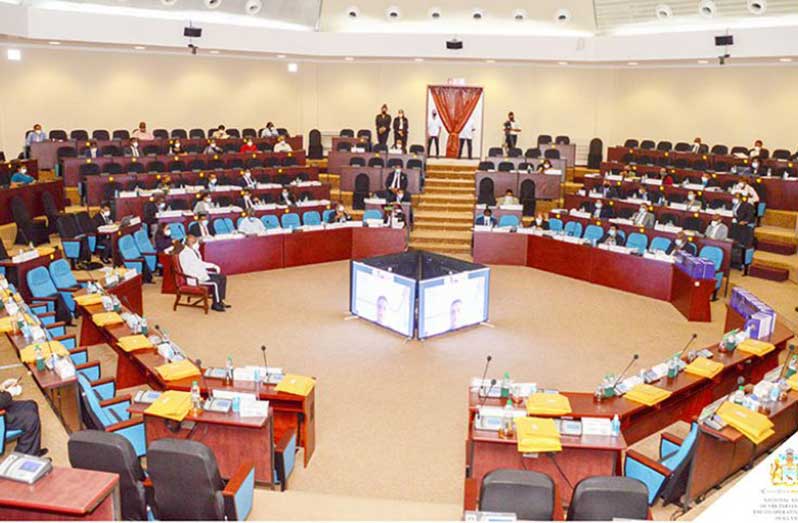
GUYANA’S National Assembly is facing a defining rule-of-law challenge amidst the mounting questions as to whether the installation or continued recognition of a parliamentarian, who is formally being sought after by the United States (U.S.) law-enforcement authorities, could proceed without damaging the credibility of the legislative arm of government.
Azruddin Mohamed and his father, Nazar “Shell” Mohamed have been indicted by a federal grand jury in the US District Court of the Southern District of Florida on 11 criminal charges, including wire fraud, mail fraud, tax evasion and money laundering.
The U.S. had made a request for the Mohameds to be extradited to face the indictments. Those extradition proceedings are currently pending in the local courts.
This case has sparked debate and even international concern as to whether Guyana’s Parliament can continue business as usual while one of its members remain under an international crime cloud, with even the US Ambassador Nicole Theriot previously publicly describing Mohamed’s potential participation in Parliament in an official capacity as “concerning” and “problematic” for Washington.
Parliaments across the globe rely on legitimacy. Installing a leader formally wanted by law enforcement can erode confidence in democratic institutions and signal tolerance for impunity and using comparative experiences across democracies, the sensitivity of the matter at hand has been proven.
For instance, during the height of Operation Car Wash (Lava Jato) congressional leadership roles were vacated or restricted when officeholders became subjects of serious criminal proceedings.
In 2014, a local investigation into money laundering at car wash stations in Curitiba, Brazil, spiralled into one of the largest corruption scandals in Latin American history, making it a landmark anti-corruption probe. The investigation of a small car wash in Brasília over money laundering proceedings uncovered a massive corruption scheme in the Brazilian federal government, particularly in state-owned enterprises.
Further, Peru’s democracy is another example of how important it is not to elevate and shield criminal offenders in the political arena. Peru’s congress has repeatedly blocked or removed leaders facing active criminal investigations to protect institutional credibility.
Over the years, the surge in organised crime in Peru has shown what can happen when states do not prioritise the strengthening state institutions but instead, disregard members of the House who are under investigation for offenses.
The elevation of politicians who face charges for crimes such as money laundering have shown to undermine the independence and capacity of courts and democratic institutions as it allows for crime to thrive.
These particular examples are relevant in Guyana as now the Speaker of the National Assembly, Manzoor Nadir faces the pertinent question as to whether Parliament can lawfully and credibly proceed with a U.S.-indicted parliamentarian, who is the subject of active foreign extradition proceedings.
The Speaker recently warned that electing such an individual could tarnish the country’s reputation and suggested that Guyana might consider legislative reforms similar to measures adopted elsewhere to bar persons facing serious charges from holding high parliamentary office.
“As Speaker I have to consider justifiable delay on the basis that Parliament must not become a sanctuary from accountability” Nadir had said.
Beyond the challenge that the National Assembly faces as it pertains to institutional integrity and public trust, the other deep concerns are precedent risk and democratic backsliding.
Once Parliament accepts a fugitive leader, it establishes a precedent that future actors may exploit, accelerating democratic erosion.
The rule of law is a principle of governance in which all persons, institutions and entities, public and private are held accountable under the laws that are publicly promulgated, equally enforced and independently adjudicated.
Over the years, the world has seen what transpires when the rule of law is eroded. For instance, Hungary is experiencing a deepening rule of law crisis, with EU institutions (Parliament and Commission) raising serious concerns.
Further, Poland has been experiencing a rule-of-law crisis since 2015, and international bodies flagged how procedural compliance without ethical restraint weakens democratic norms.
In Cambodia, opposition leadership controversies showed how tolerating legal evasion destabilised parliamentary democracy.
This is particularly relevant to Guyana as the members of Parliament now face a defining question as to whether they think democratic legitimacy includes the demonstrable commitment to the rule of law.
Guyana’s Speaker of the National Assembly can assert a duty to prevent dangerous precedents that weaken democratic safeguards.