
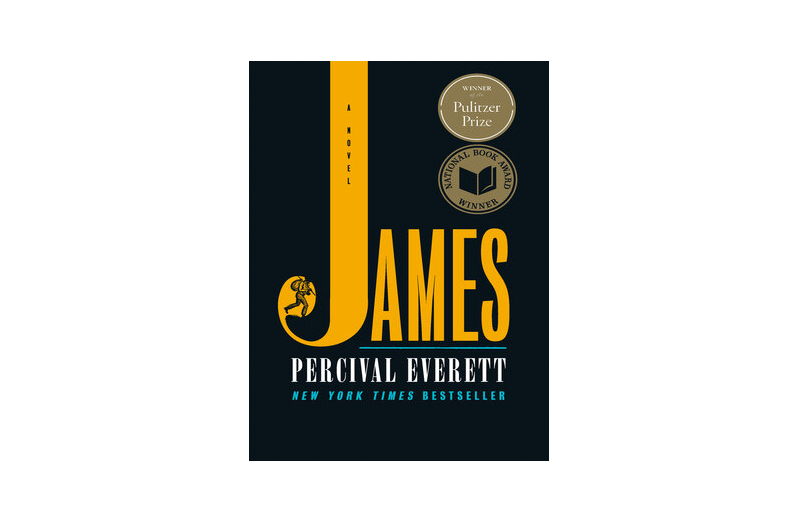
JAMES (Doubleday, $17.86) is the twenty-fifth novel by the extraordinarily prolific African American writer Percival Everett, who has also published four collections of short stories and seven collections of poetry. James was awarded both the 2024 Pulitzer Prize for Fiction and the National Book Award, which represents a remarkable achievement in an already distinguished career. James is, quite simply, a remarkable novel.
Everett, a Distinguished Professor of English at the University of Southern California, has been enjoying a late-career renaissance. His recent novels, The Trees and Dr. No, were both critically acclaimed and became bestsellers, while an earlier work, Erasure, was adapted into the Oscar-winning film American Fiction, starring Jeffrey Wright. Erasure explores questions of Black identity—how Black Americans are categorised, stereotyped, and come to see themselves. These concerns run throughout Everett’s vast oeuvre. He is a relentlessly questioning, philosophical writer, often very funny in a dry, deadpan way. James is a rigorously reasoned novel about the poetics of race, at once funny, harrowing, and deeply sad. It achieves a rare balance of intellectual inquiry and the emotional weight of lived experience. A pointed aspect of the novel is its exposure of the soul-killing restrictions that slavery imposes upon the Black body and mind. Within such a system, any subterfuge employed to resist this erasure of self becomes morally justifiable. This concern is especially evident in the novel’s philosophical engagements, particularly where James enters into dialogue with white philosophers such as Voltaire on the concept of “freedom”. In the white philosophical imagination, freedom is not conceived as universal but as unequal—Black freedom is understood as a diminished, conditional version of white freedom. From this logic, it is not a great leap to imagine that whites would extend such inequity beyond earthly life, envisioning even Heaven as racially stratified.
James has frequently been reviewed as a sequel or retelling of Mark Twain’s 1884 novel, The Adventures of Huckleberry Finn. It is not. Rather, it is its own work—one that reimagines characters from an earlier text and grants them a depth and interiority they did not previously possess. In this sense, it resembles Jean Rhys’s novel, Wide Sargasso Sea, Maryse Condé’s Windward Heights, or Tom Stoppard’s play, Rosencrantz and Guildenstern Are Dead.
In such works of retextualisation, peripheral or supporting characters from canonical texts are brought to the foreground and endowed with a history and psychology only faintly suggested—or absent—in the original. They scarcely resemble their earlier incarnations. Instead, they become protagonists, heroes, and heroines of a new narrative, granted full agency and intelligence.
In Rhys’s novel, the so-called “madwoman in the attic” from Jane Eyre is reimagined with a full backstory and, crucially, a psychological logic that explains her breakdown. Similarly, in Stoppard’s Rosencrantz and Guildenstern—minor figures in Hamlet—become fully realised protagonists of their own drama. Everett’s James may be the most successful reinvention of a fictional character yet.
In Twain’s novel, Jim—short for James—is a runaway slave and Huck’s companion, often treated as a sidekick. No one calls him James, the more formal and dignified name. Instead, he is referred to as Jim, “Nigger Jim”, or worse. The racial slur appears more than two hundred times in the novel, reflecting the attitudes of the era and Twain’s attempt to expose the brutal normalcy of racism. Its ubiquity has long fuelled controversy over the novel’s place in the American canon, though Huckleberry Finn remains, undeniably, a great work.
Everett’s James is not a retelling of Twain’s novel, despite what some reviewers have claimed. It is a reinvention—an act of imaginative recovery. Everett takes a character about whom we know very little and renders him fully human within a new fictional context. James has a wife and a daughter whom he loves deeply, and it is this filial bond that sets the plot in motion. When James learns he is to be sold and separated from his family, he flees, hiding on a nearby island. There, by coincidence, he encounters Huck Finn, who is himself in hiding from his abusive, drunken father. The reason for the father’s hatred of James is one of the novel’s many unsettling revelations.
What follows is a harrowing journey filled with danger, narrow escapes, and moments of quiet philosophical reflection on the “peculiar institution” of slavery. James is bookish and erudite—a reader who interrogates what he reads. One of the novel’s most striking elements is its portrayal of the elaborate performances enslaved people must adopt to ensure white comfort. They must pretend to be ignorant, to speak in a debased dialect that confirms white assumptions about Black stupidity. Their words and actions are carefully tailored to a white gaze. This deception is a survival strategy. One of James’s responsibilities, in fact, is to teach enslaved children not only how to read, but how to pretend they cannot—how to mangle proper English into something less threatening. He corrects their grammar only to distort it again into what white society expects to hear.
The novel is also, unmistakably, an adventure story, employing many of the genre’s familiar tropes: pursuit, peril, and last-minute escapes. When James and Huck flee the island together, the narrative opens onto a broader American landscape and assumes the shape of a picaresque journey.
Everett is a careful, deliberate writer, attentive to balance and moral complexity. The novel engages fully with its central concerns: slavery, freedom, family bonds under duress, and the violent contradictions at the heart of 1850s America. It is also often very funny, particularly in its use of African American humour. This humour shines most vividly in James’s interactions with other Black characters encountered along his descent through a country gripped by rabid racism—a society that denies Black people even the right to exist without white permission. It is an era in which a Black man could be nearly beaten to death for stealing a pencil.
James is an unforgettable novel: beautifully paced, populated by vivid and singular characters, and grounded in a historical reality that feels both authentic and immediate. It is, without question, a must-read.