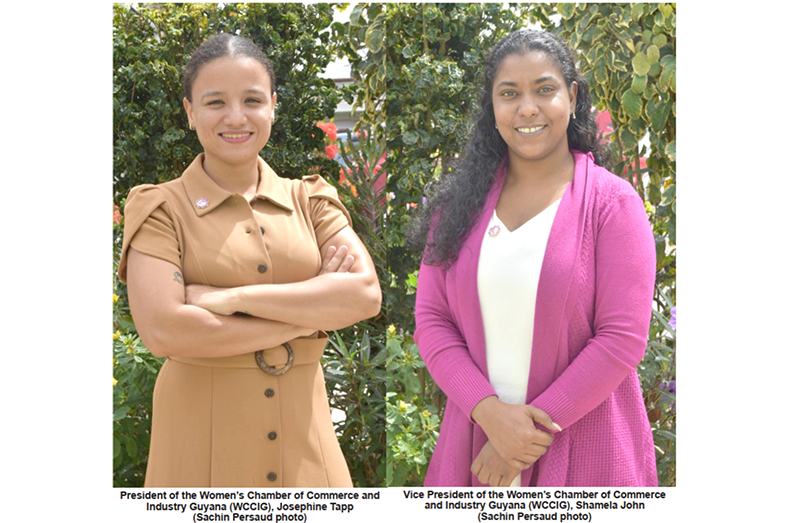
How the Women’s Chamber Is Tackling Care Work Infrastructure, Finance Gaps and Gender Violence
AS Guyana’s economy expands and new opportunities emerge, the Women’s Chamber of Commerce and Industry Guyana (WCCIG) is sharpening its focus beyond traditional business support, placing advocacy, capacity building, and economic inclusion at the centre of its work. Under the leadership of President Josephine Tapp and Vice President Shamela John, the Chamber is working to strengthen women-owned businesses, address structural barriers such as access to finance and care work, and influence national policy on issues ranging from gender-responsive procurement to gender-based violence. Through training programmes, mentorship, government engagement, and targeted initiatives for women at different stages of their professional journeys, the Chamber is positioning itself as both a support network and a policy voice for women navigating Guyana’s rapidly changing development landscape.
Now serving her second term as president, Josephine Tapp has been in business for most of her life, being part of her family’s construction business before venturing into law. Today, she works primarily in construction alongside her role at the Chamber. “I studied law professionally. I worked with a tax law firm for about four years. Then I essentially moved back to my family’s business. I think at that age I finally understood that there is this thing that my parents have built, and I really wanted to be able to give back to that and ensure that it continues.” Tapp joined the Chamber several years ago; since then, she has been an active member of the board, secretary, and now president. “I went to my first meeting, I met some incredible women, and I thought that this is really something I could be a part of,” Tapp said.
The Chamber’s main goal, according to Tapp, is to form a community and social network of women. This drive led to the development of some of the organisation’s major capacity-building projects. As Tapp shared, Chamber members have benefitted from a wide range of training and upskilling opportunities. “We do periodic training with members. We would actually have the banks come in and tell them what they are looking for and what their opportunities are. We have done training on networking, negotiation, creating partnerships, and incorporating your business. When we identify a gap that members have, we execute seminars to address those,” Tapp explained.
The Chamber has also identified gaps outside the realm of business that still profoundly impact women in business as a whole. Among the leading gaps is the lack of care work structures, something Tapp says could have a major positive impact on women in business once implemented. “One of the main things we’ve been focusing on is care work structures—ensuring that women have the space to be able to go to work, to work overtime, without having to sacrifice the well-being of their families. We would want to see school transportation systems established,” she said. “We would want to see some gender-responsive procurement, understanding that women don’t have the same level of assets as men who have been around in business for a long time.”
Gender-based violence is also something that the Chamber plans to continue working on. As Tapp explained, the effects of gender-based violence range from immediate harm to long-term challenges in attaining independence, making it an economic as well as a social ill. “Gender-based violence is usually seen as a social issue, and it is social, but it is also economic. We’re losing business owners. It’s women who contribute to the economy. If our women are affected by gender-based violence, our economy suffers.” Moreover, the Chamber would also like to see more women represented in corporate spaces. “We would want to see a lot more women represented in spaces, specifically in public consultations and on boards of state organisations. A lot of our publicly traded companies don’t meet 40 per cent women in their directorship. We want to execute a mentorship network of women in corporates.”
Vice President of the Women’s Chamber of Commerce and Industry Guyana, Shamela John, is also a longstanding member of the Chamber. With a background in finance and working as a specialist in her field, John joined the Chamber when she transitioned into opening a business venture of her own. “At the time of finding the Chamber, that was my transition period from being an employee to an employer. I joined the Chamber shortly after. I spent two years as Secretary and two years as Treasurer,” she shared.
Drawing on her expertise, John has firsthand experience of the challenges women face in accessing finance. This led to the creation of the Women Evolve Initiative. “Women Evolve exists primarily to help women who are transitioning into being structured. A lot of women make it to the second or third year and then exit because they didn’t structure their finances. We help them organise their finances, get compliance in place, and position them to approach an investor.”
However, the hurdles women face in accessing finance go beyond financial literacy. As John explains, they highlight larger structural issues and access to information. “For us women, access to finance can still be a challenge. Financial literacy was not a big topic discussed. Women do not get to network the way men do. Access to knowledge may be an issue. A lot of women have businesses but don’t register them. Something as simple as tax returns becomes a barrier. If you have the knowledge, you can negotiate interest rates, amounts, and deposits. The average person doesn’t have that knowledge.” Highlighting her own experience, she added, “I have experienced going to the bank where things were said to me that would not have been said to a male applicant. It was because I had the knowledge that I could question it.”
As Guyana continues its rapid economic transformation, the Women’s Chamber of Commerce and Industry remains committed to ensuring that women are not just participants but leaders in this growth. Through strategic advocacy, targeted training programmes, and a deepening focus on systemic barriers—from care work infrastructure to gender-responsive policies—the Chamber is building both the skills and the structural support women need to thrive.