





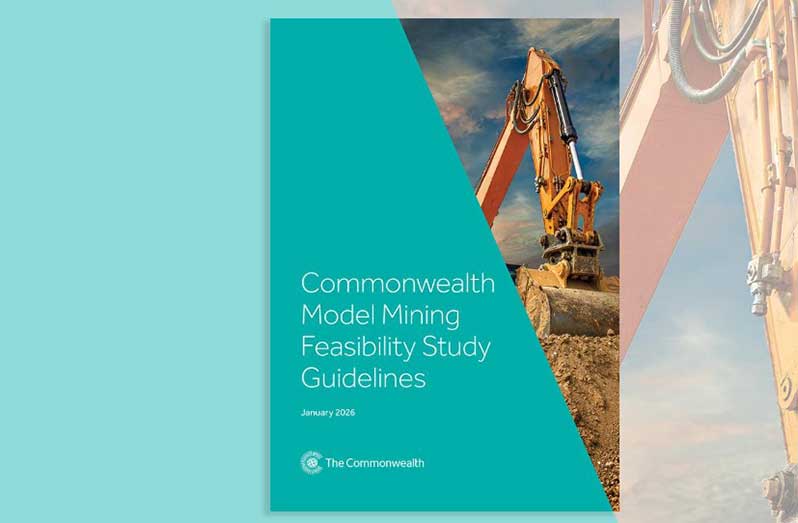
THE Commonwealth Secretariat has launched a new set of guidelines aimed at helping governments make more informed decisions about large-scale mining projects, amid growing concerns about environmental protection, community impact and long-term economic sustainability.
The Commonwealth Model Mining Feasibility Study Guidelines were introduced on Wednesday at the Secretariat’s inaugural Environmental Resilience Day, held on January 21. The guidelines are intended to strengthen how feasibility studies are used by governments when deciding whether mining projects should be approved.
Feasibility studies play a central role in determining whether a proposed mining project is viable, but the Commonwealth Secretariat says they should also serve a wider public purpose by assessing social, environmental and long-term economic consequences.
Commonwealth Secretary-General, Shirley Botchwey, said many member countries rely heavily on mineral resources, not only as a source of revenue but as a potential driver of inclusive and sustainable development.
She said the guidelines are designed to ensure that mining proposals are assessed against a broader national interest test.
“At its heart, the Model Mining Feasibility Study Guidelines are about a simple but vital question: is this project truly in the national interest?” Botchwey said. “A feasibility study should be more than numbers on a page. It should ask whether developing a resource will create lasting value, protect people and the environment, and strengthen long-term economic security.”
She warned that poorly assessed projects can leave countries facing long-term environmental damage, social disruption and weak economic returns, while strong feasibility studies can help ensure mining contributes to sustainable growth.
The guidelines were developed under the leadership of Naadira Ogeer, Head of Energy and Natural Resources at the Commonwealth Secretariat, following requests from member states for a common framework to assess mining projects.
Ogeer said the absence of model guidelines has made it harder for governments to consistently evaluate feasibility studies submitted by investors, especially at a time when global demand for critical minerals is increasing.
“These guidelines will support more informed and transparent decision-making across the mining project lifecycle,” she said, adding that long investment timelines and rising interest in critical minerals make strong early-stage assessments increasingly important.
The Secretariat said feasibility studies should not be treated as purely technical or financial exercises, but as the first and most important test of whether a mining project should proceed at all. Without rigorous scrutiny, governments risk approving projects that fail to deliver promised benefits or impose heavy social and environmental costs on communities.
The guidelines aim to help governments evaluate whether proposed projects are realistic, responsible and aligned with national development priorities.
The launch took place during the Commonwealth Secretariat’s Environmental Resilience Day, which highlighted the work of its Climate Change and Oceans Directorate as part of the organisation’s Strategic Plan 2025–2030.
Held under the theme “A Resilient Commonwealth: Driving environmental resilience for people and planet,” the event brought together UK-based High Commissioners, private sector representatives, academics and youth organisations to discuss co-operation on climate resilience, access to finance, energy transition and governance of natural resources.
The Secretariat said the new guidelines form part of a broader effort to ensure that natural resource development delivers lasting benefits to citizens while protecting the environment and strengthening economic resilience.





