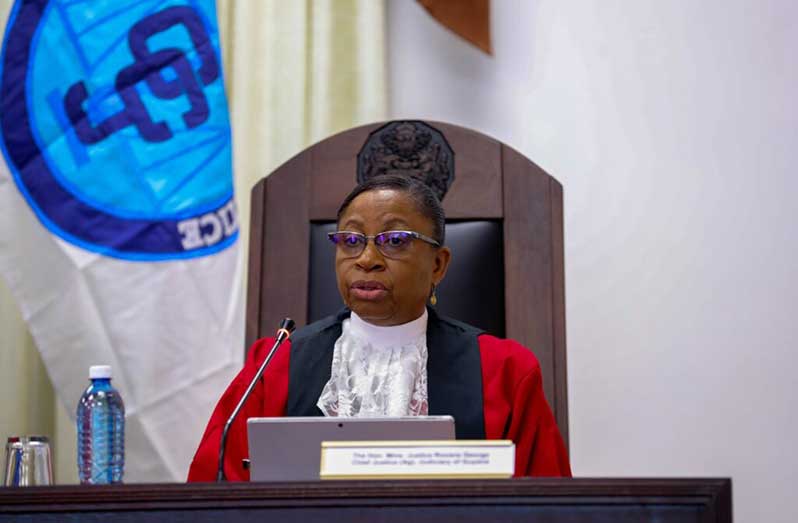
–Chancellor pledges strategic reforms, expanded recruitment to tackle operational challenges
THE Judiciary of Guyana is grappling with rising criminal and civil case volumes alongside critical staffing shortages, Chancellor of the Judiciary (ag) Justice Roxane George-Wiltshire, SC, revealed in her remarks at the official opening of the Law Year 2026.
Addressing judges, members of the Bar, magistrates, justice sector stakeholders, and diplomatic representatives, Justice George-Wiltshire highlighted both the progress and the challenges facing the country’s court system.
“In 2025, about 30,000 criminal cases and 700 civil cases were filed in the magistrates’ courts throughout the country,” she said.
She related that magistrates’ courts handle approximately 90 per cent of the nation’s criminal caseload while also managing civil matters such as petty debt, landlord and tenant disputes, domestic violence, and family and maintenance cases.
The magistrates preside over inquests, children’s courts, drug treatment courts, and are preparing to operationalise mental health courts.
Despite these efforts, she noted that staffing shortages are a significant impediment to the efficient administration of justice.
“The Supreme Court has been haemorrhaging in terms of staffing. In the last year we have lost over 100 staff mainly to the private sector, government ministries, public sector agencies, and emigration. The loss of staff is severely affecting court operations,” Justice George-Wiltshire said, emphasising that the attrition is largely due to staff seeking better pay and opportunities elsewhere.
She added, “There is grave difficulty in attracting and retaining staff to ensure that our courts function efficiently at all times. This very major challenge has to be addressed soonest even as we await proposed medium-to long-term solutions.”
The Chancellor explained that vacancies are not limited to court staff, but also affect magistrates and judges.
Currently, the magistrates’ courts have seven vacancies, resulting from promotions to the posts of Commissioner of Title and the High Court. The Judicial Service Commission (JSC) aims to fill these positions before mid-year, she said. For the High Court, five puisne judge positions remain vacant, with appointments also anticipated before mid-year.
The justice system’s staffing challenges have tangible consequences. Pending inquests and the preparation of records for appeals and committal proceedings are ongoing pressures, and the volume of trial matters takes precedence over these administrative responsibilities. “Staffing the court offices for the efficient management of cases dealt with by magistrates is a major challenge,” Justice George-Wiltshire said.
To address these shortages, she said the judiciary plans a comprehensive human resources review supported by a grant from Global Affairs Canada.
The audit will assess staffing needs, qualifications, and compensation and is expected to lead to “a revised organisational structure, job classification, and remuneration framework,” the Chancellor said.
She noted that several judicial research counsels have been appointed to support judicial officers in legal research, drafting opinions, committee responsibilities, and policy implementation, marking an initial measure to address staffing shortfalls.”
The judiciary is also advocating for more centralised and standardised appointments of staff through the Judicial Service Commission.
“Some staff are already appointed by the Judicial Service Commission on a much higher scale of pay than those appointed by the Public Service Commission and the Public Service Ministry. This has caused a bifurcated system of employment with attendant challenges, especially regarding morale,” Justice George-Wiltshire said.
She suggested that constitutional or legislative amendments may be required to outline the JSC’s authority and appointment processes.
Beyond staffing, Justice George-Wiltshire underscored ongoing efforts to modernise court operations through technology.
The development of an indigenous e-filing and case management system for magistrates’ courts is underway, in collaboration with the National Center for State Courts of the United States and regional partners.
“It is hoped that the system which will permit e-filing in both the criminal and civil jurisdictions will be operational as soon as possible since testing has commenced,” she said.
Similar digitalisation efforts have already transformed the High Court and the Full Court, allowing automatic case assignments and paperless file access 24 hours a day.
While acknowledging the judiciary’s progress, Justice George-Wiltshire stressed that additional staff will be required as part of ongoing expansion.
The Demerara High Court and Georgetown Magistrates’ Court buildings were originally designed for fewer judges/magistrates and support staff than are now required.
She noted, “The High Court building originally accommodated the Chief Justice and 10 judges. It is now meant to house the Chief Justice and 20 judges and the requisite support staff. The Georgetown Magistrates’ Courts was originally meant to house five or six courtrooms. It now has nine courtrooms with the attendant additional staff. Both buildings are in dire need of major repairs but as heritage sites they need specialist attention.”
JUSTICE SECTOR REFORMS
The Chancellor also addressed broader justice sector reforms aimed at improving operational efficiency.
These include implementing a Strategic Plan 2024-2031 under the theme “Pursuing Service Excellence through Investments in Human Resources, Management Systems and Technology,” aligning with international standards through membership in the International Framework for Court Excellence, and enhancing inter-agency collaboration through the Needham’s Point Declaration on Criminal Justice Reform.
Justice George-Wiltshire expressed gratitude for partnerships with local and international stakeholders, including the Attorney General’s Chambers, the Director of Public Prosecutions, the Bar Association of Guyana, the Guyana Police Force, and international partners such as United Nations Children’s Fund (UNICEF), United Nations Development Programme (UNDP), and the Caribbean Court of Justice (CCJ).
“We are grateful for their interest and collaborations that have inured to the benefit of the judiciary,” she said.
Despite challenges, the Chancellor conveyed optimism about the judiciary’s future. She highlighted that a structured approach to staffing, coupled with technological enhancements and legislative reforms, would improve case management and accelerate the disposal of criminal and civil matters.
“The implementation of the Strategic Plan requires the establishment of a Strategic Plan Implementation Unit which may necessitate additional human and financial resources. The Plan also speaks to the development of robust court administration,” she said.
In closing, Justice George-Wiltshire reflected on her appointment as acting Chancellor, and expressed appreciation for the support of colleagues, staff, and family.
She expressed pride in following in the footsteps of her late father, former Chancellor Kenneth George, and noting the rarity and significance of a daughter assuming such a distinguished role in the judiciary.
“As I reflected on my appointment, I thought it must be rare that a child, more especially a girl child, would follow in her father’s footsteps to serve in this esteemed capacity as head of the judiciary.
“I thank my heavenly Father, and cherish the memory of my earthly father, former Chancellor Kenneth George, whose robes I now wear. I also express my gratitude to my husband, children, mother, siblings, other family members, and my few but very dear friends. Their love, care, and support over the years allowed me to flourish in what we all know is an extremely demanding profession.”
She reiterated her commitment to impartiality, integrity, and public trust, promising that the judiciary would continue to uphold the rule of law and provide timely and fair access to justice.