The UNV Focal Point reflects on Guyana’s transformation and why volunteerism remains central to sustainable development.
THE United Nations is one of the most well-known and recognised organisations in the world. Through its work, it has helped shape and rebuild nations. In times of natural disasters, economic hardships, and even war, the UN can be found working to help. But there are people behind the world’s largest humanitarian mission, primarily volunteers, many of whom never gain acclaim, although they contribute time, work and energy to helping change lives and nations.
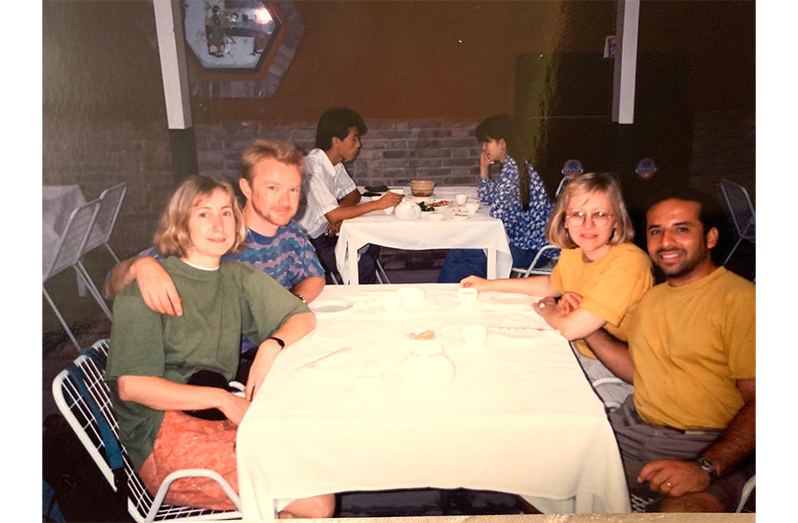
The UN’s Cesar Guedes says it is more than just volunteer work. In an interview with Pepperpot Magazine this week, Guedes, who currently serves as the new UNV Focal Point for the English/Dutch Caribbean in Guyana, said that if calculated and considered, volunteers around the world create the world’s tenth-largest industry. This is why he has dedicated his life to working across countries and continents to address a number of challenges, and why, now as we move forward, volunteers should be valued, respected, and highlighted as both their numbers and their impact grow.
Born in Peru, Guedes’ brilliance set him apart at an early age, and his academic acclaim led to his being noticed by the UN and, eventually, to his coming to Guyana in January 1992.
“I had completed my postgraduate studies in the Netherlands. I am a graduate of business administration and economics from the University of Lima. I applied to study abroad and went to do my master’s in international relations and development in the Netherlands, in The Hague, at the Institute of International Studies. It’s part of Erasmus University, a very reputable university in Europe. I was on a scholarship.”
Although among the youngest in the batch, Guedes was given the chance to volunteer on two continents, and when given the choice, he chose to explore Guyana.
“When I returned to Peru, I had two job offers with the UN Volunteers. One was to work in Equatorial Guinea within a UNDP project, and the other was to come to Guyana and work with UNIDO and UNDP within the economic recovery programme.”
The idea of Guyana offered Guedes an entirely new environment and language. As he further shared:
“One was going to the only Spanish-speaking country in Africa, Equatorial Guinea, and the other was to go to the only English-speaking country in South America. I said, I speak English, but I could do better, so probably I should go to Guyana and polish my English. If I go all the way to Africa and work in Spanish, probably I’ll be missing something. I opted for Guyana.”
Guedes’ service highlights, in the best light, the impact that volunteerism can make and has made, even in our own backyard. During its developing stage as a new nation, Guyana faced a number of hurdles. Collaborative work between the government, the UN, and other stakeholders gave the country a much-needed boost at the time, not just economically but structurally across industries as well.
“The World Bank and IMF told Guyana, this is what we suggest you do. Because if you don’t do this, we cannot bring more money. As the IMF and World Bank, we owe it to our board that every dollar that we put in a loan in a country is going to help this country to recover, not continue going into loss,” he said.
He added, “The UN was invited in full force to work in all areas: FAO, WFP, UNIDO, the World Health Organization, the organisation for women and human rights. All the big UN family came to assist and implement the humanitarian and development plans.”
While he began as a volunteer, Guedes’ career changed over the years, with an upward trajectory in developing countries and their systems. During his early years in Guyana, Guedes worked on a programme to privatise public enterprises. While a simple plan on paper, the programme required extensive work on policy and volunteer efforts.
“I was assisting the head of the programme as a junior professional in the privatisation of a portfolio of companies. You had the big ones: sugar, rice, the shipping company, the airline, the fisheries. Then you had the little ones: a cinema, a cafeteria for government employees, a small conference centre,” he shared.
His dedication to this work and the success of the privatisation programme in Guyana launched a distinguished career spanning over three decades. Guedes has held numerous roles, including assignments with UNDP, UNIDO, UNV Headquarters and UNODC. His last UN appointment was as the UNODC Representative in Afghanistan, preceded by similar senior positions leading large teams in Pakistan, Mozambique and Bolivia.
He is fondly remembered at UNV Headquarters in Bonn, where he served for five years as a Programme Specialist and Operations Officer for Latin America, the Caribbean, and the Arab States, during which time he designed and launched award-winning projects involving national, international, and youth volunteers.
Throughout his career, Guedes pursued further education to strengthen his expertise. Beyond his degrees from the Universidad de Lima and Erasmus University, he earned a Postgraduate Diploma in International Conflict Resolution from the United Nations University International Leadership Academy in Amman, Jordan, and a Postgraduate Certificate in International Programme Development Evaluation from Carleton University in Ottawa, Canada. In recognition of his dedicated service, Guedes has received several awards, including the Condor of the Andes Medal (Bolivia, 2013) and the Presidential Diploma for anti-corruption work (Pakistan, 2019).
After retiring from his Afghanistan post, Guedes joined his wife, Lisa Moreau, whom he met while serving in Guyana in the early 1990s, in Hanoi, Vietnam, in 2022, where she was assigned to the Canadian Embassy. During this time, he engaged in consultancy work and served as a guest lecturer at the Vietnam National University Business Faculty and the UN International School. His retirement, however, was brief. UN Headquarters called on Guedes in August to return to the Southern Caribbean and Guyana, the very region where his UN career began, to revamp and strengthen the volunteer programme, bringing his vast experience back to familiar ground.
Yet among his biggest achievements and career highlights has been the transformation that Guyana has undergone.
“I was a little piece of the puzzle, but if I contributed with a grain of salt, I feel now that we did the right thing because now Guyana’s private sector is very diverse—a vibrant, strong private sector. You see businesses all over.”
Highlighting the vibrancy of downtown Georgetown, Guedes said Guyana has not just grown but blossomed.
“What we did over 30 years ago, there was a vision, and with this vision, we told the Guyanese that it was the right time, at the right moment, with the right persons to be part of this impulse that didn’t stop. It continued onward. I can smell the roses.”
He added, “Nowadays, people still travel, but they travel for pleasure. At that time, people were travelling, leaving the country for survival. Now that brain drain has stopped, and I see people investing in Guyana.”
While the UN has helped Guyana over the years, what is more important is the knowledge and structural changes the country has seen. Guedes said that the Guyana of today has come a long way, not just in growth and stability, but also in leadership.
“I think Guyana now has very good leadership. It’s inspirational—a young president that connects with young people, with the media, who is hyperactive and is everywhere at the same time. He’s a champion of social media, his wife, the family, the ministers. That leadership is showcasing the spirit of a continued evolution of a new Guyana.”
He added, “I have the luxury to know what happened before and to see, as an outsider, as a foreigner, the Guyana of the early 1990s, and to be here in the 2020s, mid-2020s, and see all these changes. It’s very special.”
Now, as Guedes takes on his new role as UNV Focal Point for the English/Dutch Caribbean, his return comes at a pivotal moment. The UN has declared 2026 the International Year of Volunteers for Sustainable Development (IVY 2026), marking 25 years since the first International Year of Volunteers in 2001. The initiative directly links volunteerism to the Sustainable Development Goals, recognising volunteers as crucial drivers for achieving the 17 Global Goals, from poverty reduction and climate action to building strong institutions.
For Guedes, who has witnessed first-hand how volunteers transformed Guyana three decades ago, IVY 2026 represents a critical opportunity to reinvigorate volunteer efforts across the Caribbean and accelerate progress towards the 2030 Agenda’s targets. As someone who began his own journey as a volunteer and rose through the ranks while never forgetting the power of grassroots action, he understands that volunteers are not just helpers; they are the backbone of sustainable development.