
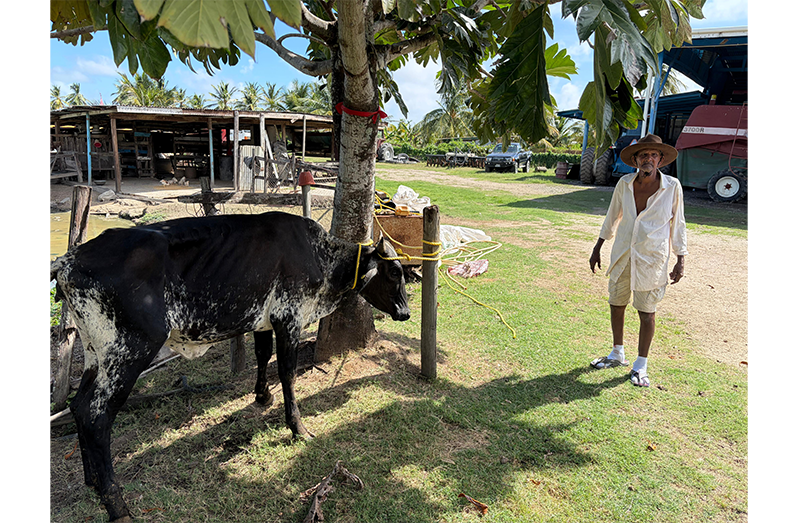
How an elderly farmer is helping to shape Guyana’s dairy future
AT 86, Mahadeo Persaud Sookram is not your average farmer.
Robust in spirit and visionary in outlook, he continues to forge ahead in sustaining his family’s long-standing legacy of dairy cattle rearing, refusing to let age or tradition define the limits of his ambition.
His life’s work is driven by a deep affection for his animals, and an enduring belief in providing wholesome, high-quality milk to the nation.
Known by several generations of residents in the Mahaica area as a reliable and trusted milk producer, Mahadeo reflects on a life marked by ebb and tide, yet each day, with quiet determination, he continues to build and improve his herd, ensuring that the values and standards of his family’s dairy tradition endure well into the future.
Persaud Sookram’s journey in cattle rearing began long before Independence, rooted in a family tradition established during the colonial era, when his grandfather acquired pedigree dairy cattle from English sugar-estate managers.
By the 1940s, as a young farmer working with Creole cows, milk yields were modest, often no more than three pints per cow per milking.
Yet, even then, he recognised that productivity was inseparable from genetics; a lesson that would shape his lifelong commitment to improvement.
Before the resuscitation of the dairy industry, including the introduction of improved breeds and the expansion of marketing opportunities, Mahadeo, through the breeds introduced using the Guyana Livestock Development Authority (GLDA)’s Artificial Insemination (AI) programme, was able to produce more than 20 gallons of milk per day.
However, due to limited market opportunities and price volatility, he had to reduce production.
Today, buoyed by renewed government support and greater market access, he is more optimistic and eager to increase milk production once again.
That commitment to improvement found new momentum under the People’s Progressive Party/Civic (PPP/C) government, led by Dr. Irfaan Ali, through its livestock development agenda, implemented by the Ministry of Agriculture through the GLDA.
Over the years, Persaud Sookram has transitioned to improved dairy breeds, such as the Holstein and Brown Swiss, significantly increasing yields.
Alongside genetic improvement, he’s relied on pasture-based management, strategic supplementation during dry periods, and careful animal observation, all traditional practices refined through decades of experience.
Today, those practices are reinforced by modern reproductive technologies.
Through GLDA’s AI programme and extension support, Persaud Sookram was able to adopt structured crossbreeding strategies, guided by GLDA’s CEO, Dwight Walrond, the Region Four (Demerara-Mahaica) Extension team headed by Ms. Ava Klass, and Mr Sunil Balkarran, Senior Livestock Officer responsible for cattle.
By crossing Brown Swiss and Holstein cattle, his herd can now produce more than five gallons of milk per day from a single milking, across two lactating cows; an achievement that underscores the value of combining farmer knowledge with scientific intervention.
Just recently, as part of the Government of Guyana’s strategic genetic improvement programme implemented through the GLDA, nineteen farmers, including Mr. Mahadeo Persaud Sookram, each received a Girolando heifer, marking a significant step in the national effort to modernise and expand the dairy industry.
The Girolando, a breed developed in Brazil from a cross between Holstein and Gyr cattle, is particularly well suited to Guyana’s tropical environment, combining heat tolerance, disease resistance, and improved milk productivity.
For Persaud Sookram, the introduction of the Girolando represents an essential milestone in his lifelong journey as a dairy farmer and, with technical guidance from the GLDA, he is eager to commence a structured breeding programme aimed at strengthening his herd and increasing milk yields to meet the growing domestic demand.
Persaud Sookram also believes that the government’s input represents an excellent investment in the future of agriculture, particularly in encouraging more young people to enter the sector.
Unlike his era, when establishing a dairy farm required significant personal resources and access to quality breeding stock was limited, today’s aspiring farmers benefit from ready access to genetically-improved animals, structured technical support through extension services, and financing options that lower entry barriers.
He sees these measures as transformative, not only for expanding production, but also for making agriculture a more attractive and viable career path for the next generation.
During the recent Girolando distribution exercise, Agriculture Minister Hon. Zulfikar Mustapha underscored the government’s continued commitment to the sector.
Minister Mustapha noted that over the past five years, the government has advanced multiple aspects of livestock development and cautioned farmers against a “tunnel vision” approach, encouraging instead the adoption of integrated production systems to ensure long-term sustainability and growth.
The Minister also disclosed that more than $110 million has been invested in about 300 embryo transplants, aimed at boosting dairy production, and improving genetic quality.
He further informed farmers that Demerara Distillers Limited (DDL), in partnership with an international company, is establishing a modern dairy processing plant at Moblissa, which is approximately 90 per cent complete.
According to the Minister, the facility will play a critical role in expanding local milk processing capacity and strengthening market opportunities for dairy farmers.
“When we give you these animals, and you continue breeding through the embryo transplant programme, you will be able to produce additional heifers for dairy production,” Minister Mustapha explained.
In addition to the dairy stock, farmers also received silage to support improved feeding systems and promote sustainable production practices.
For Persaud Sookram, modernisation does not mean abandoning tradition.
His dairy operation remains firmly rooted in pasture-based management, complemented by cash crop farming, particularly ochro, which helps stabilise household income during periods of reduced milk production.
This integrated approach practised by small farmers closely aligns with the modern sustainability principles now promoted by the Ministry of Agriculture.
As Guyana moves towards greater dairy self-sufficiency and responds to rising consumer demand for fresh milk and value-added products, Persaud Sookram’s story offers more than a reflection on longevity.
It illustrates how elderly farmers, supported by sound policy, responsive institutions, and accessible technology, can remain central to national food security.
By blending inherited wisdom with Artificial Insemination (AI), improved genetics, and the introduction of climate-resilient breeds like the Girolando, Mahadeo Persaud Sookram embodies a dairy sector that is resilient, adaptive, and firmly rooted in the future.