






By Feona Morrison
GIVEN the complexities associated with oil-and-gas exploration, Vice-President of ExxonMobil Guyana, Phillip Rietema has defended the U.S. oil giant’s decision to leave the Kaieteur Block, stating that it did not meet the company’s investment hurdle.
During last Sunday’s episode of the Energy Perspectives podcast, powered by the Guyana Energy Conference and Supply Chain Expo, he explained that the company had decided, during seismic and other exploratory works, that the Kaieteur Block was not a promising prospect.
“We exited late last year from that [the Kaieteur Block] after doing seismic, drilling wells; doing a lot of work over many years. We stepped back; we didn’t have something that met our investment hurdle…cost of supply and needing to have attractive developments. It wasn’t meeting that requirement. We stepped away to focus our time and energy in other areas,” Rietema said.
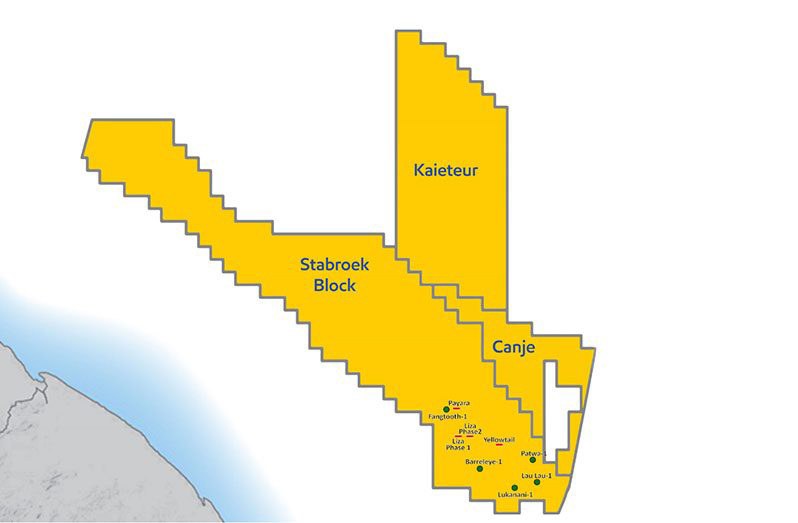
The Kaieteur Block is roughly half the size of the prolific Stabroek Block, measuring 3.3 million acres. Rietema disclosed that China’s CNOOC Petroleum Guyana, one of ExxonMobil’s co-venturers in the Stabroek Block, is still pursuing the Kaieteur Block, and the company wishes it well. Even after a couple of wells failed, the Vice-President said that the company would keep evaluating the Canje Block “to see if there are other opportunities to drill”.
Situated in deep-to-ultradeep waters roughly 180 kilometers offshore Guyana, the Canje Block spans an area of around 4800 square kilometers. After drilling three wells in the Canje Block without finding any commercial resources, Exxon requested permission to drill up to 12 wells in the block.
Exxon holds a 35 per cent ownership in Canje, followed by TotalEnergies (35 per cent), JHI Associates (17.5 per cent), and Mid-Atlantic Oil and Gas (12.5 per cent).
Rietema pointed out that the company lost a lot of money when it left the Kaieteur Block, and that all of this demonstrated the business’s high level of risk. “That’s not money we can recover; that’s just a lost investment,” he pointed out. But he noted that “it could be very rewarding as well,” referring to a significant discovery like the Stabroek Block.
ExxonMobil is the operator of the offshore 6.6 million-acre Stabroek Block.
Along with its partners Hess Guyana Exploration and CNOOC Petroleum Guyana, a consortium was formed to find and exploit petroleum from the area.
ExxonMobil Guyana holds a 45 per cent stake, followed by Hess Guyana Exploration with 30 per cent and CNOOC Nexen Petroleum Guyana with 25 per cent.
Since the first discovery in 2015, the company has three projects—Liza 1, Liza 2 and Payara—producing over 600,000 barrels a day. The prolific Stabroek Block has solidified Guyana’s position as a major player in the global oil industry and the fastest-growing economy in the world.
He stated that the corporation has three other development projects in this block—Yellowtail, Uaru and Whiptail—set to begin production in 2025, 2026, and 2027, respectively.
Each project is estimated to generate 250,000 barrels per day, bringing the total offshore oil output in Guyana to more than 1.3 million barrels per day. This will take the company’s annual revenue to US$30 billion, Rietema said. By then, six Floating Production Storage and Offloading (FPSOs) vessels would be operating.
By the end of 2023, ExxonMobil had made $614.6 billion in profits. That profit occurred at a time when the company’s annual revenue was $1.1 trillion and its overall operating expenses were estimated to be $356.1 billion.
The company has emphasised that Stabroek Block will go down as one of the greatest deepwater projects in the industry’s history.




