






WITH the lengthening of fire seasons around the world, it is predicted that there will be more fires in the future, even in areas where they has never occurred before, according to information posted on President, Dr Irfaan Ali’s official Facebook page on Wednesday.
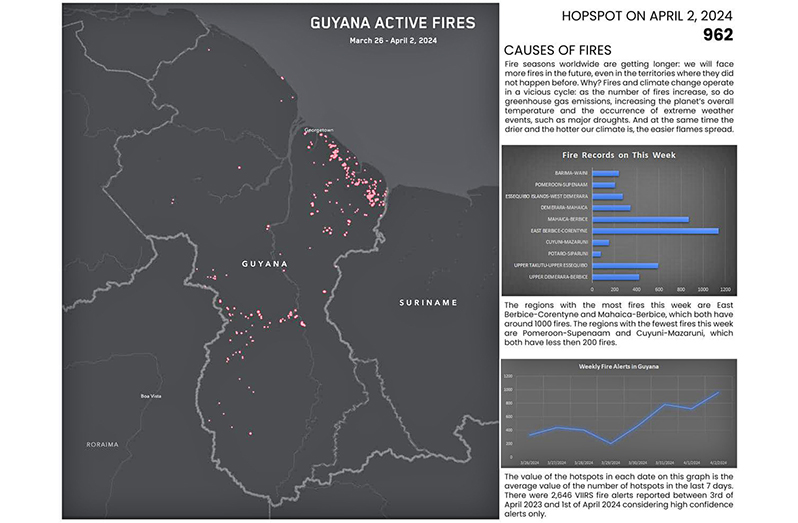
According to the information: “Fire seasons worldwide are getting longer; we will face more fires in the future, even in territories where they did not happen before. This is so because fires and climate change operate in a vicious cycle. As the number of fires increases, so do greenhouse gas emissions, increasing the planet’s overall temperature and the occurrence of extreme weather events, such as major droughts. And at the same time, the drier and hotter our climate is, the easier flames spread.”
Drawing attention to the local situation, it was stated: “The regions with the most fires this week are East Berbice-Corentyne [Region Six] and Mahaica-Berbice [Region Five], which both have around 1,000 fires. The regions with the fewest fires this week are Pomeroon-Supenaam [Region Two] and Cuyuni-Mazaruni [Region Seven], which both have less than 200 fires.”
The Guyana Chronicle reported on Wednesday that the Guyana Police Force and Fire Service were fighting a sizeable wildfire in the Perseverance/Providence area, as well as along the Demerara River below the Sand Hill area.
The ministry said in a press statement that the smoke from these fires is covering these areas, and the neighbouring communities and residents are strongly encouraged to put their safety and well-being first by taking preventive measures against the health hazards linked with smoke inhalation, given the effects of the wildfires.
As a result, the Ministry of Home Affairs provided the following recommendations for public safety: remain inside: to reduce exposure to smoke, people are advised to stay inside whenever possible and to keep all windows and doors closed; restrict outdoor recreation: if you must go outside, use a mask to reduce the danger of inhaling; Make use of air filtration.
Use air conditioning units to help with indoor air quality filtration; and keep yourself updated: keep up with the most recent announcements and warnings from the Environmental Protection Agency (EPA) and the Guyana Fire Service.
It was also suggested that people arrange alternate routes: if travel is required, think about taking detours to avoid smoke-filled areas and busy roads; drive carefully. Smoke causes visibility to be reduced, so drivers should drive very carefully through affected areas.
The use of high beams or warning lights was encouraged, and they asked that drivers pay attention to passing vehicles and pedestrians, and take extra safety measures to keep vulnerable populations safe. These include youngsters, the elderly, and people who suffer from respiratory conditions. The Ministry of Home Affairs also highlighted how crucial it is to drive very cautiously.
In order to ensure safe navigation through affected regions, motorists were also urged to lower their speeds and make use of their high and low beams.
Additionally, residents were strongly urged to call 912 as soon as they noticed any grass fires or wildfires in their neighbourhoods.




