






— FAO calls for reversal of soil degradation
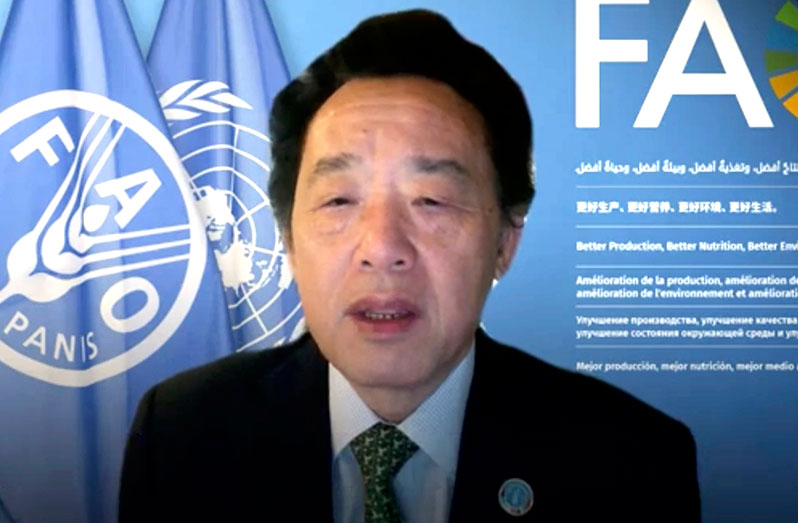
REVERSING soil degradation is vital if we want to feed a growing global population, protect biodiversity and help address the planet’s climate crisis, Director-General of the Food and Agriculture Organisation of the United Nations (FAO), QU Dongyu has told a meeting of agriculture ministers in Berlin.
As much as 95 per cent of global food production depends on soil. However, unsustainable agricultural practices, the overexploitation of natural resources and a growing population are putting increased pressure on soils. A third of them are already degraded, and experts estimate that soil erosion could lead to a 10 per cent loss in crop production by 2050.
After oceans, soils are the largest reservoirs of carbon and play a crucial role in mitigating and adapting to the impacts of the climate crisis. The degradation of the world’s soils has already released up to 78 gigatonnes of carbon into the atmosphere (one gigatonne is equivalent to the mass of 10,000 fully loaded U.S. aircraft carriers). According to the Global Soil Organic Carbon Sequestration map, soils could sequester up to 2.05 petagrams of CO2 equivalent per year, thus offsetting as much as 34 per cent of greenhouse gas emissions from agricultural land.
Soils are full of life as well, holding an estimated 25 per cent of global biodiversity.
“Our growing population requires more food that is nutritious and safe, free of contaminants and pathogens,” FAO’s Director-General told the gathering. “Countries must make stronger commitments towards sustainable soil management,” Qu added.
Over 70 agriculture ministers from around the globe were invited by their German colleague, Cem Ozdemir, to exchange thoughts and ideas at the Global Forum for Food and Agriculture (GFFA), a conference that is held each year in Berlin.
FAO’s latest State of the World’s Land and Water Resources for Food and Agriculture has already warned that agricultural systems – the interconnected complex web of soil, land and water – are at “breaking point”.
BIGGEST THREAT
Soil erosion is the biggest threat. It is estimated that by 2050, soil erosion could lead to a 10 per cent loss in crop production and remove 75 billion tonnes of soils.
“Soil pollution is also an issue. It knows no borders and compromises the food we eat, the water we drink and the air we breathe. The excessive or inappropriate use of agrochemicals is one cause of the problem. The global annual production of industrial chemicals has doubled since the beginning of the 21st century, to approximately 2.3 billion tonnes, and is projected to increase by 85 per cent by the end of the decade,” the FAO Chief said.
Another challenge comes from salinisation, which affects 160 million hectares of cropland worldwide and every year renders 1.5 million hectares unproductive.
Finally, there’s a lack of reliable data. Over 55 per cent of surveyed Members of the Global Soil Laboratory Network (GLOSOLAN) lack adequate analytical capacities, including human resources, harmonisation procedures and equipment.
In October, FAO launched the Global Map of Salt-Affected Soils, a joint project involving 118 countries and hundreds of data-crunchers that allows experts to identify where sustainable soil management practices should be adopted and informs policy makers when dealing with climate change adaptation and irrigation projects.
MORE IS NEEDED
According to FAO’s Director-General, countries must make stronger commitments, while instruments such as the Voluntary Guidelines for Sustainable Soil Management, the World Soil Charter and the International Code of Conduct for the Sustainable Use and Management of Fertilizers can provide added impetus.
Greater investments — particularly for supporting the adoption of sustainable soil management practices — and the recarbonisation of soils are also a priority, along with land tenure security.
The Director-General welcomed the adoption of a joint communique’ by participants representing what he described as “a reflection of your commitment to healthy soils, including protecting agricultural land through tenure security,” and said FAO would help facilitate its implementation.
“FAO, including through the Global Soil partnership, is committed to healthy soils and to supporting sustainable soil management at all levels for better production, better nutrition, a better environment and a better life for all, leaving no one behind,” Qu said. (FAO)




