






Dear Editor,
GUYANESE have divergent views on constitutional reform. There are those Guyanese who advocate for additional constitutional reform beyond the 2000s amendments that were incorporated into the revised 1980 Constitution; while others are baffled as to what specific articles/provisions they want to alter or add.
The latter group prefers to focus instead on “food on the table” issues, including inflation and how in combination with the COVID-19 pandemic, these factors are heightening their social and health distress. It was the five-month March 2, 2020, election fiasco when a glaring attempt to stage an electoral coup d’état– which nearly culminated in anarchy–that provided an impetus for constitutional reform. Some people believe that the post- election turmoil had its root in the Constitution, while others disagree; they locate it in the inordinate obsession with power by opposition forces.
While the existing Constitution (with 2000s amendments) is not perfect, it has many admirable features, like separation of powers, the rule of law, multiple ‘rights’ commissions, numerous individual rights, among others. However, if there is no enforcement mechanism in place, what sense does it make to alter or add more articles/provisions to accentuate the situation? There is also a desire to know if ‘compliance’ will take centre stage to drive the constitutional process. A substantial segment of the population prefers this approach.
They do not necessarily have any major problem with the existing Constitution but do have deep misgivings about the lack of constitutional compliance with accompanying penalties.
Having signed onto constitutional reform, the PPP/C Government is forcefully confronted with the historical reality of top government officials’ and politicians’ unwillingness to adhere to constitutional provisions and the rule of law. The UWI professors are correct when they say that many administrative matters are wrongly sent to the High Courts for adjudication. These matters are supposed to be settled at the executive level. This shift highlights a dilemma of the political actors and their reluctance to respect and observe the rule of law. The transformation of attitudes is therefore paramount to ensure compliance.
To buttress their commitment to inclusivity, the PPP/C Government cites their embrace of the Carter-Price formula, as an important constitutional device for the selection/appointment of the GECOM Chair. Though this formula worked well for over 23 years during which period there was no complaint about its efficacy, it was nevertheless discarded by the PNCR-led Coalition when they unilaterally appointed a GECOM Chair, contrary to the Constitution, only to be admonished by the Caribbean Court of Justice.
Again, with the successful passage of the No-Confidence Motion (NCM) in December 2018, the PNC refused to resign in accordance with the Constitution [Article 106 (6)]. There were several other constitutional aberrations but there was no provision for the imposition of any penalty for violation.
I reiterate, for any constitutional change to succeed, it must also be accompanied by an attitudinal transformation, and this would pose a huge challenge. But with the right perspective and passion, this could happen, even though it might take a long time. One cannot make old habits the foundation of a new social order, any more than those old ways brought the new order into existence.
The PPP/C’s commitment to “inclusivity” is also aligned with its Weston ideology and the Constitution. With support from the PNC/R, for example, it enacted in 2000s some radical constitutional changes: (I) established five Rights Commission: Child, Indigenous Peoples, Women & Gender Equality, Human Rights, and Ethnic Relations [Article 212(A) & 212 (G)]; (ii) initiated a new system of parliamentary management with the establishment of Parliamentary Sectoral Committees: Natural Resources, Economic Services, Foreign Relations; and Social Services (Article 119B, 1,2) where the “Chairperson and Deputy Chairperson of each parliamentary sectoral committee shall be elected from the opposite sides of the National Assembly;” and (iii) reduced the powers of the Presidency [including restricting the incumbent to hold such office for no more than two terms: Article 90(3)]. There are also the Standing Committee on (I) Parliamentary Oversight on Public Security and (ii) on Appointments.
The PPP/C’s ideology is also guiding the preparation of the “One Guyana Development Strategy”. This ideology is not doctrinaire; it is organic and allows for adaptations in response to technological and social changes. And the ideology is not in conflict with, but it is in alignment with the Constitution. In my opinion, the PPP/C would not want to rupture this symbiotic relationship which has taken decades to evolve.
The rationale advanced by some people for constitutional change, like power sharing, is that it could mitigate or eliminate race tension and social upheaval. While this is an attractive theoretical construct, it is doubtful if it would match reality. A major inhibiting force is the elusive ‘trust’ factor. And if the primary goal of constitutional reform is to institutionalise ‘executive power-sharing’, that could become a very thorny issue, while undermining the very foundation of political competition for State power.
Smart people will not take the easy way out. They would work hard to win State power through mobilisation, advocacy, and connecting with the people with policies and programmes. No ethnic group is in the majority, so that any political party must appeal beyond its ethnic -base and geography to have a good chance of winning State power. What is of primary importance is the need for a fundamental change in attitudes towards institutions and their mission, and not a pre-occupation with ‘power- sharing.’
No CARICOM country has power-sharing as a constitutional provision, why should Guyana set a bad precedent? Trinidad & Tobago, for example, has a similar history and demographic structure like Guyana; why power-sharing is not central to their political landscape? In Guyana, power is already shared by opposition forces at every layer of government, except at the Executive (Cabinet) level. There is no barrier for opposition forces to acquire Executive power (Cabinet) again if they push forth with a sharp vision, smart programmes, and policies, and simultaneously reject violence, intimidatory tactics, and caustic rhetoric.
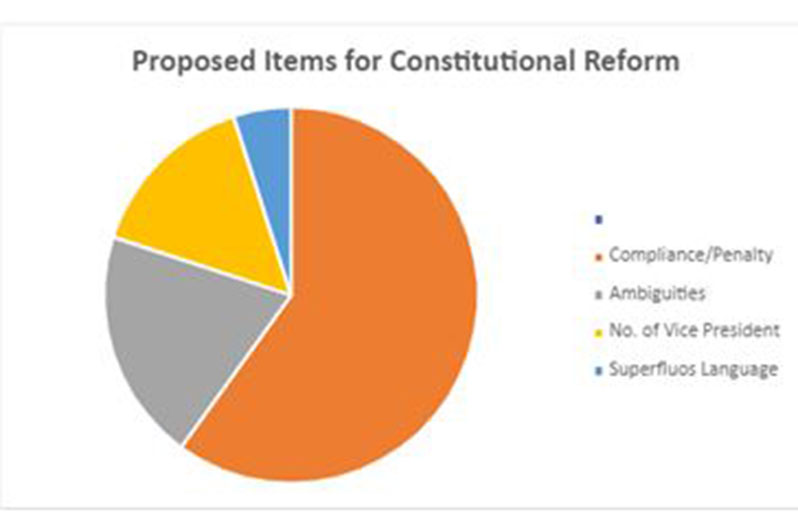
What urgency the Parliamentary Standing Committee for Constitutional Reform (PSCCR) which is charged with the responsibility for ‘continually reviewing the effectiveness of the working of the Constitution and making periodic reports thereon to the Assembly, with proposals for reform, as necessary’ (Article: 119 A), could inject into the process, does not look compelling. When the process is set in motion, the following items are recommended for consideration: (i) focus on compliance and penalties; (ii) clarify ambiguities (e.g., how are the procedures for changing “entrenched” provisions different from those that are not entrenched [Ref: Article 164 (1) (2)] and what does “create a republican community” mean (in Preamble); (iii) delete superfluous/conflicting language like Guyana is “in the course of transition from capitalism to socialism” (Article 1); and (iv) limit the number of Vice- President to just one (ref: Article 102). In my opinion. this PSCCR effort is likely to be overshadowed by potent factors like “inclusivity” and “food on the table,” including rising prices.
Yours sincerely,
Dr Tara Singh


