






…will consult with opposition on critical matters
ITERATING its commitment to remain in interim mode until the swearing in of a President following the conduct of General Elections, government, on Wednesday, said it will consult the opposition on critical matters that could have implications on the future governance of the country. But Political Scientist, Dr. David Hinds, said the A Partnership for National Unity + Alliance For Change (APNU+AFC) Government should not restrict itself but, rather there should be a period of shared governance until elections are held.
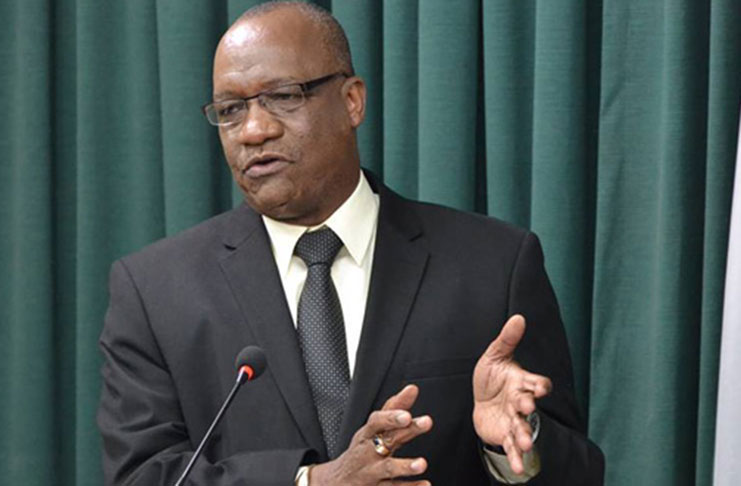
At his post-Cabinet press briefing at the Ministry of the Presidency, the Ministry’s Director-General, Joseph Harmon, said Cabinet, in accepting the June 18, 2019 decision of the Caribbean Court of Justice (CCJ), agreed that government will transition into an interim mode, in accordance with the consequential orders of the CCJ laid out on July 12, 2019. “By convention, normal business of government will continue albeit on a different footing by virtue of its interim status,” Harmon told reporters.
“In its interim mode, the government shall, exercise restraint by not engaging in any initiatives that are likely to be considered controversial such as embarking on new policy initiatives, programmes or projects including the signing of new international agreements or embarking on new, major infrastructural projects,” he added.

However, he said government, in cases of national importance and interest, will consult with the opposition before taking certain actions that may have future implications on the governance of the country under a new administration. The director general explained that if a new decision will impact the functioning of a new government, it would become necessary to meet the opposition and decide whether that decision can be lawfully taken.
Government, however, will continue to ensure the smooth functioning of the country. In its interim state, the government will attend to matters that are considered urgent, and in the public’s interest, such as matters of security, the maintenance and rehabilitation of public infrastructure, the maintenance of systems for public health delivery, housing and education, and other routine government functions, the director-general explained.
Added to that, it will continue to implement projects and programmes, approved by the Parliament of Guyana, particularly in cases in which contracts have been signed and works commenced prior to the interim period.
“Cabinet further agreed that the government maintains its full array and range of powers that is Executive, Statutory and Common Law. The ministers shall continue to exercise jurisdiction and responsibility for all ministries, agencies and departments that are within and under their portfolio,” Harmon reported.
He made it clear that all public service rules remain in force and applicable, and the Guyana Police Force, the Guyana Defence Force and other arms of law enforcement are expected to continue to perform and execute their statutory duties and responsibilities, by enforcing the law, and lawful instructions received.
“In addition, it was clearly understood that the interim government is the government and is empowered to ensure the welfare of all citizens, maintain law and order, manage and deliver public services, command the police and army, ensure peace and security and attend to routine functions and administration,” he stated.
Cabinet, in its discourse, iterated that the guidelines for its interim status were based on the internationally-accepted conventions related to the role and functions of interim governments.
But Political Scientist and Executive Member of the Working People’s Alliance (WPA), Dr. David Hinds, said government ought not to be in a restrictive mode. “I think the government has adopted that position but my own view, is that at this crucial point in our history, we do not need a restricted government. We need a government that is empowered, because we are dealing with very, very important matters,” Dr. Hinds told the Guyana Chronicle in an interview.
He opined that government should be allowed to function as per norm; however, when addressing matters of significant importance, it should do so together with the opposition, thereby allowing the opposition to co-govern.
“So rather than saying let’s have a caretaker government that is not empowered, let’s have a government that is empowered with the understanding that on these big crucial matters, that you are telling this government it shouldn’t proceed with, all they need to do is to get together with the opposition and agree on a way forward,” Dr. Hinds reasoned.
He recalled that the WPA, upon realising that the 1990 elections could not have been held by the constitutionally mandated date, approached to the then President, Desmond Hoyte, and suggested that there be shared governance. The late President Hoyte endorsed the proposal but the People’s Progressive Party (PPP) rejected it from the start.
“We suggested to them (PPP), look, for the period from December 1990 to whenever elections are held, let’s approach the PNC (People’s National Congress) and have a power sharing government with Mr. Hoyte continuing as president and the PPP/C Leader as a Prime Minister. The PPP said the PNC would never agree to it but they said WPA if you want to, you can go on a wild goose chase, and when we went to the PNC, Mr. Hoyte readily agreed,” he recalled.
Against that background he said nothing is impossible in the political arena.
“My preference would have been for us to have a government with full powers to operate and the opposition consulted. I see no reason why we shouldn’t have the contract with the harbour bridge. That thing is crucial and caretaker or non-caretaker things like that should not be held up,” he told this newspaper.
In urging collaboration between the government and the opposition, Dr. Hinds said it would be in the best interest of the PPP/C to return to the National Assembly with government and extend the period for the holding of elections, in accordance with the Constitution.
“Now, if the PPP fails to go to Parliament and extend the life of the government, the government continues. It is not in the PPP’s interest, except they are looking to ‘bruk-up’ the country and cause war. If they do not go, the government remains; the doctrine of necessity would apply. I cannot understand why they keep saying that they wouldn’t go and extend the life of the Parliament, because there is nobody that could physically put those people in jail and all those kinds of thing, the government remains,” he reasoned.
The political scientist said civil society must do better to cause the leaders of the country to act in the best interest of the country.
“Those civil society organisations, the churches, the trade unions, the private sector commission and all these organisations, they are the ones who should step in – and not to be lecturing GECOM – that is not the role of civil society,” he said.
He added “civil Society’s role is to mediate the partisan fight… Your role is when a society is on the edge to mediate. I think if those organisations were to come together and meet the two leaders together and said this is a model we should use, I think at least make the leaders think, and I don’t think it is too late,” Dr. Hinds told this newspaper.




