By Anthony Layne
IN Guyana, awareness about Haemophilia and other bleeding disorders such as von Willebrand Disease, (VWD) Rare Factor Deficiencies and Rare Platelet Disorders, seems limited to a small circle. This includes some doctors — perhaps those affiliated to the Guyana Haemophilia Society (GHS) — a handful of confirmed affected persons and their relatives. It is therefore hoped that this article will help to develop some level of awareness about Haemophilia and other, even less well-known, bleeding disorders.
WHAT IS HAEMOPHILIA?
Haemophilia is an inherited bleeding disorder in which the blood does not clot properly. This can lead to spontaneous bleeding or bleeding following an injury or surgery. Blood contains many proteins called clotting factors, that can help to stop bleeding. People with haemophilia –haemophiliacs—have low levels of either factor V111 (8) or factor 1X (9). The severity of haemophilia that a person has is determined by the amount of a factor in the blood: the lower the amount of the factor, the more likely it is that bleeding will occur, which can lead to serious health problems. Additionally, the bleeding can be fatal if it occurs within a vital organ, such as the brain.
In rare cases, a person can develop haemophilia later in life. The majority of cases involve middle-aged or elderly people; or young women who have recently given birth or are in the later stages of pregnancy. This condition is often resolved with appropriate treatment.
CAUSES
Haemophilia is usually inherited, that is, it is passed through a parent’s genes. Genes carry messages about the way the body’s cells will develop as a baby grows into an adult. They determine a person’s hair and the colour of one’s eyes, for example.
Sometimes haemophilia can occur when there is no history of it in a family; this is called sporadic haemophilia. About 30 per cent of people with haemophilia did not get it through their parents’ genes. It was caused by a change in the person’s own genes.
HOW HAEMOPHILIA IS INHERITED
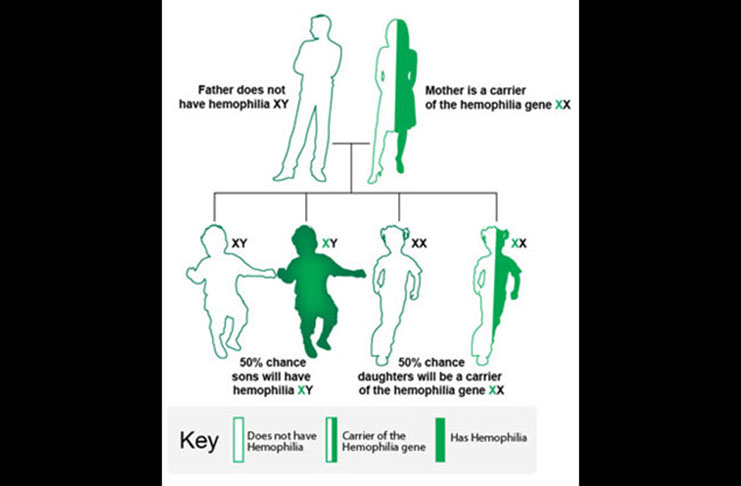
The haemophilia gene is passed down from a parent to child. The genes for Haemophilia A and B are on the X chromosome. Hence, the reason haemophilia is called an X-linked (or sex-linked) disorder.
When the father has haemophilia but the mother does not, none of the sons will have it; all the daughters will carry the haemophilia gene.
If a woman inherits a copy of the altered gene from either of her parents, she is said to be a “carrier” of the haemophilia gene. In other words, she has one normal and one altered copy of the gene; she can pass either gene onto her children. For each child, there is a 50 per cent chance that a son will have haemophilia and a 50 per cent chance that a daughter will carry the gene. On average, “carriers” of haemophilia will have about 50 per cent of the normal amount of clotting factor, but some “carriers” have far lower levels of clotting factor.
Haemophilia can result in:-
Bleeding within joints that can lead to chronic joint disease and pain
Bleeding in the head and sometimes in the brain, which can cause long-term problems, such as seizures and paralysis
Death can occur if the bleeding cannot be stopped, or if it occurs in a vital organ, such as the brain
There are several different types of haemophilia, the following two being the most common:-
Haemophilia A (Classic Haemophilia)
This type is caused by a lack or decrease of clotting factor V111
Haemophilia B (Christmas Haemophilia)
This is caused by a lack or decrease of clotting factor 1X
SIGNS AND SYMPTOMS
Common signs of haemophilia include:-
Bleeding into the joints. This can cause swelling and pain or tightness in the joints; it often affects the knees, elbows and ankles
Bleeding into the skin (caused by bruising) or into a muscle or soft tissue, causing a build-up of blood in the area (called a haematoma)
Bleeding of the mouth and gums and bleeding that is hard to stop after the loss of a tooth
Bleeding after circumcision (surgery performed on male babies to remove the foreskin covering the head of the penis)
Bleeding after having shots, such as vaccinations
Bleeding in the head of an infant after a difficult delivery
Bleeding in the urine or in stool
Frequent and hard-to-stop nosebleeds
THE AFFECTED
Haemophilia occurs in about one of 5,000 male births. Haemophilia A is about four times as common as Haemophilia B, and about half of those affected have a severe form. The disorder affects people from all racial and ethnic groups.
INHIBITORS
About 15-20 per cent of people with haemophilia develop an antibody called an inhibitor, that stops the clotting factors from being able to clot the blood and stop bleeding. Treatment of bleeding episodes becomes extremely difficult, and the cost of care for a person with an inhibitor can skyrocket, because more of a clotting factor or a different type of clotting factor is needed. People with inhibitors often experience more joint disease and other problems from bleeding, that result in a reduced quality of life.
TAKING CARE OF YOUR SELF
There is much that a haemophiliac – a person with Haemophilia– can do to manage his\ her condition on a day-to-day basis. First, one MUST keep up with the treatment and strictly follow the doctor’s advice. Additionally, there should be strict adherence to the four measures listed below:-
1) Handle injuries correctly: clean small cuts, scrapes and injuries, then apply pressure and a bandage. Medical attention should be sought for serious injuries.
2) Inform all your health care professionals that you (or your child) has haemophilia; and remind them before undergoing any procedure, such as dental work. Most important, you may need to take medications to clot your blood beforehand.
3) Certain medications such as aspirins can slow blood-clotting, so check with your doctor about what you should take and should not take. Also, check with your doctor about vaccines, such as those for Hepatitis A and B, that you may need. Most blood products nowadays are checked for
things that can cause disease, but it is still worthwhile to check if you need to take steps to prevent getting infected.
5) Stay active. If your child has Haemophilia A, they can still be active; exercise makes them stronger, which makes injuries less likely. Exercise also helps by managing weight—extra pounds strains the body, which raises the risk of bleeding.
It is worthy of note that while haemophilia is the best-known bleeding disorder, many other types exist and most are inherited.
von Willebrand Disease (VWD) is a genetic disorder caused by missing or defective von Willebrand factor (VWF), a clotting protein. VWE binds factor V111, a key clotting protein and platelets in blood vessel walls, which help to form a platelet plug during the clotting process. The condition is named after Finnish physician Erik von Willebrand, who first described it in the 1920s.
VWD is the most common bleeding disorder. It is carried on chromosome 12 and, unlike haemophilia, occurs equally in men and women.
SYMPTOMS
People with VWD experience frequent nosebleeds, easy bruising and excessive bleeding during and after invasive procedures, such as tooth extractions and surgery. Women often experience menorrhagia, heavy menstrual periods that last longer than average; they also experience haemorrhaging after childbirth.
Researchers have identified many variations of this bleeding disorder:-
Type 1 VWD
Type 2 VWD ( Four sub-types: sub-type 2A; sub-type 2B; subtype 2M and sub-type 2N)
Type 3 VWD
Acquired VWD
Rare Factor Deficiencies:-
These are several rare, inherited bleeding disorders in which one or more clotting factors are not in the blood, are present in only small amounts or do not work properly.
Rare Platelet Disorders:-
Bleeding disorders in which platelets lack a protein needed for the blood to clot. These disorders are inherited in an autosomal recessive fashion. When a disorder is inherited in an autosomal recessive fashion, one inherits two mutated genes, one from each parent. These disorders are usually passed on by two carriers, whose health is rarely affected; but they have one mutated gene (recessive ) and one normal gene (dominant ) for the disorder.