
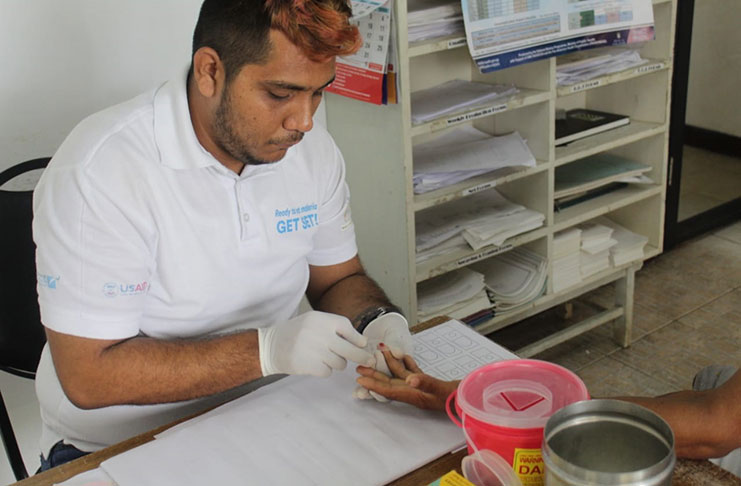
INCREASED training and awareness activities for residents and workers in Region Seven (Cuyuni-Mazaruni) have been instrumental in the fight against malaria in the endemic region, according to health officials.
Regional Malaria Coordinator, Dr Dexter Browne, said 13,390 malaria smears were done in the region in 2018, of which, 3,405 were positive. The number of positive cases, he said, represents an increase when compared to the 2,774 cases recorded in 2017. Though the number of positive cases increased, Dr Browne noted that this was not a wholly negative situation. “These increases [were] mainly because of an awareness of testing done in Region Seven,” Dr. Browne explained.

According to the World Health Organisation (WHO), “malaria is a life-threatening disease caused by parasites that are transmitted to people through the bites of infected female Anopheles mosquitoes.” The WHO also noted that the disease is an acute febrile illness, and as such, causes fevers. “In a non-immune individual, symptoms usually appear 10 to 15 days after the infective mosquito bite,” the WHO explained; he added, that the first symptoms would be fevers, headaches, and chills. Initially, these symptoms may not be recognised as malaria, but if untreated for 24 hours or more, the malaria may progress into severe illness.
At the Bartica Regional Centre, which is the central hub that oversees all other health centres in the region, there is a Vector Control Services (VCS) Unit that carries out malaria testing, diagnosis and treatment. “We focus primarily on malaria [since] Region Seven is a region that is endemic [sic] to malaria,” Micrologist Royan Teixeira said.
According to Teixeira, in Region Seven, there is great awareness about malaria. He said many persons, particularly those working in the interior locations, would request the test as soon as they feel a slight fever because of how wary they are of the disease. “We detect the different species of malaria, and based on the different types of species, we feel that person might have, they will be treated for that,” the micrologist said.
Bartica is located at the confluence of the Cuyuni and Mazaruni Rivers, and is on the left bank of the Essequibo River. Other communities, some with sizeable populations, are relatively distant and accessibility becomes difficult. As such, the provision of testing and treatment services for persons within the endemic region is constrained by the geographical challenges that exist.
RDT SERVICES
Rapid Diagnostic Testing (RDT) is a mechanism that is used to help with the detection and treatment of malaria across the country. Teixeira explained that the Vector Control Services Unit is training workers within the mining camps to do RDT.
In Region Seven, RDT was initiated in November, 2017 and since then, persons who volunteered their services have been trained in many of the communities.
Teixeira further explained that persons who worked in medium and large-scale mining camps were the ones targeted for training, because their operations were stable. “We would usually train the cooks or the general manager, the stable persons in the camps, so they can provide the services for their camps and for persons around the camps,” he said. He added that business persons and residents in the more populated areas (like at the Puruni landing) would be trained as well.
The RDT, as explained by the micrologist, assists in the diagnosis by providing evidence of the presence of malaria parasites in human blood. Different from the usual microscopic test done at the VCS, RDT is conducted through the use of small ‘Malaria Kits.’ Using the kit, a blood sample is taken and applied to a cassette that detects the antigens that would indicate that someone has malaria.

“We’re trying to promote prompt and fast treatment, because Puruni and those areas are far away from Bartica, so instead of a miner feeling sick and having to wait for hours before coming out of the communities and getting to Bartica, there are personnel right there who are trained to do testing and who they can access the services from,” Teixeira said. “This is all so that we can get [the number of] malaria cases to drop as well,” he added.
Just recently, on World Malaria Day, the Health Ministry recognised several of the volunteers in Region Seven who provide the RDT services. “I have a dredge and about 14 workers, so every time I have to send them to Puruni Landing to get testing and so it’s not fair so I just decided to go and do the training and get to know how to do it myself,” Shelliza Savory, a volunteer, shared.
According to her, malaria is very prevalent, and the RDT is an excellent way of helping to curb it. But though scores of persons from the areas are trained, the micrologist explained that the treatment and the testing kits are only given to the persons who performed well in training. Volunteers are required to meticulously document and report on the testing they have done and the treatment they have provided.
“The RDT is an initiative we are really strong behind and we are really proud of how persons are performing, especially in reporting as they should and doing the right things,” Teixeira shared.
PREVENTION
Ironically, Senior Micrologist, at the Bartica Regional Hospital, Nathalie Griffith, was recently diagnosed with malaria. While on an outreach activity to train miners in the Puruni area, Griffith was bitten by a mosquito, and two weeks later was diagnosed with malaria.
“Tell you the truth, I didn’t walk with a netting because we weren’t expecting to stay overnight in the backdam,” she said, while adding that “it’s not a nice feeling at all, because when you start getting the fever, the headache, the chills and the joint pain and so… It’s not easy at all.”
Through her years of service, Griffith has always advocated for the prevention of malaria. According to her, “it’s better to prevent it.”
In 2018, the Ministry of Public Health embarked on an “Anti-Malaria Campaign” in Regions One, Seven, Eight and Nine. Since then, 91,000 insecticide-treated bed and hammock nets have been distributed to those at risk of getting malaria. The use of mosquito repellents is also recommended. “What I could say is just walk with the net and use the nets, wear long-sleeved clothing, use the mosquito repellent and so,” Griffith stressed.
According to the ministry, in the last five years, Regions One, Seven, Eight and Nine have accounted for more than 95 per cent of all malaria cases in the country.