






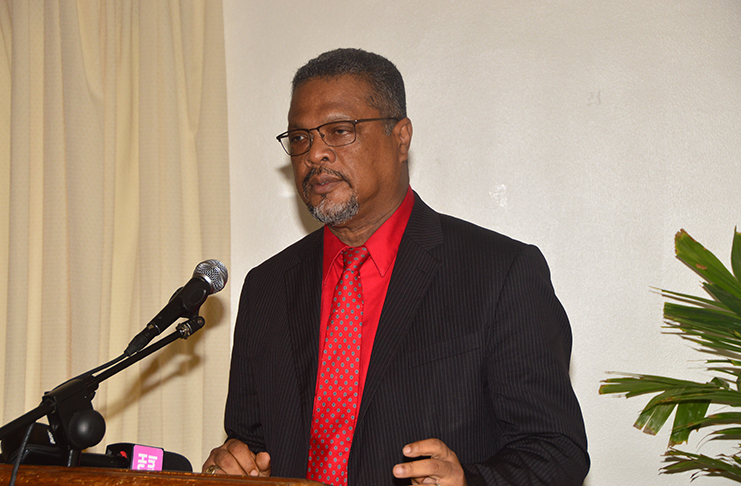
…stakeholders gather to discuss draft noise regulations
NOISE induced deafness is incurable and that is a reality which should be of primary concern for persons who work in noisy environments, especially if there are no measures to reduce or control the level of noise.
In an effort to boost or even implement such measures in the workplace, stakeholders from the Ministry of Social Protection, International Labour Organisation (ILO) and other organisations have met to consult on draft noise regulations at the Herdmanston Lodge on Tuesday.
Employers, managers, employees and policymakers have constantly been encouraged to make occupational safety and health a primary concern, since it is an essential part of best practices in the workplace. Noise pollution, which is a part of occupational health and safety, also has to be considered a priority because exposure to excessive noise could harm workers’ health, resulting in the loss of hearing.
“It is a high risk to our health…we have noise at home, in our communities but we are dealing with noise in work…we are crafting regulations which should be implemented,” said Chief Labour Officer (CLO), Charles Ogle during his presentation on Tuesday.
It has been proven that loud noise in the workplace could lead to accidents; the distraction of workers; stress and increased likelihood of errors.
As the stakeholders move ahead with their discussions, the CLO advised them to consider the aforementioned factors and make regulations simple, easy to read and relevant to the local environment.
He believes that, once created, the regulations and potential laws should be enforced so that persons would respect the law and uphold the rights of workers to work in a safe environment.

Chairman of the National Advisory Council on Occupational Safety and Health, Earl Morris, also expressed the need for strict regulations because if exposure to noise is not properly controlled it could lead to permanent hearing loss.
According to information from the World Health Organisation (WHO), 360 million persons suffer from hearing loss and 32 million of those persons are children. The main cause of deafness was due to the exposure to excessive noise.
In addition, 1.5 million teenagers are at risk due to the unsafe use of audio devices and the exposure to uncontrolled noise at entertainment venues.
Persons who are also at high risk of losing their hearing are ground/airport workers; musicians, construction workers, brush cutters, mining and agriculture workers and even police and soldiers.
“There needs to be an effective plan to ensure the safety of those and other workers… the regulations, I believe, should include education and training, compulsory use of hearing devices and control,” said Morris.
ILO Consultant, Lennox Marcelle and the Minister within the Ministry of Social Protection, Keith Scott echoed similar sentiments.
The minister, who declared the consultations opened, said the regulations should be focused on ensuring that employers assess and control the risk arising from excessive exposure to noise.
He said that a lot has to be done but with cooperation and consultations, there would be a clear pathway for success.
At its 192nd Session, early in 1974, the Governing Body of the International Labour Office/ ILO decided to convene a meeting of experts on noise and vibration at the workplace as part of the organisation’s activities aimed at improving the working environment.
The meeting duly took place and the experts adopted the present code of practice, publication of which was approved by the Governing Body in March 1975.
This code provides guidance for governments, employers and workers. It sets out the principles that should be followed for the control of workplace noise and vibration, and contains the information required for the establishment of control programmes for individual plants.
It has no compulsory character; it does not lay down minimum requirements but is rather intended to stimulate, guide and promote noise control at the national level. The technical standards that it lays down are objectives which can be attained by successive stages.
Persons who are interested in knowing more about the code could visit the following link: https://www.ilo.org/safework/info/standards-and-instruments/codes/WCMS_107878/lang–en/index.htm




