






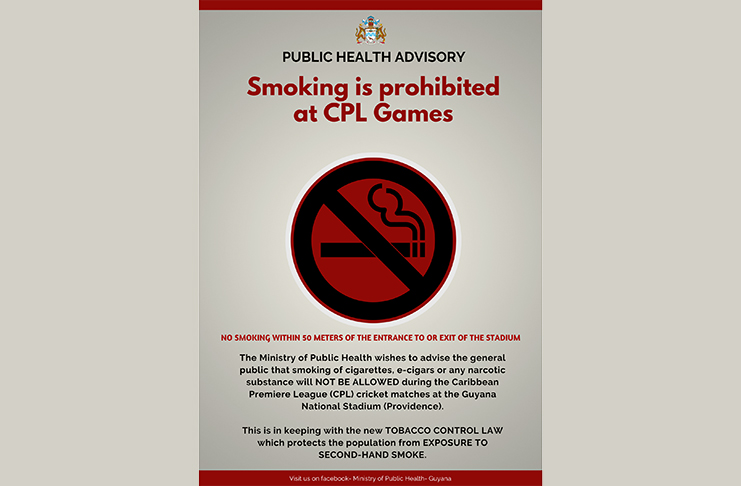
…as gov’t steps up enforcement of Tobacco Control Act
In keeping with the new tobacco control bill, no smoking will be permitted at the Caribbean Premier League T20 games which begin here on Thursday at the Providence Stadium.
The Ministry of Public Health made the announcement on Tuesday. The Ministry said in an advisory that no smoking will be permitted within 50 metres of the entrance to or exit of the stadium. “The Ministry of Public Health wishes to advise the general public that smoking of cigarettes, e- cigars or any narcotic substance will NOT BE ALLOWED during the Caribbean Premier League (CPL) cricket matches at the Guyana National Stadium (Providence).”
Guyana has, since 2005, subscribed to the Framework Convention on Tobacco Control (FCTC), an international health treaty under the auspices of the World Health Organisation (WHO). The Treaty sets out a guiding framework for the global struggle against the tobacco epidemic, and the Guyana Tobacco Control Act follows several of the articles of the Convention and also a series of tobacco control policies. This input from the FCTC, and the comprehensive stakeholder consultations which included the business community, the consumer association, transportation services, trade unions and the general public have made the Guyana Tobacco Control Act one of the most complete tobacco control laws in the Americas. PAHO’s Director of the Department of Non-communicable Diseases and Mental Health was high in his praise of the Act: “The adoption of this bill,” he said, “is not only a milestone for public health in Guyana; it is a tremendous advance for CARICOM and the entire Region of the Americas.”
Among the main provisions of the Act is ensuring 100% smoke-free environments in all indoor public spaces, indoor work spaces, public transportation, and specified indoor spaces to protect people from exposure to tobacco smoke. Such indoor public spaces would include bars, restaurants, certain parts of public parks, waiting rooms in offices and so on. This provision would cut down secondary smoking and its dangers.
There is a ban on all forms of advertising, sponsorship and promotion of tobacco products. Tobacco products were often advertised at sports events, and tobacco sponsorships were often given to sports activities in which young people were involved.




