






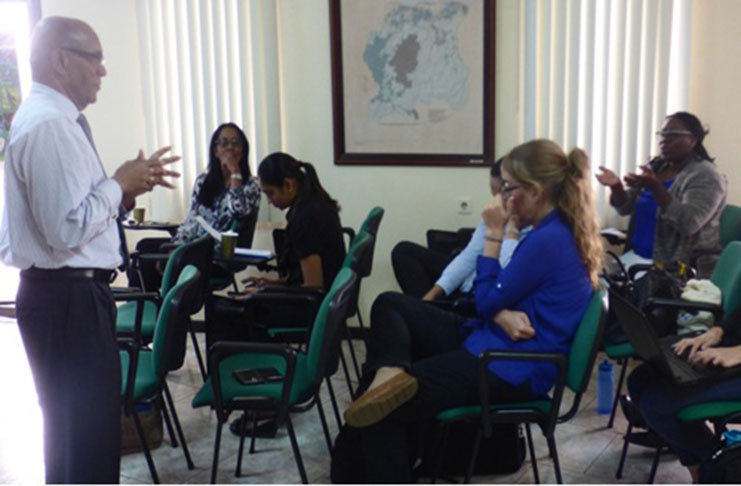
A TEAM from the Forest Carbon Partnership Facility (FCPF) Project in Guyana recently participated in a three-day REDD+knowledge-sharing exchange with neighbouring Suriname.
The March 18-22 mission included formal/technical presentations, summary discussions and field visits organised by the National Institute for Environment and Development in Suriname (NIMOS).
Guyana’s delegation comprised officers from the FCPF Project Execution Unit (PEU) and REDD Secretariat, as well as an indigenous representative of the Project Steering Committee (PSC). A representative of the Guyana office of the Inter-American Development Bank (IDB) also accompanied the team.
Part of the REDD+ Country Readiness Process, the exchange allowed Guyana and Suriname to share experiences on issues of climate change, its impact on their respective populations, environments and economies; and the ensuing relevance of a globally endorsed incentivised system to Reduce Emissions from Deforestation and Forest Degradation (REDD+).
Both being High Forest Cover, Low Deforestation (HFLD) countries is viewed as added opportunities for unified global advocacy on REDD+ issues. Suriname will host the second International HFLD Conference in July, and requested Guyana’s input to plan/prepare the agenda programme.
Though Suriname’s REDD+ Readiness is advanced to the country now finalising a Draft REDD+ Strategy and Grievance Redress Mechanism (GRM), it is yet to establish a national Measurement Reporting and Verification System (MRVS).
Recognising Guyana’s strides with the MRVS since its first report was endorsed in 2012, Suriname remains focused on learning and replicating, where applicable.
During a REDD+consultation with Matta indigenous village, stakeholders questioned the Guyana delegation about what tangible REDD+ benefits exist for indigenous people and how REDD+ can address land rights issues.
While in Guyana indigenous people are granted titled ownership of communal lands, those in Suriname do not have such rights. Though REDD+ Readiness presents similar challenges for the two neighbours, there are different dynamics that may require unique approaches in each state.
The Guyana team visited too the Brokopondo District with stops at the Afobaka Dam that provides hydroelectric power and the Dennebos forest concession, where the team observed tree-felling activities and demonstration of an independent log-tracking system.
Guyana remains committed to information and knowledge sharing with other FCPF countries, as REDD+ efforts continue internationally in response to climate change.




